Dear bibliophiles, good day.
By Barthélemy d’Arcole, Inspector of Bibliophilic Aesthetics and Modern Heresies to the Guild of Bibliopolices.
A book is also judged by its dress. The binding protects, but it also speaks: it tells the period, the taste, the care and sometimes the vanity of an owner. To learn to read it is to add a sense to reading, and an argument to any valuation.
The first distinction separates the paper-wrapped state (French broché: a simple paper cover, sewn, which is the original state of publication) from the bound book, covered in boards and a nobler material. Between the two, the half-binding, whose spine and corners are leather and whose sides are paper or cloth, is an elegant and widespread compromise. Note that for some modern books the original wrappers are more sought after than a later binding.
Then come the materials. Morocco, a close-grained goatskin, is the noblest and the most sought after; calf, supple and smooth, dominates the classical centuries; sheepskin, tanned sheep hide (French basane), more modest, dresses ordinary books, and one should not confuse it with chagrin, which is grained. Vellum and parchment, white and rigid, come from ancient times, while in the nineteenth century percaline and publisher’s cloth industrialise binding.
The decoration signs a period. The so-called “à la Du Seuil” binding, a double frame of gilt fillets enhanced with corner fleurons, is a seventeenth-century design, older in fact than the binder Augustin Du Seuil who gave it his name. The fanfare binding spreads the interlacing of the Renaissance; the dentelle (lace) binding, openwork borders typical of the eighteenth century; the mosaic binding inlays pieces of coloured leather; and the Jansenist binding, unlike all the others, gives up every decoration on the sides to put beauty in the material alone. The Romantic nineteenth century, for its part, multiplies tools and ornaments.
One must also know how to name what one is looking at: the boards, which are the two sides; the spine, with raised bands or flat; the headcaps, at the top and bottom of the spine; the corners; the edges, sometimes gilt or painted; and finally the endpapers, those inner leaves sometimes decorated with dominoté paper. To name is to be able to describe, and so to sell or buy knowingly. Some bindings also bear the signature of a great binder (Trautz, Lortic, Cuzin, Marius-Michel), a signature that adds value provided it is authentic, which is not always so; mistrust, here as elsewhere, is a form of respect.
To go further, see our pages on formats, first editions and bibliophily.
The dress does not make the book, but it always admits something about it. GUILDE · esthétiques — B. d’Arcole.
Document classified: restricted circulation.
Si cette chronique vous a plu : recevez trois nouvelles par semaine — livres rares, reliures, enchères, et les Dossiers IGLI. 18 ans d'archives, quelques milliers de lecteurs.
Pas de pub, pas de revente de données. Désabonnement en un clic.
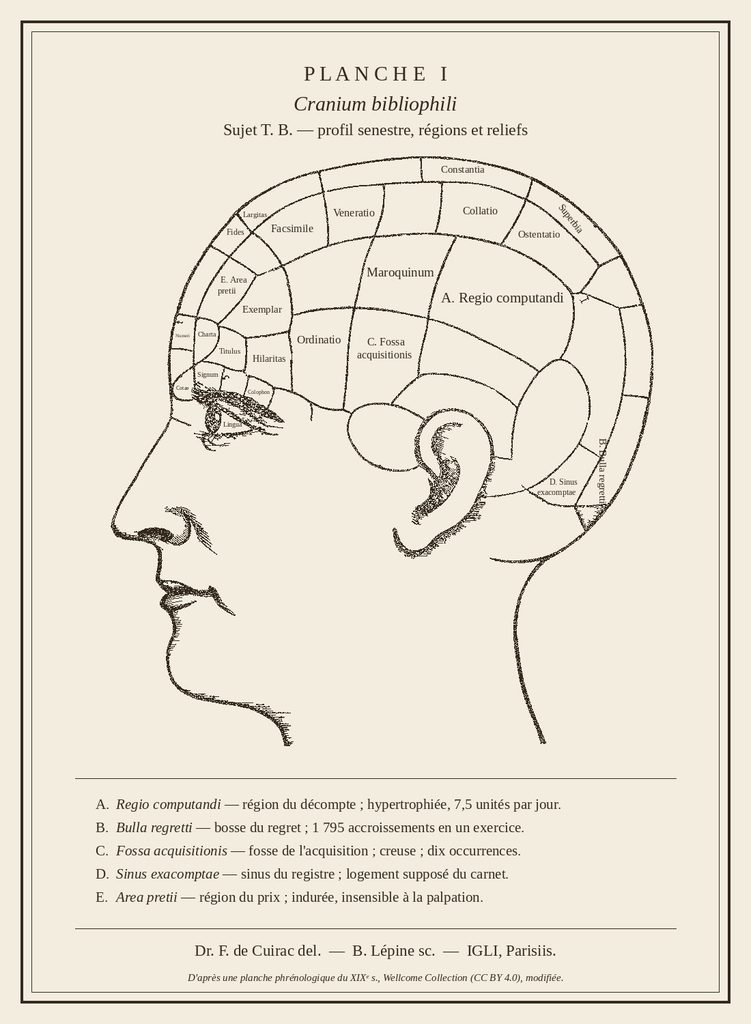
IGLI Clinical Files: Thierry B., the Man Who Counted the Books He Did Not Buy


Leave a Reply