The format of an old book tells you how the printed sheet was folded: 2 leaves for a folio, 4 for a quarto, 8 for an octavo, 12 for a duodecimo. Height does not tell you. Booksellers have used height as a shortcut since the 19th century, and the shortcut is wrong often enough to be worth understanding.
Dear bibliophiles, good day.
By Barthélemy d’Arcole, Inspector of Bibliophilic Aesthetics and Modern Heresies to the Guild of Bibliopolices (a learned society of French invention, whose members are all the same person).
In a bookseller’s description you sometimes read “small 12mo” or “tall 8vo”. The “small” and the “tall” are there to correct the format, which proves that the format is not a size. The buyer is asked to make the adjustment himself.
The format records how the printer folded the sheet that came off his press. Folded once, it gives 2 leaves, that is 4 pages: a folio. Folded a second time, it gives 4 leaves and 8 pages: a quarto. Folded a third time, 8 leaves and 16 pages: an octavo. The duodecimo, or 12mo, has 12 leaves and so 24 pages. A sheet left unfolded is a broadside (the French say in-plano). You will see the same formats written fol., 4to, 8vo, or 2°, 4°, 8°. It is one system with several spellings.
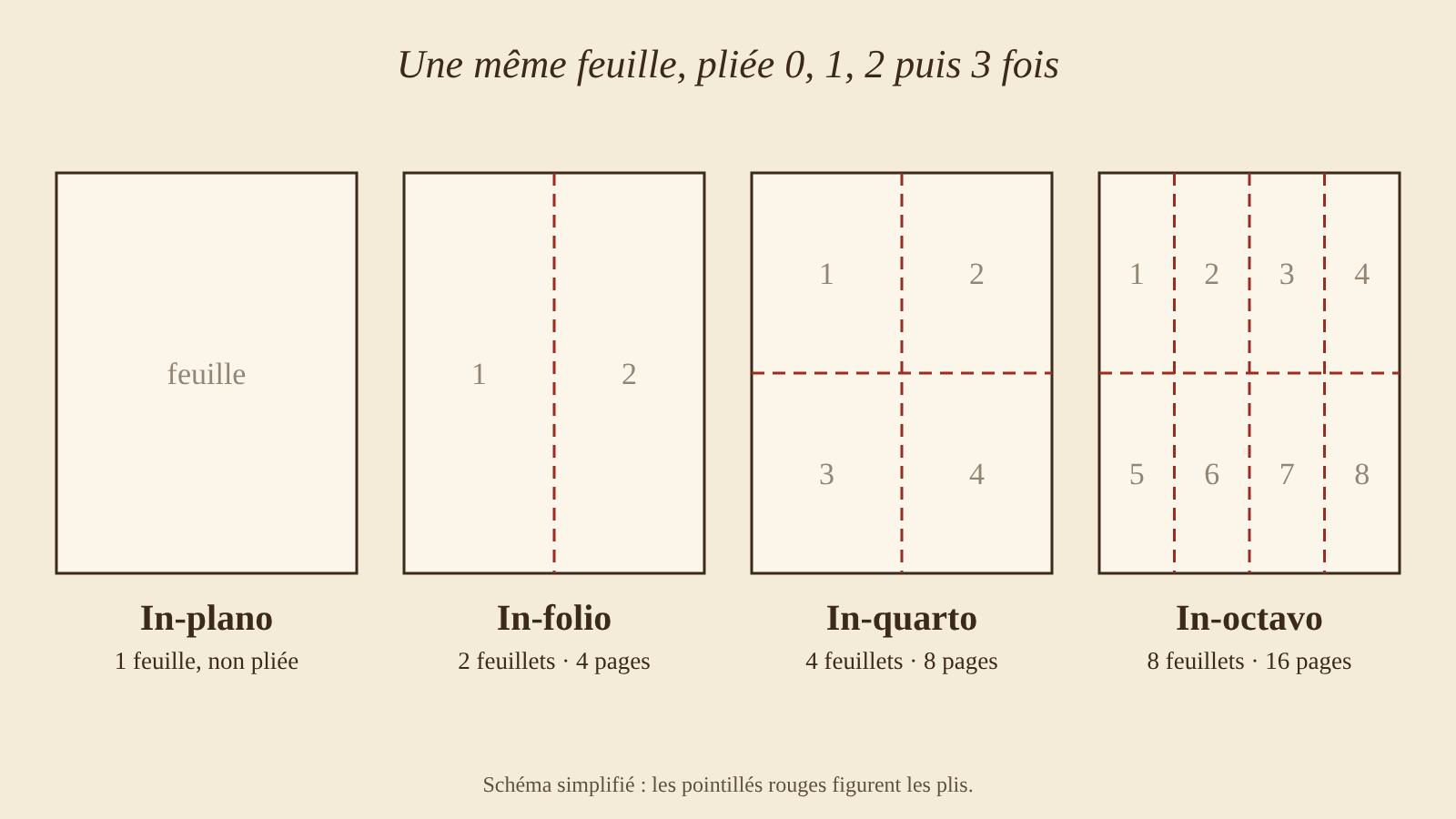
The height of the finished book depends on the paper the printer started with, and paper did not come in one size. The Lyon municipal library’s Guichet du Savoir lists 18 French paper sizes, from the smallest, the pot, to the largest, the grand-monde, running from 31 × 40 cm to 90 × 120 cm. Two octavos can therefore stand at different heights.
The Folger Shakespeare Library says the same thing from the other side. Its reference page notes that the format names once designated standard paper sizes, and that in the 19th century they came to describe book height, with octavo meaning “little”, quarto “ordinary size”, folio “big” and elephant folio “huge”. That is the shortcut, and Anglo-American catalogues use it loosely. French booksellers, who have a stricter table, set their own thresholds on the height of the bound volume. Here is the French table, given as a reference and not as a rule for English-language catalogues.
| Format | Leaves per sheet | Pages | Height of bound volume (French trade) | Typical contents |
|---|---|---|---|---|
| Large folio | 2 | 4 | over 40 cm | Bibles, atlases, show books |
| Folio (2°) | 2 | 4 | under 40 cm | Learned works, theology, law |
| Quarto (4°) | 4 | 8 | under 30 cm | Scholarship, illustrated books |
| Octavo (8°) | 8 | 16 | under 25 cm | Ordinary literature |
| Duodecimo (12mo) | 12 | 24 | under 20 cm | Novels, devotional books (18th century) |
| Sextodecimo (16mo) | 16 | 32 | under 16 cm | Small classics |
| 18mo | under 14 cm | Charpentier editions (19th century) | ||
| 32mo | 32 | 64 | under 10 cm | Almanacs, very small books |
To use it, stand the book upright and measure the spine from the top of the board to the bottom. These figures are ceilings: a bound volume of 27 cm is a quarto, because it is over 25 cm and under 30. It is a clue and not a proof. The binder’s plough may have trimmed the margins, and sheet sizes varied. To be sure, look at the fold itself.
You can do that without taking the book apart. Look at the foot of the first page of each gathering. The printer put a letter or a number there, the signature, so that the binder could keep the gatherings in order. Often only the first half of the gathering carries one. Count the leaves up to the next signature. A gathering always has an even number of leaves, and it is wise to count two gatherings in a row, because they do not all look alike. Count in the body of the text, never in the endpapers or the preliminary pages, which mislead.
That number, together with the direction of the paper’s lines, gives the format. Hold a leaf against the light: laid paper shows lines, called chain lines. They run vertically in a folio and in an octavo, and horizontally, as a rule, in a quarto. This is the method described by the Enssib, France’s school for librarians.
Below the octavo, the Ancien Régime had its small formats: the 12mo, the 16mo and the 24mo. The 12mo is folded in two ways, giving either a single gathering of 12 leaves, the French way, or two gatherings of 8 and 4 leaves, the Dutch way. The 32mo stays rare. As for a book wider than it is tall, it is called oblong; the French say “à l’italienne”.
Beware of names. A “sextuple-octavo” and a “twentymo” do not exist. And some formats are not what their name announces: the in-18 jésus of Charpentier, in the 19th century, has the size of an old octavo, because machine-made paper came in larger sheets. The name of a format can therefore lie about the size, and sometimes about the fold.
The format also has a history. In the first decades of printing the folio dominates, and the small formats go to books of hours, devotional works and pamphlets. They existed before printing: Parisian pocket Bibles of the 13th century are known. At the turn of the 15th and 16th centuries Aldus Manutius published Greek and Latin classics in portable volumes at Venice. The 16th century kept the folio for work and study.
In the 17th century the quarto becomes the format of literature: Ronsard, Voiture and Malherbe were printed in it, living or recently dead. It is solemn without ostentation. Toward the end of the century it gives ground to the duodecimo, which the Elzevier family used for plays, in their Dutch pirated editions. Dictionaries stay in folio. Bayle’s Dictionnaire of 1697 has 2 volumes, and Diderot and d’Alembert’s Encyclopédie has 35 volumes, produced between 1751 and 1772. The Geneva edition by Pellet, in 1777-1779, republished it in quarto, with pages half the size and at a lower price. In the 18th century the duodecimo prints most literary texts, the humbler genres included. A work first issued in quarto with fine illustrations could be reissued in duodecimo in 18 volumes.
The 19th century has its heretic. In the 1840s Charpentier sold books at 3.50 francs a volume in the format called in-18 grand jésus. That is roughly the height of a modern paperback, 18 cm. Publishers were no longer bound to any format standard, and nothing ties a format name to a size.
One last precaution, for the description in front of you. When the bookseller writes “8vo?”, he hesitates, and he gives his measurement in millimetres. When he writes “small 12mo” or “tall 8vo”, it is for you to correct. In either case, do not take his word for it: count the leaves.
What is the difference between 4to and quarto?
None. Quarto is the Latin form, 4to the usual abbreviation, also written 4°. In both cases the printed sheet was folded twice and gives 4 leaves.
How do you measure the format of an old book?
You measure the height of the spine, from the top to the bottom of the board, and set it against the table. It is the booksellers’ rule of thumb, but it proves nothing: only the fold tells the format.
Why do some descriptions say “folio raisin” or “octavo jésus”?
These are names of paper, taken from the watermark the sheet carried. A jésus octavo is an octavo folded from a sheet of jésus paper. The paper name gives the starting size, which the word octavo alone does not.
Are there formats larger than the folio?
Yes: the unfolded sheet, or broadside. For very large picture books, Anglo-American libraries speak of “double elephant folio”, the largest sheet then available, about 96 × 66 cm according to Yale. Audubon’s Birds of America is the best-known case.
I measure with the ruler first, and then with the signature.
GUILDE · BdA/FORMATS
Sources: Guichet du Savoir (Bibliothèque municipale de Lyon), answers of 18/09/2023 and 14/06/2024; Enssib, “Déterminer le format” (material bibliography); BnF, glossary of the old book; Biblissima, Le livre ancien; Folgerpedia, “Bibliographic format” (Folger Shakespeare Library); Crouch Rare Books, “Book formats”; Roger Chartier, review of Isabelle Olivero, Les Trois Révolutions du livre de poche (Sorbonne Université Presses, 2022), La Vie des idées; Yale University Library on double elephant folio.
The files on the “sextuple-octavo” and the “twentymo” were closed for lack of a subject.
Document classified: restricted circulation.
Si cette chronique vous a plu : recevez trois nouvelles par semaine — livres rares, reliures, enchères, et les Dossiers IGLI. 18 ans d'archives, quelques milliers de lecteurs.
Pas de pub, pas de revente de données. Désabonnement en un clic.
IGLI Clinical Files: Thierry B., the Man Who Counted the Books He Did Not Buy


Leave a Reply