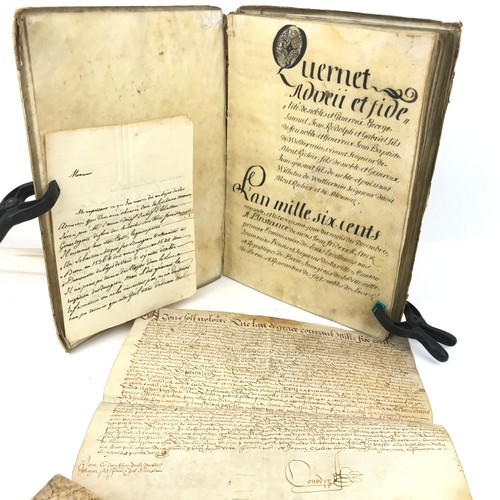
Bibliophilie.com has been written in Paris since 2007. It covers antiquarian books, bindings, auctions, forgers, thieves and the booksellers between them.
The site is run by a learned society that exists only on paper, the Guild of Bibliopolices. Its inspectors, chroniclers and secretaries are all one author, which no one has ever objected to. This English section brings together the guides and stories that travel best.
Start here: the guides
- What is a bouquiniste?
 The trade of bouquiniste has been listed since 2019 in France’s national inventory of intangible cultural heritage. It has neither a diploma nor a legal definition. The green boxes along the Seine hold dealers who sell, in the open air, books that nobody has appraised. […]
- What is bibliophily? (and what is a bibliophile?)
 Bibliophily is the love and study of the book as an object, and not only as a text; it asks for attention, not for money. The bibliophile looks at edition, binding, paper, condition and provenance, and differs from the plain reader and the bibliomaniac. A definition, common misconceptions and a way to begin. […]
- How to sell your old books: where, how and at what price
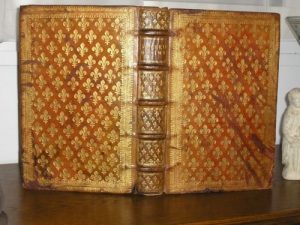 The specialist bookseller pays cash, at half the retail price or less, since he must resell. The same title runs from ten euros to ten thousand depending on printing and condition. The auction house charges seller and buyer alike, and the choice of channel decides the rest. […]
- How to value an old book
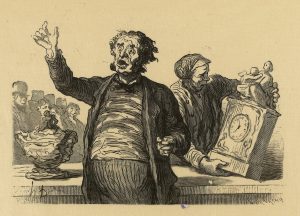 An ordinary 17th-century book is worth less than a sought-after 20th-century first edition: age does not make the price. Sheepskin is sheep, morocco is goat, and the gap in value between the two bindings is visible to the naked eye. What remains is to learn what the market actually pays. […]
- The main types of binding in old books
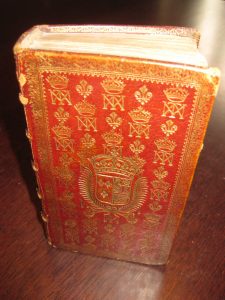 Morocco is goatskin, calf is the classic leather of the classical centuries, and sheepskin is its humbler cousin. This guide names the main types of binding in old books, from half-binding to the Jansenist style, so that you can describe exactly what you are holding. […]
- What is an incunable?
 An incunable is a book printed in Europe before 1 January 1501, in the first decades after Gutenberg’s invention of printing, around 1450. Gothic types, abbreviations, no title page and blank spaces for hand-painted initials mark these first printed books. Here is how to recognise one. […]
- How to recognise a first edition: the guide
 A first edition is the first appearance of a text in print, and the first printing of that edition is the copy collectors want. Edition statements, colophon dates, limitation notices and the bibliographers’ “points” tell it apart from a reprint dressed up as the original. Here is how to check. […]
- Book formats explained: folio, quarto, octavo, or how to read a fold
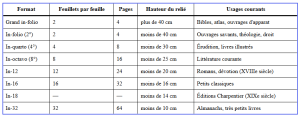 The format of an old book tells you how the printed sheet was folded: 2 leaves for a folio, 4 for a quarto, 8 for an octavo, 12 for a duodecimo. Height does not tell you. Booksellers have used height as a shortcut since the 19th century, and the shortcut is wrong often enough to be worth understanding. […]
Auctions and the market
- Have Auction Fees Really Run Out of Hand, or Is It Simply Organised Fraud?
 Between 1985 and 2025, buyer’s premiums on books were multiplied by 2.66, the consumer price index by 2.23. The gap lies almost entirely in the years 2000-2013, when the rate went from a little over 10% to about 25% including VAT. Since 2023, some houses have passed 30%. […]
- Binding by the Picture: The Very Rare “Puzzle Bindings”, or “Bindings with Surprises”, “Vexierbuch”, “Puzzle Binding”
 A German puzzle binding of about 1680, opening six different ways, was offered at $45,000 in Bruce McKittrick’s Rare Books catalogue no. 66. Such bindings are very rare, and nearly all recorded examples have been restored. They sat in the libraries of German Protestant nobles and princes between 1570 and the 18th century. […]
- The Ranking of Binding Skins
 Christian Galantaris ranks copies in eight degrees, from the modern binding with short margins to the mosaic binding. Three centuries of catalogues have fixed the hierarchy of skins, and prices still recite it. In March 2024, Harvard had the binding of Les Destinées de l’âme removed. […]
Stories: thieves, forgers, collectors
- A Bibliophile on the Titanic, or the Fate of Harry Elkins Widener
 On the night of 14 to 15 April 1912, about 1,500 people died on the Titanic, along with an unknown number of old books. Among the passengers was Harry Elkins Widener, 27, one of the most pampered and promising young bibliophiles of the early 20th century, whose mother later gave Harvard a library in his memory. […]
- The Sacrificed Books of The Ninth Gate: Inquiry into Polanski’s Cursed Book
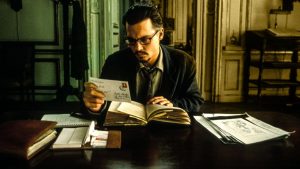 For The Ninth Gate, released in 1999, head prop master Gilbert Pieri bought two authentic old Latin books. One ran past five hundred pages, the other past eight hundred. He took them apart, and some twenty leaves went back into three bindings made to sit on Johnny Depp’s knees. […]
- The Guilde des Bibliopolicés – Presentation
 The Adjectival Control Protocol PCA/22 tolerates two acceptable adjectives per entry, no more. It emanates from a circle with neither premises nor uniform, where the grey coat and the loupe on a chain remain allowed. Paul Mandebois presides, Barthélémy Tranchefile inspects, and the scriptorium opened in 2008 has changed hands. […]
- When They Guillotined the Booksellers: Paris, Spring 1794
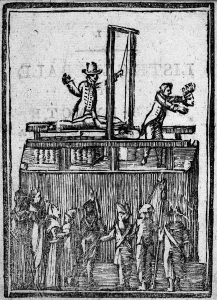 Between January and May 1794, five Parisian booksellers went to the scaffold without having taken up arms. Froullé kept shop on the quai des Grands-Augustins, Gattey at 14 Palais-Royal. The indictment rested on their catalogues, and Froullé admitted selling two thousand copies of a pamphlet. […]
- IGLI Clinical Files: The Unspeakable in Bibliophilia — Inaugural Study and Call for Witnesses
 The IGLI opens a register in which the patient is no longer made of paper: the first subject entered bears the initials H. O. He confesses an exclusive fondness for nineteenth-century morocco, and for several copies of the same 1857 Madame Bovary. Miss Berthe Lépine holds the pen. […]
- From Bookseller to Billionaire: The Life and Fate of the Quaritch Bookshop
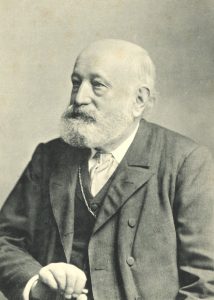 The bookshop of Bernard Quaritch, founded in London in 1847, once gathered 6 Gutenberg Bibles. Since 2004 it has belonged to a financier from Singapore. Other fortunes buy a football club. John Koh bought a bookshop, and set it afloat again with his own money. […]
This site also exists in French: bibliophilie.com.