By Barthélémy d’Arcole, Inspector of Bibliophilic Aesthetics and Modern Heresies to the Guilde des Bibliopolicés.
Dear bibliophiles, good day.
In March 1981, in a library in Milan, an Italian semiologist gave a lecture to librarians in which he set out, in perfect seriousness, the rules for making a library thoroughly hostile to its readers. There was a good deal of laughter; nothing changed; the text has become a classic. I borrow his method here and turn it on another edifice, one the Guild frequents more often.
For there is an abundant literature on how to sell. There is none on how to sell well to few people, which is nonetheless the art most practised in the profession and the only one in which our age has made measurable progress… or even on how not to sell, and that generally conceals darker designs.
Below will be found the eight precepts that govern this art. I did not invent them: I noted them down, then put them in the imperative, which is the only operation a semiologist is permitted to perform on a custom.
1. Arrange the catalogue in an order no one can guess.
Neither alphabetical, nor chronological, nor thematic: the order in which the boxes arrived. An incunable between a solfège method and a lot of postcards, then forty numbers of twentieth-century literature, then, without warning, three manuscripts.
Thus the amateur will be able to look up nothing: he will have to read everything. Whoever has read your four hundred and twelve lots will have paid his entrance fee in time, the one currency you do not invoice and yet levy on each of them. It will be objected that alphabetical order has solved this problem since Callimachus, around 250 BC. The answer is that it solves the wrong problem.
2. Make up your lots of one desirable item and six that are not.
“Lot of fourteen miscellaneous volumes, including an Elzevir.” The amateur who wants the Elzevir will carry off the other thirteen, which he does not want, which he cannot throw away — one does not throw away a book, it is the last taboo of a civilisation that has not many left — and which he will therefore end by reselling.
You will not have sold him a book: you will have handed him a problem. And since this problem can only be solved in a saleroom, your buyer of today is your seller of tomorrow. The composite lot is not a defect of classification, it is a reproductive organ: it manufactures stock, transport and commission out of nothing, indefinitely, like those machines that eighteenth-century mechanicians dreamed of, which were to run without being fed.
3. Let the bidding advance by a rule you will never state.
Fifty, eighty, ninety-six, one hundred, one hundred and twenty, one hundred and fifty, one hundred and eighty, two hundred, two hundred and twenty, five hundred and twelve. The sequence is neither arithmetic nor geometric; it is written down nowhere; it is perfectly known to all who count.
Whoever announces ninety will have singled himself out to the whole room with the efficiency of a foreign accent. Do not correct him — one never corrects. Go up to one hundred with perfect courtesy, which is the finished form of exclusion.
4. Put into every description a term whose definition helps in no way.
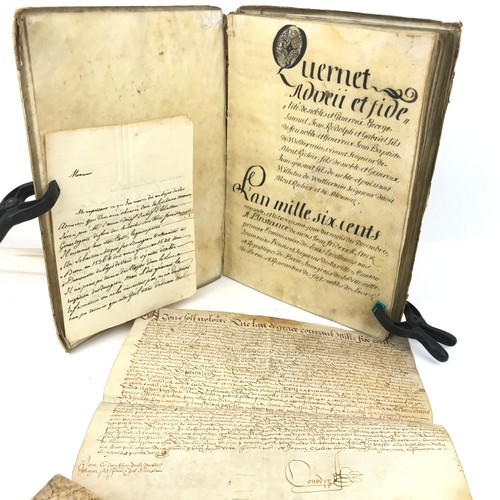
“Light dampstain in the margin,” “a few scattered spots of foxing,” “copy a little short in the margins,” “binding slightly later.” These expressions all have a precise, attested meaning, which can be looked up in any handbook — and knowing them tells you nothing about the condition of the object, since everything rests on light, a few, a little and slightly, four adverbs for which no bibliographer has ever fixed the scale.
Your language therefore does not serve to describe. It serves to signal that a language is being spoken. Linguists call this the phatic function: the message carries no information, it checks that the channel exists and that your interlocutor exists.
5. Publish your results exclusive of fees.
It is the French custom, and it must be kept: a lot knocked down at one thousand euros cost the winner twelve hundred and fifty or thirteen hundred, but it is one thousand that will enter the databases, one thousand that the experts will cite, one thousand that will serve as an estimate in ten years, one thousand that will be compared with a London result calculated by another convention.
You will thus write the history of rare-book prices in a currency nobody has ever paid. This is not falsification: it is a convention, and conventions presuppose an informed reader. It happens only that the informed reader is here precisely the one for whom the information was no longer of any use.
6. Make the room inhospitable.
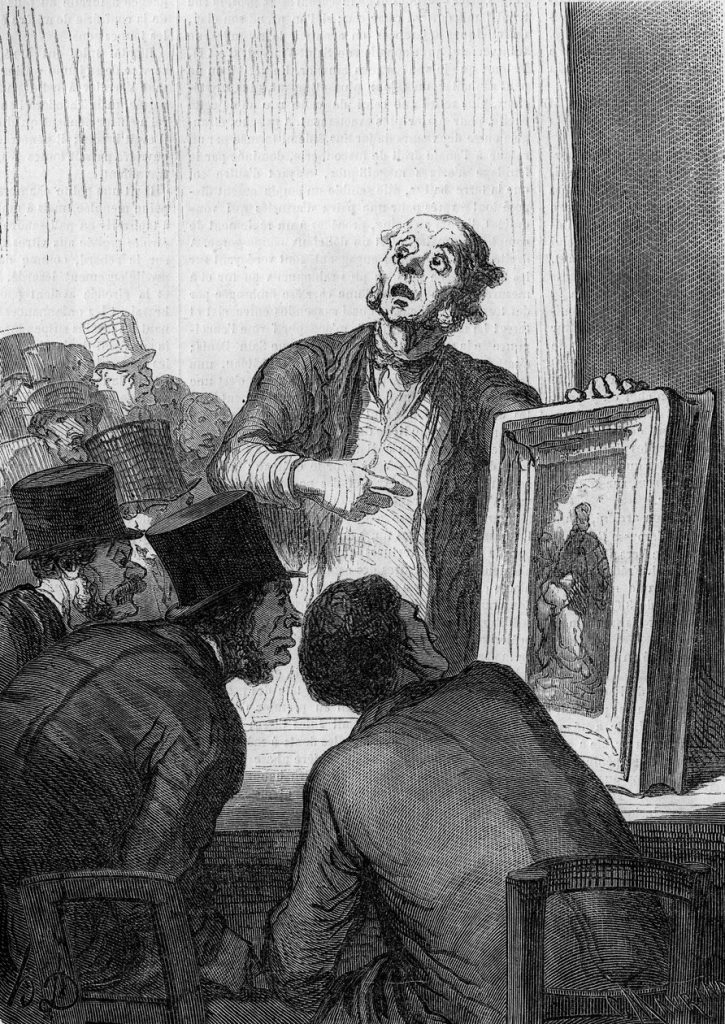
Folding chairs, excessive heating, no cloakroom, no surface on which to set down a catalogue. This will be put down to negligence; it is a sorting. The curious leave, the professional stays, for he has been before and will come again. An establishment that discourages passers-by is not badly kept: it is kept for something else.
7. Multiply the channels until no one knows any longer where the sale is.
In the room, by telephone, on three platforms, with different fees for each and deadlines that do not match. Whoever nonetheless manages to establish where he is bidding, at what total price and under what right of withdrawal will have passed your real entrance examination.
8. Never answer a precise question.
To “is leaf 137 present?”, answer that the lot may be viewed at the exhibition. This is not a refusal, it is a displacement: the question concerned the object, the answer concerns the procedure, and since the procedure is irreproachable, the question ceases to exist.
It remains to say what one manufactures by applying these eight precepts, and one would be wrong to answer: deception. No profession is capable of coordinating itself for three centuries in lying; it manages very well in ritual.
Together, these rules produce a community.
A device that methodically discourages the newcomer does not lose clients at random: it retains those who agree to learn a code. To know that after one hundred and twenty comes one hundred and fifty; to know that a few spots of foxing means “go and look”; to know that a result is understood exclusive of fees and must be marked up in one’s head; to know that one never buys the Elzevir alone, and to plan in advance what one will do with the other thirteen; to know that the precise question is not put by telephone but at the exhibition, in a low voice, to the right person. This body of knowledge is learned nowhere, written nowhere, and constitutes exactly what medievalists call an initiation.
The auction house is therefore not a deficient market. It is a restricted-entry market that has kept the forms of the open market. It resembles a public place as the Latin Mass resembled a speech: everyone could attend, a minority knew what was said there, and this asymmetry was not a defect of the rite — it was its function.
Hence the very particular irritation aroused by online platforms. They are reproached for their approximate descriptions and their superlatives. Their scandal lies elsewhere: they have put the code in writing. They sort the catalogue by ascending price, display the total, fees included, before the bid, sell item by item, answer by message, and the reply stays written. They have desacralised, and we know what one gains by desacralising: a wider public and a dissolved community.
The title of this manual must therefore be corrected. These eight precepts do not serve to discourage the buyer: they serve to distinguish the one who is discouraged from the one who is adopted.
And if you have read this far nodding at each article, it is because you are not an auctioneer, because you have long been on the right side of the sorting, and because you no longer have any reason to complain of it.
References. Umberto Eco, De Bibliotheca, trans. Eliane Deschamps-Pria, Paris, L’Échoppe, 1986 (lecture delivered in Milan on 10 March 1981). Roman Jakobson, “Linguistique et poétique,” in Essais de linguistique générale, vol. I, Paris, Éditions de Minuit, 1963, for the phatic function. Luciano Canfora, La Véritable Histoire de la bibliothèque d’Alexandrie, Paris, Desjonquères, 1988, on Callimachus’s classifications. Book of Judges, XII, 5-6, for the password and the use made of it.
GBA/DE-AUCTIONIBUS
Document classified: restricted circulation – given the number of active bibliophiles and auctioneers….


Leave a Reply