IGLI Clinical Files: Thierry B., the Man Who Counted the Books He Did Not Buy

Dear bibliophiles, good day.

Special Zoobibliological Surveillance Service — General Inspectorate of the Printed Book (IGLI)

By Doctor Fulbert de Cuirac, sworn veterinarian of printed entities, expert to the Bureau of Abnormal Manifestations of the Book, commissioned for owner-adhesion disorders and heraldic-bibliological rejection phenomena.

The service received a written declaration, made spontaneously, in the margin of a fable that M. Philibert Cramoisi published on Facebook. It is reproduced here in full, without correction or cut:

“I keep up, with application, in a little Exacompta notebook, the exact count of all the books I do not buy. And well, imagine, Monsieur Cramoisi, that for the year 2026 alone I have bought only 10 and let 1795 get away. Which makes exactly 1795 regrets.”

— Thierry B., 26 August 2026.

M. Cramoisi forwarded the item to the service, rightly judging that it belonged less to fable than to clinical practice.

Mlle Lépine having copied the item into the register, the service examined its terms. Four call for comment.

“with application” — the subject himself qualifies his diligence, and qualifies it favorably. He does not report a failing: he reports a bearing. The service stresses the complete absence of shame, the usual marker of settled forms.

“a little Exacompta notebook” — the precision of the brand is deliberate. The subject did not take a diary, nor a notebook, nor one of those Moleskine notebooks in which amateurs record their desires. He took a trade ledger, ruled in columns. He does not confide. He keeps the accounts.

“let get away” — hunting vocabulary. The verb supposes that the quarry was within reach, that it moved, and that it left. The service observes that the subject does not say given up on, or set aside, or judged too expensive: he describes 1,795 escapes.

“exactly 1795 regrets” — this is where the declaration tips over. The subject no longer counts books, he counts regrets.

Observations. Over the 239 days elapsed of the 2026 financial year: volumes acquired, 10; volumes let get away, 1,795; total volumes examined, 1,805.

The rate of renunciation stands at 7.5 volumes a day, Sundays included. The residual half-volume has been carried to the account of the odd volumes.

The acquisition ratio is 1 to 179.5. The service knows of no living collection in the département with a rejection rate of that height; the books would not survive in it. That is precisely what held our attention.

Mlle Lépine raised, with the firmness for which she is known, an objection of procedure.

The register of entries admits only entities furnished with a shelfmark. Now the 1,795 volumes of the notebook have entered no collection, have received no bookplate, and have been the object of no owner adhesion. They have neither spine, nor shelf, nor owner. They fall under no jurisdiction known to the service. This library of regrets is a non-library.

After examination, the Bureau rules as follows.

A book that is regretted, dated, numbered and carried in a column exists sufficiently to fall under our jurisdiction. These entities will be classed under the denomination libri praetermissi — the volumes passed over — and will open a separate series in the register. The shelfmark will be assigned to them without any indication of location, the box remaining empty.

Mlle Lépine signed, adding in pencil in the margin that she carried it out but did not share it. The service places the note on file.

Diagnosis. Neurosis bibliocomputatrix privativa — privative computational neurosis, benign form, slow course.

Not to be confused with ordinary bibliomania, of which it is the exact reverse. The bibliomaniac accumulates what he owns and ruins himself. The subject accumulates what he does not own and spends nothing. His non-library counts 1,795 volumes that he does not have.

Sub-Inspector Peutre, in charge of the on-site report, points out that this is to date the only collection in the département posing no conservation problem: no dust, no acidification, no foxing, no worms, no humidity-control requirement, no shelving, no disputed estate. The service acknowledges the remark as exact and judges it misplaced.

Prognosis and recommendations. The prognosis is favorable, subject to the following reservations.

1. The notebook will be maintained. The service warns against any well-meant attempt by the subject’s circle to do away with it: the uncounted regret does not disappear.

2. The subject Thierry B. is prescribed to acquire, within 6 months, 1 volume drawn at random from those he has let get away, and to record its effect. The service wishes to determine whether possession relieves or aggravates. It inclines toward aggravation.

3. At the observed rate, the pagination of the Exacompta will be exhausted before the winter of 2031. The service recommends opening a second volume now and having it bound in calf, so that the collection of the absent has at least a spine.

VISA

Dr. Fulbert de Cuirac, sworn veterinarian of printed entities — examination and diagnosis
Mlle Berthe Lépine, at the register — subject to the reservation entered in the margin
Sub-Inspector Achille Peutre — on-site report and verification of the columns
For the Guild of Bibliopolices.

Shelfmark: IGLI/SSSZ/CI/[N] — Libri praetermissi

Document classified: restricted circulation — Guild IGLI.
Reproduction discouraged on gummed paper unless necessary.

La lettre du bibliophile

Si cette chronique vous a plu : recevez trois nouvelles par semaine — livres rares, reliures, enchères, et les Dossiers IGLI. 18 ans d'archives, quelques milliers de lecteurs.

Pas de pub, pas de revente de données. Désabonnement en un clic.

À lire ensuite

From Bookseller to Billionaire: The Life and Fate of the Quaritch Bookshop
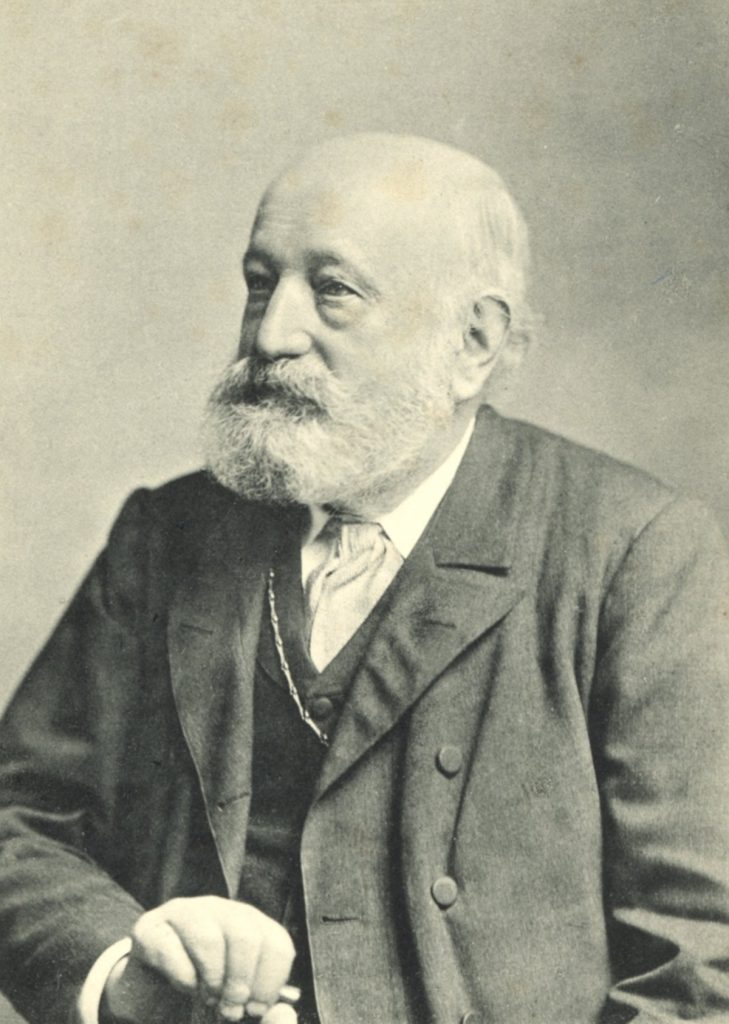
Portrait photographique de Bernard Quaritch, libraire à Londres

Dear bibliophiles, good day.

By Olympe Marcelet, inspector of platforms, emphatic keywords and prices one prefers not to display.

In front of Bernard Quaritch’s shop, at 15 Piccadilly, in 1861, a crate set out on the sidewalk offered pamphlets at 1 penny. One of them was Edward FitzGerald’s English translation of the quatrains of Omar Khayyam, which Quaritch had published 2 years earlier in 250 copies, put on sale at 1 shilling and sent down to the crate for want of buyers. That poem is today in every English anthology, and the 250 copies of 1859 rank among the most sought-after books of the century. The greatest bookseller of his day thus sold off for 1 penny a book that he would himself republish in 1868, and then twice more.

Bernard Quaritch was a German from Thuringia, born in 1819, who landed in London in 1842 with no baggage but a letter of recommendation to Henry Bohn, the city’s foremost bookseller. He is said to have told Bohn, on leaving him, that he meant to become the first bookseller in Europe. He opened in 1847 in a street behind Leicester Square, then in Piccadilly in 1860, and in 1884 he kept his word in his own way, at Sotheby’s, at the Syston Park sale.

The Mainz Psalter of 1459 rose to 4,950 pounds, the highest price ever paid for a printed book, and the Gutenberg Bible from the same library to 3,900 pounds. Both went to him, to Piccadilly, in a shop that was not yet 40 years old. At the exchange rate of the day, 4,950 pounds came to 125,000 gold francs.

In 1878, Quaritch had also founded a club of amateurs, the Sette of Odd Volumes, limited to 21 members in memory of the 21 volumes of an edition of Shakespeare. Each guest bore a ridiculous title there, and Quaritch had himself called the Librarian. The menus were printed, and I would give a lot to own one.

At his death, in December 1899, The Times held him to be “the greatest bookseller who ever lived.” His general catalogue, 17 volumes published from 1887 to 1897, can still be consulted, and in 1906 the firm counted among the founders of the association of British antiquarian booksellers. His son kept the shop until 1913, the firm became a company in 1917, and the family remained among the shareholders until 1971. In France, the Auguste Blaizot bookshop, opened in Paris in 1840 and installed in the rue du Faubourg-Saint-Honoré, still bears its family’s name. Quaritch, for its part, has changed hands twice.

A lord took over, and it was still a matter among booksellers. Milo Cripps, Baron Parmoor, ran Quaritch for some thirty years, first as manager, at the end as owner. A bookshop that owns its walls depends on no one, and he had understood that. In 1987 the botanical library of Robert de Belder was dispersed at Sotheby’s, Quaritch bought heavily there, and with the proceeds of the resale Lord Parmoor bought the walls of the building in Lower John Street, on Golden Square. In the early 1990s, when he wanted to lure a young bookseller, Bogislav Winner, away from Maggs, he went himself to John Maggs to ask, in a manner of speaking, for the hand of his employee.

John Koh, for his part, is a financier. A Singaporean born in 1955, he was a lawyer for 19 years and then managing director at Goldman Sachs, and his fortune is estimated at about a hundred million dollars. In 2004 Lord Parmoor sold him the bookshop, without the building. The arrangement fits in 3 lines of the English register: an empty company created on 29 July with John Koh as director, renamed Bernard Quaritch Limited on 28 September, and the booksellers appointed to its board on 1 October. Qatar, for its part, goes to the Parc des Princes (the Paris Saint-Germain stadium). In 22 years I have found neither a library catalogue in his name nor a sale of his books.

Lord Parmoor died in 2008. In 2009 Quaritch left Golden Square, whose walls no longer belonged to it, for South Audley Street, in Mayfair, where Winner counted 135 steps to his office. It was a climb. Winner would say later, with the restraint of a bookseller speaking of his former employer, that the bookshop had changed a great deal under John Koh’s style of management. Between June 2012 and March 2013, 7 directors left the board, Winner among them. On 1 March 2013 only one remained, the owner, who lives in Singapore.

I opened the 8 latest accounts filed at the English companies register, from 2017 to 2025. All bear the same signature, J T L Koh. On 31 August 2017 Quaritch still had 2.66 million pounds sterling of books in stock, but it was living on credit at Barclays, 822,109 £ remaining due, and it paid 150,000 £ rent a year to a property company of its owner. On 17 July 2018 John Koh repaid the bank, 852,000 £, with his own funds and those of entities linked to him. By 31 August the bank debt had vanished and the bookshop owed 597,240 £ to its owner.

The following financial year lasted 15 months, from September 2018 to November 2019, and it is the year of the bloodletting. For an antiquarian bookshop, stock is everything; walls can be rented and booksellers replaced. On 10 June 2019 Quaritch left Mayfair for a townhouse at 36 Bedford Row, in the lawyers’ quarter of Holborn, far from the galleries and hotels; a long lease worth 3,813,015 £ entered its assets and left them in the same year without the notes saying which, the stock melted from 2.39 million to 347,000 £, and the bookshop lost about 2.2 million, which turned its equity negative.

During Covid, John Koh lent again, up to 450,000 £ in 2021, secured by a mortgage on his company’s building. 14 employees remained. Since 2020, Quaritch has made money every year, about 1 million pounds over 6 financial years, and the owner was repaid in 2024. I do not like financiers who buy themselves bookshops. This one paid out of his own pocket when payment was due, and I owe him at least this line. He could have bought a football club; he may have saved a bookshop. The stock was worth 934,985 £ on 30 November 2025, a third of 2017, for 15 employees. Shapero, in Mayfair, carried nearly 11 million at 31 March 2024. Quaritch’s furniture and computers, written down to zero since 2018, were not renewed until 2025, for 12,822 £.

In 2022, for its 175th anniversary, Quaritch invited its booksellers of yesterday to Bedford Row, around a cake in the founder’s likeness. It still exhibits from Boston to Hong Kong, and I keep its printed catalogues, in which I have never seen a book at 1 penny, and which remain the best written in London.

The accounts for 2025 were signed on 24 August 2026 by the sole director. In April 2005 the Financial Times related that John Koh read old travel narratives on the plane from Singapore, and that he was interested in everything that rests on paper and history.

I do not know whether he still reads on the plane.

GUILDE · OM/QUARITCH

No director could be reached. Document classified: restricted circulation.

Be the first to comment

Leave a Reply

Your email address will not be published.