By Hugues Ouvrard, custodian of the Guild’s chronicles, receiver of correspondence and answerable for everything published under names other than his own, and for nothing said in it.
Never having been co-opted, he appointed himself to this post; nobody objected.
There are purchases one prepares, watches, notes in a notebook (or a digital alert) while waiting for the occasion. And there are those that fall on you while you are talking about something else.
I had a lunch appointment with Nicolas M., a bookseller in the sixth arrondissement of Paris. We were in his shop, seated, talking about everything and nothing before going out — those pre-lunch conversations that always run twenty minutes longer than planned. He faced me. Behind him, in the bookcase, at shoulder height, stood a board of black morocco, set face-on, framed by gilt fillets, and in the centre two letters: O. H.
I stopped listening.
Ouvrard Hugues, yes well, everybody knows by now. In that order, the order of the civil register, of ledgers and roll calls. Two gilt letters on a black board, thirty centimetres from Nicolas’s back, as he went on talking to me without suspecting that the conversation was over. 😊
I asked him to turn round. I asked him whether it was deliberate. Had I not known Nicolas, I would have had my doubts, but with him, no “Malaise”… There is no chance, only appointments, and in my mind I had already acquired the book before knowing what it contained. I bought it before going out to lunch. It helps the digestion.
The book? Don Quichotte en images (Don Quixote in pictures), by Edmond Morin, published in Paris by Arnauld de Vresse, 55 rue de Rivoli. Convenient, for a great text. It is an oblong album, all plates, in which the knight receives and hands out blows of the cudgel with a generosity that never flags — the caption of one of them announces bluntly that the hero and his squire are beaten by Yanguesan muleteers, and the image keeps the promise.
Morin is an illustrator one meets everywhere in the nineteenth century and about whom little is said: L’Illustration, Le Monde illustré, children’s albums, Norman beach scenes. His Don Quixote is all movement, drawn broadly, without Doré’s monumental seriousness. It is an album for laughing, not a monument.
The copy was bound later: black morocco slipcase, black chemise, gilt fillets in a frame, a dos long spine fully decorated, a red morocco title label, inside dentelle. The publisher’s illustrated cover, green, has been kept — which, for this kind of cheap publication meant to be destroyed by children, is the real luxury of the copy. And on the board, these two initials, gilt-tooled with a small iron, in a sober typeface.
Someone paid to have a picture album dressed like a serious book, then had his name put on it. It is exactly the kind of gesture I understand. I paid for the same thing.
Out of laziness and lack of humility, I posted the book in the Facebook group “Le coin du bibliophile”, asking whether anyone had an idea of the owner. The answer was immediate and, let us say, not entirely scientific.
Matthieu opened the ball seriously: Octave Homberg? Octave Hamelin? Then Philippe, an administrator of the group, wrote “Ouvrard Hugues…..” followed by an emoji crying with laughter, and six people approved, which shows I am very badly surrounded.
Then, bibliophiles being facetious (there is an idea for an article, by the way: “why are serious bibliophiles deadly boring?”), various opinions were expressed.
Benoît proposed Octave Huzanne, which would make the copy a major piece for the history of nineteenth-century bibliophily. Jonathan suggested Orsène Houssaye. Arnaud regretted that it was not a book about wigs, which would have let us read the monogram as On Hair. I proposed Ouictor Hugo…
Since then I have carried on alone, without an audience, which is the first symptom.
There is Oustave Haubert, whose Hadame Ovary went before the criminal court and never quite recovered. Onoré de Halzac, dead of too much coffee and too little sleep, who would have had the album bound before paying for it. Omile Hola, author of J’Haccuse, who would at least have checked the collation. Oscar Hilde, who had only his genius to declare at customs and a black morocco binding to have put on it. And the likeliest of all, Odmond Horin, the illustrator himself, who would have bought his own album to check that it had been properly printed.
There remains Oiguel de Hervantès, who would have bought back his own book to see what had been made of it, and would not have been pleased.
One can play at this a long time. It is even the main use of two nameless letters: they belong to nobody, so they belong to everybody.
Once the laughing is done, there remains Octave Homberg.
The name is the only one on the list that stands up: a real collector, a man whose sales mattered, and initials that match. But matching is not proving. A gilt monogram in the centre of a board, without bookplate, without sale mark, without stamp, without manuscript note, without a catalogue in which to find a description of the binding, proves strictly nothing. There have been thousands of O. H.’s, and most never had anything bound but their missal.
I have, for the moment, no trace that would allow me to attribute this copy to anyone. If someone recognises the binder’s hand, or remembers seeing this album pass through a sale, that information interests me far more than my own jokes.
I did not buy it for Morin, whom I like without seeking him out. I did not buy it for Cervantes, of whom I already have a few copies that ask nothing of anyone. I bought it because an unknown person, more than a century ago, had two letters that speak to me put on a black board.
It is a ridiculous reason. It is also, if we are honest, one of the only reasons for which people actually buy old books: coincidence, encounter, the absurd and tenacious feeling that the object was waiting for you. We dress it up afterwards with considerations of rarity, condition, provenance. But at the moment the hand reaches out, there is only that.
The true owner of these initials remains unknown. Until he is found, the copy is at my house, and the letters are in the right order.
We did end up going to lunch. I paid for the book before the meal, which is as good a way as any of ordering one’s priorities.
Thanks to Nicolas M., who did not know he was keeping my name behind his back.
GUILDE · HO/O.H.
Reference assigned by the custodian, who did not resist. Document classified: restricted circulation.
La lettre du bibliophile
Si cette chronique vous a plu : recevez trois nouvelles par semaine — livres rares, reliures, enchères, et les Dossiers IGLI. 18 ans d'archives, quelques milliers de lecteurs.
Pas de pub, pas de revente de données. Désabonnement en un clic.
By an adept, in the manner of Lucas Corso, surveyor of the bibliophilic margins.
Some years ago I was told about a man in Toulon who owned Latin leaves of the seventeenth century whose provenance was murky. Not murky in the way ordinary bibliophiles mean it: no dubious trimming of the margins, no ill-judged restoration. Murky because these leaves, he said, came from a book that had been taken apart on purpose to make another book, one that had never existed. I noted the name, filed the information under things to check, and then forgot it. Until the other evening, when I watched Roman Polanski’s The Ninth Gate again.
The film, released in 1999, adapts Arturo Pérez-Reverte’s El Club Dumas. It tells of the quest of a rare-book broker, a trade I know well, commissioned to authenticate one of the three known copies of a book called De Umbrarum Regni Novem Portis, On the Nine Gates of the Kingdom of Shadows, supposedly printed in Venice in 1666 by one Aristide Torchia, and said to have been co-signed by the Devil himself. Torchia, burned by the Inquisition, was supposed to have left three copies identical except for nine engravings which, compared with one another, would yield the keys to invoking Lucifer. The book does not exist, of course. Pérez-Reverte invented it for his novel. Polanski had it manufactured for his film. And this is where the bibliophilic story starts to get interesting.
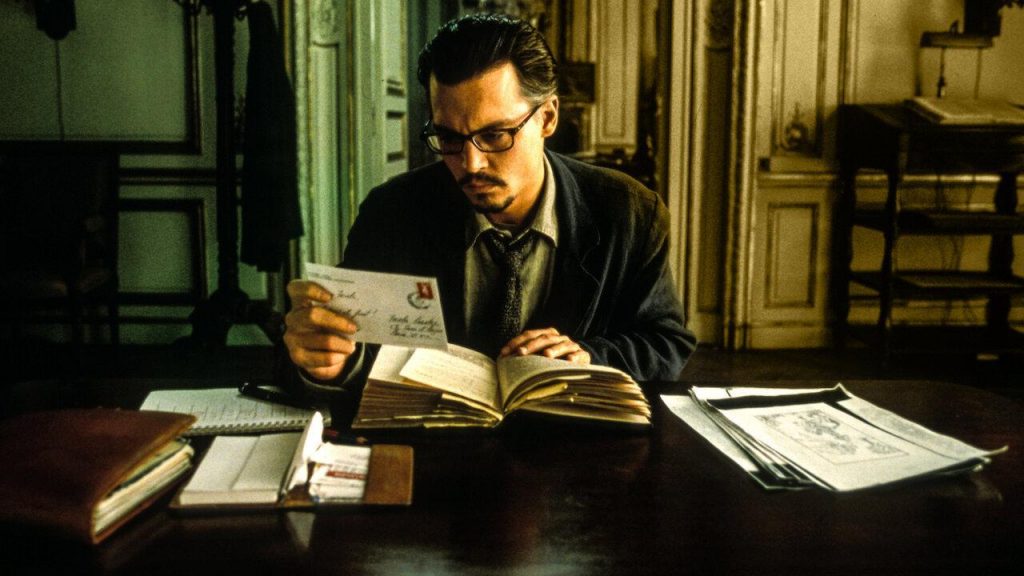
Three false books, two real ones sacrificed. The production designer of The Ninth Gate is Dean Tavoularis, the man behind The Godfather, Apocalypse Now and Bonnie & Clyde. Oscar, 1975. A man of that stature has a team of prop makers, and the film’s head prop master is called Gilbert Pieri. Pieri had to make three hero copies of the Ninth Gate: the Balkan, the Fargas and the Kessler. Three distinct bindings, nine engravings per volume and, a decisive detail, a Latin text inside that had to look real under the camera, in close-up, open on Johnny Depp’s knees.
Pieri did not print that text. He did what any bibliophile will recognise as heresy: he bought two authentic old Latin books, one of more than five hundred pages, the other of more than eight hundred, and he took them apart. Some twenty leaves from the two volumes were combined, reinserted into the custom-made bindings, and duplicated to serve the three copies needed for the film. The detail is known to specialist collectors, who tell it to one another on forums devoted to film props. Some claim to own original pages from these two books, torn out during production and given to members of the crew. One of them eventually identified the source book by typing a Latin phrase from the film into Google: it was a Latin theological and Catholic work of 1588, from which the production had merely removed a few words to give the illusion of a coded text.
Some twenty leaves of a book of 1588, dismembered to appear in a Polanski film: this should make any lover of old paper tremble. Two real books were immolated on the pretext of making a third, rarer still, since it does not exist.
Then there are the nine engravings. They are, in Pérez-Reverte’s novel as in the film, the central element: each copy contains nine, but three of them differ from one volume to the next, and comparing the eighteen images reveals the secret. These engravings, too, have a bibliophilic history worth attention.
Here is a rare particularity: the engravings already existed in Pérez-Reverte’s novel, where they bear the initials AT and LCF; those in the film take up their formal language. The formal language of these engravings, as everyone knows, draws ostensibly on the Hypnerotomachia Poliphili, the allegorical romance printed by Aldus Manutius in Venice in 1499 and attributed to Francesco Colonna. It is, as everyone knows, one of the most prestigious incunabula ever printed, famous for its one hundred and seventy-two anonymous woodcuts, themselves the object of five centuries of speculation about their author. A copy can be consulted online on Gallica, the digital library of the Bibliothèque nationale de France (bpt6k587910); those who want to see what a perfect copy costs today will remember that a Poliphilo in a fine binding has passed four hundred thousand euros at public sale, and that Jean Grolier alone owned five copies.
To make his cursed book, then, Pérez-Reverte had the formal language of the rarest and most mysterious book of Western printing adapted. It is a choice of great elegance: a seventeenth-century fake imitating a real book of the late fifteenth. The film’s engravings were drawn, engraved and printed like real copperplate prints, nine for each copy, twenty-seven prints in all, not counting the variants that Polanski had redrawn. Those prints exist somewhere, framed at Polanski’s or at Pieri’s, or scattered among the members of the crew.
As for official sales, the record is poorer than for The Name of the Rose. Neither Christie’s, nor Sotheby’s, nor Bonhams, nor Heritage, nor Propstore has seen a hero copy of the Ninth Gate go through. The three bindings made by Pieri are, to my knowledge, still in private collections; one belongs to the collection of a certain “balkan.press”, a discreet figure who runs a specialist website devoted to the object.
But the parallel market is teeming. More than forty official replicas of the book are listed online, sold for between five hundred and twelve hundred dollars depending on quality. A whole tinkerer’s literature circulates, with manufacturing tutorials, reconstructed typefaces, tracings of the nine engravings and of the tenth (the one called the “true ninth gate”, inscribed LCF). The Ninth Gate is probably the most copied prop book in the history of cinema.
And then there are the leaves. Those from the two sacrificed books. They circulate quietly, sometimes on eBay, more often in private transactions between collectors. The bibliophilic status of these objects is staggering: they are at once fragments of real old books (the Latin theological work of 1588), film props deposited by the production, and relics of the shoot co-signed Polanski. Three provenances for a single leaf: for the collector, an object to the third degree.
I do not know whether the man from Toulon really has Latin leaves that passed through the shooting of The Ninth Gate. I did not bother to go and see. But the idea that real old books were destroyed (consumed is the right word) to make a fictional book whose market value reaches several hundred euros today in replica, and incalculably more as a hero copy, should give us pause.
Polanski and his team inverted the bibliophilic equation. Where the usual market pays for the old manuscript and despises the modern copy, their film does the opposite: it buys and destroys a theological book of 1588 to make a modern fake that resells for more than the pages it is woven from. The cursed book has done its work. The real work has dissolved into the matter of the fake. And the leaves now in circulation are, as in the film, fragments that must be compared with one another to guess where they come from.
Burned books vanish, but those that are shut away always end up coming back.
Guild shelfmark: GBO-C/2 — Le Livre Démembré [The Dismembered Book]
Document classified: restricted circulation — Bureau of Litigious Props.
Nous utilisons des cookies pour mesurer l'audience du site et améliorer votre expérience de lecture. En continuant à naviguer, vous acceptez ces cookies. Vous pouvez à tout moment ajuster vos préférences.
ID used to identify users for 24 hours after last activity
24 hours
_gat
Used to monitor number of Google Analytics server requests when using Google Tag Manager
1 minute
_gac_
Contains information related to marketing campaigns of the user. These are shared with Google AdWords / Google Ads when the Google Ads and Google Analytics accounts are linked together.
90 days
__utma
ID used to identify users and sessions
2 years after last activity
__utmt
Used to monitor number of Google Analytics server requests
10 minutes
__utmb
Used to distinguish new sessions and visits. This cookie is set when the GA.js javascript library is loaded and there is no existing __utmb cookie. The cookie is updated every time data is sent to the Google Analytics server.
30 minutes after last activity
__utmc
Used only with old Urchin versions of Google Analytics and not with GA.js. Was used to distinguish between new sessions and visits at the end of a session.
End of session (browser)
__utmz
Contains information about the traffic source or campaign that directed user to the website. The cookie is set when the GA.js javascript is loaded and updated when data is sent to the Google Anaytics server
6 months after last activity
__utmv
Contains custom information set by the web developer via the _setCustomVar method in Google Analytics. This cookie is updated every time new data is sent to the Google Analytics server.
2 years after last activity
__utmx
Used to determine whether a user is included in an A / B or Multivariate test.
18 months
_ga
ID used to identify users
2 years
_gali
Used by Google Analytics to determine which links on a page are being clicked


Leave a Reply