IGLI Clinical Files: The Bibliophile Lost for 24 Hours on a Classifieds Site

Dear bibliophiles, good day.

By Dr. Achille Dandillot, physician-inspector in the clinical section of the IGLI, holder of a chair he created himself and that nobody thought of disputing. File no. 2, reference IGLI-DC-2/207.

The patient’s sister telephoned at ten past seven, and she spoke low. Her brother had gone onto the classifieds site the evening before just to look, and since then, nothing more. He had not dined, he had not slept. He could be heard, from time to time, repeating prices with no sentences around them: ninety euros, a thousand euros, fourteen euros eighty. Around five in the morning he had said aloud, to himself, “this one might be the one.” His sister waited two hours before calling, out of consideration for him.

I record the symptom under the name of price palilalia. The patient no longer repeats words, he repeats prices, and the price is the only element that survives from a listing stripped of its description. We had not yet met this stage in so practiced a subject.

Mr. R. is fifty-two and owns 2,000 volumes, a good part of them in period bindings. He has frequented public sales for twenty years, he reads printers’ Latin, he knows how to collate. Our services already knew him: file IGLI-DC-1/193, gallicanosis in a benign form, resolved without treatment. I add, because the diagnosis depends on it entirely, that he has never in his life bought a Jean de Bonnot.

The place where we found him has no name in our nomenclature. A plain. Or a dump; the word comes to me and I keep it.

Under the two words livre ancien (“old book”), the site’s Books section declares 545,417 listings. The same two words, entered in Antiques, give 2,859, and the first on the list is a marble clock with its urns, €130.

The vocabulary of the site comes down to four adjectives that trade places without anyone losing by it: “old” (ancien), “old” (vieux), “rare,” “collectible.” One therefore finds, on the first screen of every query and without having had to look for them, a Larousse encyclopedia set sold as old books for €10, a lot of rare old books advertised with “over 100 years old” in parentheses for €15, a rare old book of 1862 at €1,000 whose title and author are both withheld, an old book at €8 about which nothing whatever is given, and a rare old book entitled L’Éléphant rose at €14.80. Another listing offers old Victor Hugo books, sold on account of a death, without saying whose, and a pair of Art Deco bookends appears in the same category, where, admittedly, it holds something up. The patient was looking for a book printed before 1700.

The prices have no scale. A Bible in Latin, a Vulgate printed at Lyon in 1732, €90. Three lines higher, a sentimental novel of 1920, €89. Under the word incunable (“incunabulum”), 154 listings mix Gutenberg facsimiles at €100 with a Bartholomaeus Anglicus of 1525 at €2,200; university essays on incunabula appear there too, at €15, with nothing to distinguish them from the objects. Under the word bibliophilie, the very first listing, shown at €8,000, is not a sale: a bookseller is buying there, and he filled in the box because it was compulsory.

The photographs remain. Always the same one: the closed volume, laid on a flowered duvet, shot from three-quarters. Never the title page. Never the spine. The description comes down to two words, “see photos,” and there is nothing to see in the photos. I add, to no purpose, that it is often the same flowers, big pink peonies on a cream ground, and that I ended up wondering which home-linen manufacturer has equipped a whole generation of sellers.

The history had been left open. The patient first searched for an Elzevier and obtained eleven results, four of them for a twentieth-century Dutch scientific publishing house and one for a cat to give away. He then refined, reliure plein veau XVIIe (“17th-century full calf binding”), and received the pair of bookends and an arithmetic textbook of 1883. Precision degrades the result: the engine seems not to know what full calf is, and to retain the listings that share the most letters with the query. He finally typed incunable, the highest word in the vocabulary, and received a Gutenberg facsimile and an essay on woodcut engraving.

He then gave up all querying, typed livre ancien, and stopped reading. I propose to call this state scrolling acedia. Slack jaw, high breathing, thumb descending at regular intervals, loss of the sense of time, critical intelligence intact: questioned the next day, Mr. R. knew perfectly well that the last three hundred listings were worth nothing. We found him at page forty-one, between a lot of Bibliothèque verte (a children’s series) and the arithmetic textbook of 1883, returned there by a path I cannot explain.

We did not speak to the patient and we refrained from telling him he was wasting his time, since he knows it and it is the only thing he still knows. My assistant read aloud, slowly, the complete entry for one book. A real one. Full title, place, printer, date, format, collation, pagination, condition of the binding, nature of the endpapers, accidents, provenances with the names of their bearers. After two minutes, Mr. R. looked up.

The protocol stops there. The cure by catalogue entry, a heavy variant of the gentle bibliographic electrotherapy administered in the previous file, takes three minutes of exact description and requires no apparatus. One does not get a bibliophile off the site by showing him the door; one gets him off by making him hear a described book. The patient asked the time, took a long while to admit that a whole day was missing, and said he had found nothing.

Neither greed nor laziness holds a man that deep in the listings. Hope holds him. Among 545,417 badly named and undescribed listings, there is the 17th-century full calf sold for forty euros by someone who does not know what he holds; I had one in my hands a long time ago, picked up off a sidewalk by a colleague who knew nothing about it and who showed it to me that same evening, delighted. The patient is therefore right, and a man who is right does not get treated. We have no long-term treatment to offer.

The bookseller’s catalogue entry serves first to make it possible to say no. Its collation and its list of defects make the day finishable, and a catalogue makes a passion habitable. The site never delivers its verdict. A man who never obtains a verdict stops only from exhaustion, and exhaustion came, in Mr. R., at the twenty-fourth hour.

Prognosis guarded. The patient slept eleven hours and resumed his work. For practiced subjects, I recommend that a third party call the subject by name, aloud, in the room, after forty minutes of presence on the site, and by the surname, not the first name, the first name waking no one. The other measures I had planned to propose do not stand up against hope, and I withdraw them.

It remains to be seen whether the site has anything to do with it. The Institute draws up no indictment and I impute no intention to a company I do not know, but I note the state of the boxes. A seller must choose a category, state a price and post a photograph.

He may leave the description empty, and many do. No field demands a printing date, a format, a binding condition, whereas the patient never bought anything else than that. The same category takes in a marble clock, a pair of bookends, a lot of Bibliothèque verte and a Bartholomaeus Anglicus of 1525.

The engine appears to rank by shared letters, and the company appears to sell visibility options that can carry listings that say nothing to the head of the list. The price box cannot be left empty.

I looked at the site for twenty minutes on my way home, for the needs of the file. I bought nothing. His sister writes that he no longer wants to hear anything about anything.

He went back Thursday. So did I.

GUILDE · AD/BONCOIN

La lettre du bibliophile

Si cette chronique vous a plu : recevez trois nouvelles par semaine — livres rares, reliures, enchères, et les Dossiers IGLI. 18 ans d'archives, quelques milliers de lecteurs.

Pas de pub, pas de revente de données. Désabonnement en un clic.

À lire ensuite

The Murder of the Parisian Binder, an Investigation by Hélène Vasseur.
Couverture en couleurs du Petit Parisien de 1910 montrant un atelier de reliure

Dear bibliophiles, good day.

By Alcide Raturon, perpetually provisional secretary of the Guild, in charge of awkward comparisons, defensive enthusiasms and statistics consulted with a frown.

Hélène Vasseur is a forensic physician (and a police commissioner). She files her cases with the Guild on a regular basis, which gives our two services a family likeness that neither she nor I asked for.

And she took a day off without telling her institute what for: she accepted my invitation with the air of someone accepting a drink so as not to argue. She does not believe in time travel; she believes even less in desk hypotheses, which she calls desk hypotheses.

I needed her for that double incredulity. When you have frequented binders’ workshops as long as I have, you see moroccos, raised bands, finishing tools, and you no longer see the room. I needed someone whose trade is to walk into a room where a man has died and to understand, before anything else, what happened in it.

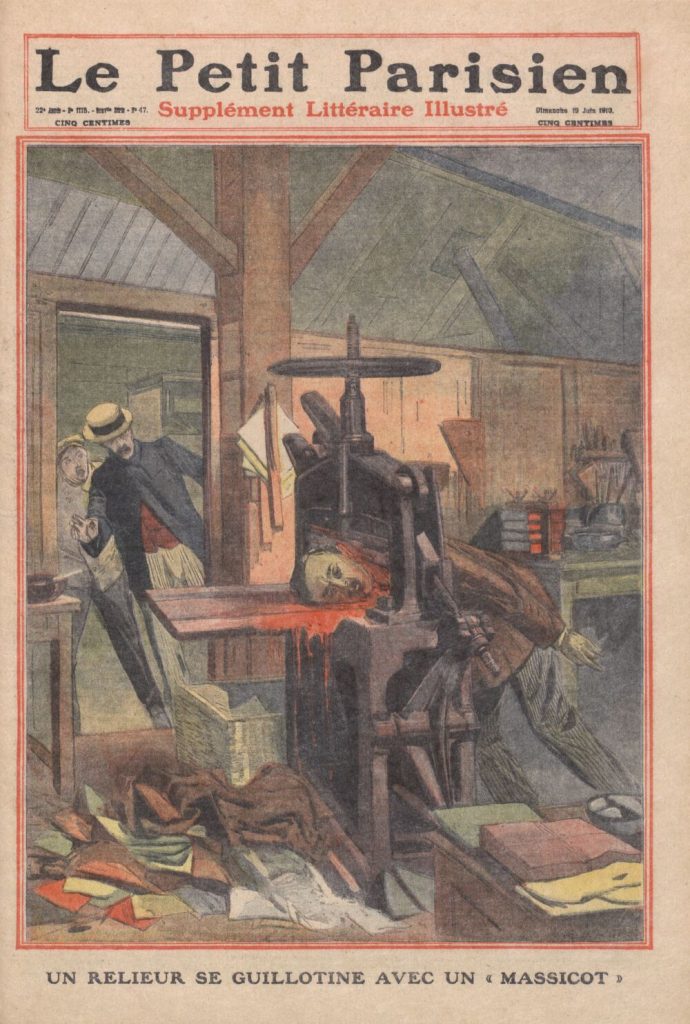
The cover of the Petit Parisien had been lying on my desk for weeks. A workshop under a timber roof, scraps of leather and paper scattered over the floor, a machine with a flywheel, and across the machine a man in a brown jacket, his head resting on the bed of the cutter, the blood running in orange-red sheets over the wood; at the door, a gentleman in a boater holds out an arm and restrains a young man by the shoulder.

Beneath it, in capitals: UN RELIEUR SE GUILLOTINE AVEC UN « MASSICOT » [A BINDER GUILLOTINES HIMSELF WITH A “MASSICOT”, the guillotine paper cutter]. Inside the issue, the news item gives the names. The proprietor, M. Stanislas Ruffin, a bachelor, was found by his two workmen, Philippe Cordebaigt and Antoine Lassouche, at 37 rue de l’Amiral-Roussin; the paper says he was frantic over the poor state of his affairs, and the police commissioner of the Necker district, M. Cœuille, carried out the customary findings.

The dailies of Saturday 4 June, which the Guild keeps in a bundle, already disagreed among themselves: Le Journal reported a proprietor of 53 panicked by his affairs, Le Matin and Le Figaro a workman of 52 suffering from neurasthenia, who worked there “as a rule” among “the other workmen”. Two deaths to choose from in the same workshop. I followed Le Journal, because the Supplément followed it. We were five months after the January flood, which had put so many cellars under water and swollen so many stocks of paper and leather; the hypothesis of a craftsman strangled by a payment deadline stood up. I have no figures on the ruined binders of 1910 and do not claim to have any: my hypothesis was worth what the hypotheses of a statistician without statistics are worth.

We arrived on Friday 3 June 1910 at 7:05, by the usual route, which the Guild’s rules forbid me to describe and which I would be hard put to explain.

The Supplément did not give the day, it said “a few days ago”; the dailies of Saturday the 4th said “yesterday morning”. So Friday it is, a day like any other for dying. Hélène looked at her watch, then at the street, then at the horses, and said “right” in the tone she uses when she is told of a body. She opened a black-covered notebook that she did not put down all morning, and wrote the time. We were received in the courtyard as, on such a day, two well-dressed people are received: as relatives or as creditors, and we were both, depending on who was asking.

The rue de l’Amiral-Roussin smelled of coal and flour paste. The workshop occupied the back of a courtyard, and the body had not been moved. I shall not describe it, the cover shows it well enough, with a care that the draughtsman, who was not there, owes to a reporter’s account.

The two workmen stood near the door, hats in hand, repeating one after the other the same sentence about how they had stepped back. A third man stood with them, very upright, a boater on his head: M. Anatole Pradel, bookseller of the quai Voltaire, who had come at opening time to collect a volume entrusted to M. Ruffin for binding.

Commissaire Cœuille arrived shortly afterwards with an inspector and a notebook of his own. He looked like a man who had been promised a short case. He listened to M. Pradel, he listened to the workmen, he read the paper found on the workbench, three lines in ink, “Je n’en peux plus. Pardonnez-moi. S. Ruffin” [I can’t go on. Forgive me. S. Ruffin], and he pronounced the word the press was going to take up. Suicide. I nodded. Statisticians without statistics nod when what they hear confirms what they read the day before. I hold nothing against the commissaire: he had before his eyes a proprietor in difficulty, a farewell note and a machine, and he did what one does in front of that.

Hélène, for her part, had gone round the room without touching anything, hands in her pockets, which is the first gesture of her trade and the last of the binders’. She introduced herself to the commissaire as a doctor of medicine. He took this for a family eccentricity, and let her approach the body because the district doctor had not yet arrived and the commissaire was hungry. She laid the back of her hand on the jaw, lifted an arm, put it down, looked at the other. She wrote a line. “Dead since last night,” she told me in a low voice, “between seven and ten. Not this morning.” I pointed out that the workmen had found him this morning. “They found him this morning,” she answered. “But he died last night.”

She raised her eyes to the ceiling. A transmission ran under the roof timbers, a long iron shaft, and from this shaft a belt came down to the cutter, which the newspaper says is driven by motive power. Hélène asked me where the belt was. I looked: it had been moved onto the loose pulley, the one that turns idle and leaves the machine at rest. “He kills himself,” said Hélène, “the blade falls, and afterwards he disengages.” I defended my hypothesis for ten minutes: he had disengaged beforehand. “Disengaged beforehand, the blade would not fall. Disengaged afterwards, he was no longer there to do it.” She closed her notebook on that sentence.

The commissaire handed me the paper as one hands a receipt to a man who looks as if he knows about such things, which is the only advantage of my face. I saw in it what he had no reason to see. The paper was no ordinary sheet. It was a flyleaf, laid paper, yellowed, with the tip of a watermark at the edge, torn out of a book. The book was on the workbench: a small duodecimo in its vellum wrapper, from which the first blank leaf was missing. Le Pastissier françois, Amsterdam, Elzevier, 1655; a cookery book, and one of the Elzevirs that collectors have always chased. The sale records have made it one of the dearest of them all: a copy found for 6 sous by Fontaine de Resbecq in 1856, another knocked down at 2,910 francs in the Potier sale of 1870, a third pushed to 3,255 francs at the Benzon sale in 1875; Willems counted only about thirty. In 1910 a fine copy came to something like two years of Cordebaigt’s pay. It was M. Pradel who had brought it in for binding.

I felt offended before I felt enlightened. A binder who wants to die has every reason in the world; he also has, on his shelves, reams of ordinary paper, and he does not tear the blank leaf out of an Elzevir that a client has entrusted to him. The very idea is foreign to his trade, which consists in not doing that. Hélène, to whom I showed the tear, put it otherwise: “Whoever wrote that is not from the trade.”

She took Philippe Cordebaigt aside, on the threshold, and I let her, because a workman does not have the same things to say before his commissaire as to someone who listens while taking notes. She put her questions in the order of the morning, minute by minute, the way one unwinds a thread. The workmen had the key to the back door; they had arrived a little before seven, at the same time as M. Pradel, who was waiting in the courtyard; M. Pradel had taken hold of the handle before them, said “Don’t come in, gentlemen,” and held them back with his arm, as in the drawing. “Did he say that before or after he had seen?” Hélène asked. Cordebaigt thought for a long time, with the conscientiousness of people who are asked for an exact order of events. “Before,” he said. “The door wasn’t open an inch.”

The order book was under the elbow of the machine. Nobody had opened it: commissaires read farewell letters, and it is binders who read order books. Hélène opened it with a handkerchief, at the last written page. The last line, in the proprietor’s hand, the same as that of his labels, as Cordebaigt, who read it every day, confirmed before I did, said: “Pastissier de M. P. Un exemplaire fait de deux : cahiers du milieu d’un autre, marges refaites à la pâte sur dix feuillets. Refusé de signer la reliure. Écrire à l’acheteur.” [Pastissier for M. P. A copy made from two: middle gatherings from another, margins remade in pulp on ten leaves. Refused to sign the binding. Write to the buyer.]

For those who do not frequent Elzevirs: the book is judged by the height of its leaves, and margins remade in pulp make it taller without the eye suspecting. A gilt signature at the foot of the spine vouches for the rest (or not, it is true, but we are in mourning, so let us be nice to the binders).

Between the copy made from two and the copy tall in the margins and signed, the gap was counted in years of wages; between the signed copy and the letter Ruffin meant to write to the buyer lay, for a bookseller of the quai Voltaire, the criminal court. M. Pradel needed Ruffin’s name as one needs a character witness, and he had brought to a man whose name carried weight two books to make one. The man had refused, which was the only thing M. Pradel had not foreseen, and had announced that he would write to the buyer, which put him, at the hour that Hélène’s notebook gave for his death, under a blade that awaited only a click and a witness who disengages the belt.

“It is a murder,” said Hélène. She said it in the courtyard, without raising her voice, her back to the workshop, as she no doubt tells her interns that the coffee is cold. I had been wrong. I told her so; she replied that she had heard worse from people who were right.

“One rarely kills for a book,” she added. “One kills for money. And when there is a book, the money is never far.”

I then invoked the Guild’s rules, which are clear: the time traveler observes, does not interpose himself, and does not explain to the police of 1910 that they are mistaken. She looked at me the way she would look at a void. “Then you will report,” she said. That is what I am doing. She wrote, for her part, a ten-line report that no one will read and that she refused to show me, which I understand.

M. Pradel, on the threshold, was adjusting his boater. Commissaire Cœuille carried out the customary findings, as the newspaper says, and the Petit Parisien printed the article on the Sunday, for five centimes. As for the Pastissier françois, it left the workshop bound by a successor, with Ruffin’s name gilt at the foot of the spine. A catalogue of 1924 gives it as tall in the margins and signed. It is signed: Ruffin had refused to do it.

GUILDE · AR/MASSICOT

Be the first to comment

Leave a Reply

Your email address will not be published.