What is bibliophily? (and what is a bibliophile?)

Dear bibliophiles, good day.

By Mathieu Lenoir, scourge of received ideas, reader of present usage and appointed contradictor of bibliophilic confusions for the Guild of Bibliopolices.

People think they know what bibliophily is, and they are almost always wrong. It is neither snobbery, nor a rich man’s business, nor the cult of everything old. It is something else, and it is finer.

Bibliophily is the love and study of the book as an object, and not only as a text. The bibliophile does not merely read: he is interested in the edition, the printing, the binding, the paper, the condition, the provenance, in short everything that makes one copy that copy and no other. That is how he differs from the simple reader, who loves the text without caring about the medium, and from the bibliomaniac, who accumulates without measure, sometimes without even reading, and in whom passion has turned into mania. One can be an excellent bibliophile without a fortune, and a very poor one with a great deal of money.

What makes a fine book for a bibliophile is the meeting of several qualities: the edition, since the first edition is sought after; real rarity; condition; the quality of the binding; and provenance, meaning former owners, bookplates, dedications. None suffices alone; it is their conjunction that makes the desirable copy, the format placing the type of work at once.

A few received ideas deserve a twist. First: bibliophily is mere snobbery. No, it is an attention, and loving the way a book is made is no more snobbish than loving the way a house is built. Second: one has to be rich. False, one can build a coherent and learned library on modest means provided one chooses well. Third: only old books count. Wrong again, for there is a bibliophily of the twentieth century and even of the contemporary, age not being the criterion, but care and interest.

One does not become a bibliophile by buying dear, but by learning to look. Read, compare, frequent booksellers and bouquinistes, learn to recognise a format, a first edition, a binding, and even an incunable: taste comes as the eye is trained, and, when the moment comes, you will know how to value and sell knowingly.

This guide is the entrance to a small lexicon continued by our pages on formats, first editions, bindings and incunables.

True luxury is not owning everything: it is knowing exactly what you love, and why. GUILDE · ML/BIBLIOPHILIE.

Document classified: restricted circulation.

La lettre du bibliophile

Si cette chronique vous a plu : recevez trois nouvelles par semaine — livres rares, reliures, enchères, et les Dossiers IGLI. 18 ans d'archives, quelques milliers de lecteurs.

Pas de pub, pas de revente de données. Désabonnement en un clic.

À lire ensuite

IGLI Clinical Files: The Gilt-Edge Syndrome
Dear bibliophiles, good day.

Special Zoobibliological Surveillance Service. IGLI. By Dr. Fulbert de Cuirac, sworn veterinarian of printed entities, expert to the Bureau of Abnormal Manifestations of the Book, appointed for disorders of owner attachment and heraldic-bibliological rejection phenomena.

File opened at the request of: Mr. B., amateur, 16th arrondissement, worried owner.

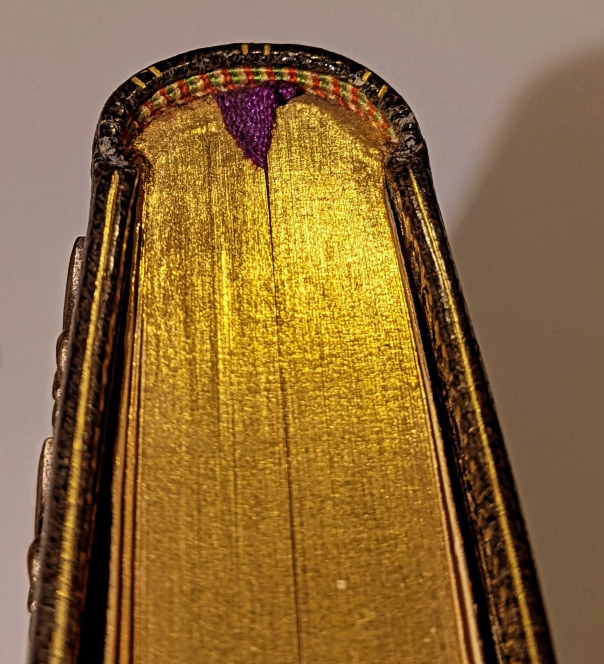
Entity concerned: octavo volume of the mid-19th century, full red chagrin (grained leather), ornamented spine with raised bands, gilt on all three edges, very fine general condition. For clinical discretion, we shall call it the Gilt Patient.

According to the provenance register, the entity spent forty years in the window of a Latin Quarter bookshop, exposed in broad daylight, before Mr. B. acquired it at a public sale. Since its installation at the latter’s (corner shelf, middle position, respectable neighbors), the entity has shown behavioral disturbances that the owner describes, with the touching imprecision of non-specialists, as “the fidgets.”

The facts were recorded over three weeks by the owner, then verified by the service. Every morning the entity is found shifted by a few millimeters toward the lit end of the shelf, on the window side. Pushed back into place, it reoffends. During the home inspection, Miss Lépine, my assistant, found on the floor fine deposits of gold powder tracing a path of about fourteen centimeters, what the service, in its nomenclature, calls a vanity trail (traînée de vanité). The neighboring volumes, two honest half-sheepskins with no gilding, show an abnormal lateral compression, like subway passengers at rush hour. They are making room. Modest entities always make room.

Placed under observation at the service, on our calibrated shelving, the entity confirmed the picture: systematic orientation of the gilt edges toward the light source, whatever the initial position; reflections described by the staff as “provocative” in hours of strong sunshine; and a marked refusal of darkness. Placed in closed storage as a test, the entity developed overnight an onset of tarnishing that our control specimens of gilding, stored in the same conditions, did not show. It tarnishes on purpose. We are dealing with blackmail.

The service diagnoses gilt-edge syndrome, a classic form of vainglorious heliotropism (Splendor compulsivus, variety vitrinae nostalgicus): acquired inverted photophobia following prolonged exposure in a shop window during the formative years. The entity spent forty years being looked at; it contracted the shopfront disease, which consists in mistaking light for love. The domestic shelf, with its egalitarian dimness where an Elzevir is worth a morocco, is for it a social demotion that its organism rejects. Differential diagnosis: we ruled out simple mechanical slippage (the shelf is level, Miss Lépine set her own spirit level on it, and hers forgives nothing) as well as the intervention of a cat, a hypothesis always advanced by owners and almost always slanderous.

The service’s recommendations, in order. Do not yield to shop-window blackmail. Permanent display would aggravate the syndrome and, incidentally, fade the chagrin: vanity punished where it sins, which is morally satisfying but bibliographically regrettable.

Second, rotation of esteem: fifteen days per quarter on the living-room display stand, announced to the entity in advance. Gilt entities put up with everything except improvisation.

Third, neighborhood therapy: place on its left a 17th-century Elzevir in ivory vellum, modest and perfectly printed. Prolonged contact with discreet glories is the only known long-term treatment for vanity, in books. In owners, the service promises nothing.

Fourth, follow-up: new inspection in six months. Miss Lépine will keep the register of displacements, which she has in fact already opened, numbered and paginated unasked, as is her habit.

Prognosis favorable. The entity is not malicious; it was simply loved in public too young.

GUILDE · FC/VITRINE

Reproduction on gummed paper discouraged without necessity. Document classified: restricted circulation.

Be the first to comment

Leave a Reply

Your email address will not be published.