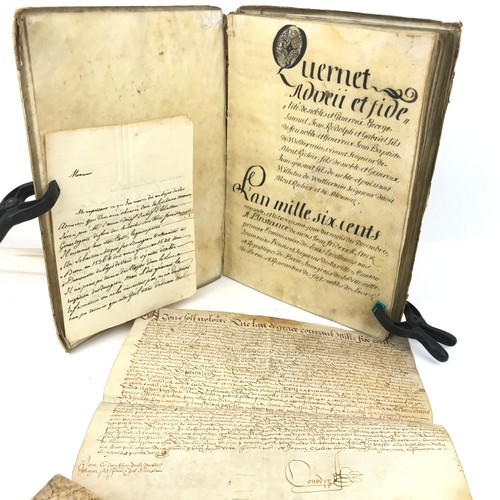
Bibliophilie.com has been written in Paris since 2007. It covers antiquarian books, bindings, auctions, forgers, thieves and the booksellers between them.
The site is run by a learned society that exists only on paper, the Guild of Bibliopolices. Its inspectors, chroniclers and secretaries are all one author, which no one has ever objected to. This English section brings together the guides and stories that travel best.
Start here: the guides
- General Principles of Pagination and Foliation
 Sheet, leaf, page and gathering are the four bibliographical units used to describe books printed from the 15th to the 18th century. This guide separates foliation from pagination, shows how signatures reveal the number of leaves, and ends with a signature formula from Münster’s Cosmographia of 1550. […]
- What is a bouquiniste?
 The trade of bouquiniste has been listed since 2019 in France’s national inventory of intangible cultural heritage. It has neither a diploma nor a legal definition. The green boxes along the Seine hold dealers who sell, in the open air, books that nobody has appraised. […]
- What is bibliophily? (and what is a bibliophile?)
 Bibliophily is the love and study of the book as an object, and not only as a text; it asks for attention, not for money. The bibliophile looks at edition, binding, paper, condition and provenance, and differs from the plain reader and the bibliomaniac. A definition, common misconceptions and a way to begin. […]
- How to sell your old books: where, how and at what price
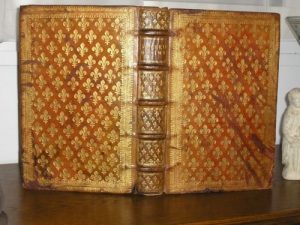 The specialist bookseller pays cash, at half the retail price or less, since he must resell. The same title runs from ten euros to ten thousand depending on printing and condition. The auction house charges seller and buyer alike, and the choice of channel decides the rest. […]
- How to value an old book
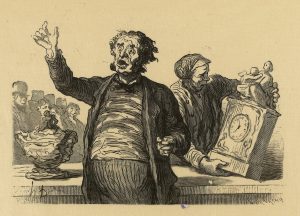 An ordinary 17th-century book is worth less than a sought-after 20th-century first edition: age does not make the price. Sheepskin is sheep, morocco is goat, and the gap in value between the two bindings is visible to the naked eye. What remains is to learn what the market actually pays. […]
- The main types of binding in old books
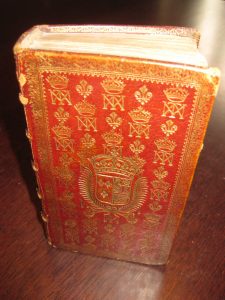 Morocco is goatskin, calf is the classic leather of the classical centuries, and sheepskin is its humbler cousin. This guide names the main types of binding in old books, from half-binding to the Jansenist style, so that you can describe exactly what you are holding. […]
- What is an incunable?
 An incunable is a book printed in Europe before 1 January 1501, in the first decades after Gutenberg’s invention of printing, around 1450. Gothic types, abbreviations, no title page and blank spaces for hand-painted initials mark these first printed books. Here is how to recognise one. […]
- How to recognise a first edition: the guide
 A first edition is the first appearance of a text in print, and the first printing of that edition is the copy collectors want. Edition statements, colophon dates, limitation notices and the bibliographers’ “points” tell it apart from a reprint dressed up as the original. Here is how to check. […]
Auctions and the market
- So What Is the Price of the Saint-Brieuc Manuscript? 850,000 Euros or 1.2 Million Euros
 The Viennese dealer’s listing gives the dating, the scriptorium, the collation and two named and dated expert opinions. Where the price should be, a single word: Inquire. The invisible tags of the same page nonetheless carry a number, and the 48th Boston fair announces another. […]
- Harry Potter Among the Antiquarian Booksellers
 AbeBooks, owned by Amazon since 2008, publishes each year its ten most expensive sales, ten entries and ten prices. I read the reviews from 2021 to 2025, some sixty sales. The name that comes up most often wears round glasses and a scar on its forehead. […]
- Have Auction Fees Really Run Out of Hand, or Is It Simply Organised Fraud?
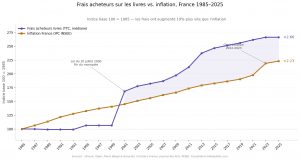 Between 1985 and 2025, buyer’s premiums on books were multiplied by 2.66, the consumer price index by 2.23. The gap lies almost entirely in the years 2000-2013, when the rate went from a little over 10% to about 25% including VAT. Since 2023, some houses have passed 30%. […]
Stories: thieves, forgers, collectors
- IGLI Clinical Files: The Bibliophile Lost for 24 Hours on a Classifieds Site
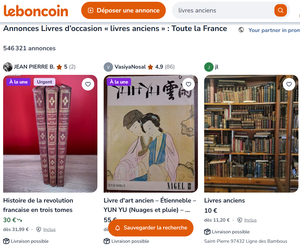 Five hundred forty-five thousand four hundred seventeen listings sit under the two words livre ancien. Mr. R., fifty-two, with 2,000 volumes in period bindings, scrolled through them for twenty-four hours without eating or sleeping. A Lyon Vulgate of 1732 is priced there at €90, a sentimental novel of 1920 at €89. […]
- Portrait of a Binder: Charles Meunier (1866-1948) and His “Binding a Day”
 Charles Meunier entered his apprenticeship with Bénard at the age of eleven and set up on his own at twenty. By 1897, Beraldi already counted five to six hundred bindings from his workshop. He claimed he wanted to produce one design a day, and the good taste of his time held it against him. […]
- IGLI Clinical Files: The Gilt-Edge Syndrome
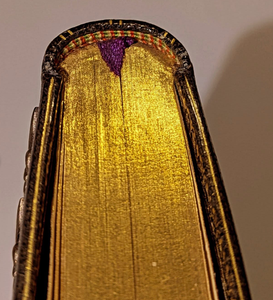 A red grained-leather octavo, gilt on all three edges, is found every morning shifted a few millimeters toward the window. Its owner, an amateur from the 16th arrondissement, watched the phenomenon for three weeks before calling the IGLI. The volume comes from forty years in a Left Bank shop window. […]
- A Black Morocco Binding, Two Initials, a Question of Provenance
 In a bookshop in the sixth arrondissement of Paris, a board of black morocco bore two gilt letters at the centre: O. H. They are my initials in the order of the civil register. The book was Edmond Morin’s Don Quichotte en images, published in Paris at 55 rue de Rivoli. […]
- IGLI Clinical Files: Thierry B., the Man Who Counted the Books He Did Not Buy
 Ten books bought in the year 2026, and one thousand seven hundred and ninety-five let get away. Thierry B. keeps this tally in an Exacompta notebook and declared it in writing on 26 August. The service examined the terms of that declaration, and four of them call for comment. […]
- Bibliophile Miscellany: New Hypotheses on the Voynich Manuscript
 Arthur Tucker and Rexford Talbert suggest that the Voynich manuscript may be Mexican in origin, after comparing its plants with an Aztec herbal. They count 37 of its roughly 302 plants as potentially Central American and propose a lost Nahuatl source for the text, adding that much remains to be done. […]
This site also exists in French: bibliophilie.com.