Dear bibliophiles, good day.
I invite you to discover one of the greatest hoaxes ever worked on old documents: the Vrain Lucas affair.
Michel Chasles (1793–1880) was a French mathematician to whom we owe important work in geometry. His name is attached to Chasles’s relation (ab + bc = ac in a quadrilateral), and we also owe him Chasles’s theorem. He coined the term homothety. But in the small world of bibliophilia and autograph collecting, the name of Chasles is tied to the incredible swindle of which he was the victim at the end of the nineteenth century, and therefore, inescapably, to that of the brilliant forger Vrain Lucas.
The swindle began in 1861 and would last several years. At that time Michel Chasles was 68 and a member of the Académie des sciences, elected in succession to Guillaume Libri, the notorious thief of manuscripts, which is rather comical. Heir to a rich family of timber merchants and a former pupil of Monge, he had had a chair of geometry created for him at the Sorbonne. A confirmed bachelor, he devoted his life to mathematics, and he was said to be of a very gentle, very friendly nature.
Vrain Lucas (1816–1881) was his opposite. Of very modest origins, he nonetheless learned to read and write. A self-taught man, he would be, in the words of the account I follow, “successively an attorney’s clerk, a clerk of the court at Châteaudun, then an employee of the mortgage registry in 1847. In 1852 he went to Paris to obtain a post as cataloguer at the Imperial Library (today’s BnF) but was not accepted, on the pretext that he did not hold the baccalauréat. He also applied to the Auguste Durand bookshop, to which he was recommended, but was not taken on, on the ground that he knew no Latin. Having a family to feed, he accepted a post as canvasser at the genealogical firm Courtois-Letellier, whose main business was to produce false pedigrees of nobility for bourgeois short of titles. There he acquired an uncommon skill at counterfeiting supports and handwriting, notably by ageing inks and papers with candle smoke and dirty water…”
In 1861 Vrain Lucas approached Chasles on the strength of their common origins, the Eure-et-Loir. He knew that the mathematician was a lover of historical documents. Chasles shared with Vrain Lucas his passion for such documents and confided his dream of writing a book founded on authentic ones. Vrain Lucas came back to see him soon afterwards with three letters, from Molière, Racine and Rabelais. It was the beginning of a chain of events that would last nearly 6 years and involve more than 27,000 forged letters sold by Vrain Lucas to Chasles, for close to 150,000 francs of the day (nearly 600,000 euros today according to Frédéric Castaing).
Curiously, and this is one of the questions the affair raises, a relationship was born over a few years between two men whom everything separated: a forger who found in it a way to express this form of art and to provide for his needs, and a member of the Institut, fascinated by letters, some of which touched directly on his favourite field, mathematics, and which would be the undoing of them both. Like any amateur offered unique documents, Chasles probably lived there the best years of his life as a collector, and one may imagine that the bond with Vrain Lucas was one of dependence, founded on trust…
It seems today that a swindle of such scale, and of such length over the years (27,000 letters, over 6 years), could in a way exist only because the one was Chasles and the other was Vrain Lucas; they somehow found each other.
The affair broke on 15 July 1867 at the Académie des sciences, when Chasles presented his letters between Pascal and Newton, which called into question the Englishman’s theory of gravity. At once improbabilities appeared, and to answer the sceptics Vrain Lucas fed Chasles further letters: whenever a letter or one of its passages was challenged, Chasles warned Vrain Lucas, who supplied other letters to answer the objections. It was a vicious circle; the controversy swelled; it was a bubble that would end by bursting… and it raises the question of how far Chasles was really deceived at a certain point.
One of the key objections to the Pascal and Newton letters was that at the time they were supposedly written, Pascal was about thirty… and Newton eleven. The controversy was enormous, it crossed borders, yet, remarkably in hindsight, the debate went on. But the machine was running, and for nearly 2 years Vrain Lucas answered the objections of Chasles’s detractors. A mad story when one considers it more than a century later: the Académie française itself took Michel Chasles’s side.
Concerning Newton and Pascal, members of the Institut pointed out to Chasles that the handwriting of the documents presented was very different from that of the letters historically certified as written by Pascal. Faced with the doubts arising in the minds of the academicians, Chasles was obliged to state that he had the letters from Vrain Lucas. In 1869, fearing that important pieces would escape him, Chasles had Vrain Lucas watched by the police for a month. Chasles was demanding three thousand more pieces from Vrain Lucas, who was slow to supply them; the mathematician feared that he would sell these priceless pieces abroad and resolved to have him arrested for fraud and breach of trust. It is incredible to note that, at the edge of the abyss, Chasles still seemed to believe in the authenticity of the letters.
Arrested on 9 September 1869 for fraud and breach of trust, questioned and quickly exposed with the help of two palaeographer experts, Henri Bordier and Émile Mabille, the forger confessed. During the trial the imperial prosecutor, to the stupefaction and then the hilarity of the courtroom, read out the following forged autographs: a letter from Archimedes to Hieron; a letter from Alexander the Great, king of Macedon, to Aristotle; a letter from Thales, sage of Greece, to Prince Ambigat, king of the Gauls; a letter from Queen Cleopatra to Julius Caesar; a safe-conduct from Vercingetorix for Pompey; a letter from Lazarus the risen to Saint Peter; a letter from Mary Magdalene to Lazarus the risen; a letter from Charles Martel to the duke of the Moors; a letter from Charlemagne to Alcuin.
On 16 February 1870, Vrain Lucas was sentenced by the 6th criminal chamber of the Seine to two years’ imprisonment and a fine of 500 francs, together with the costs. Over a period of sixteen years he had forged more than 29,472 autographs, letters, documents and manuscripts attributed to 660 personalities, ranging from classical Antiquity to the Age of Enlightenment, and in all he had extracted nearly 140,000 gold francs from his victim.
On 13 September, Chasles had to acknowledge that he had been fooled and to explain how he had bought so large a number of forgeries from Vrain Lucas and how much money he had lost in this unfortunate affair, which in addition had made him a laughing stock among his colleagues of the scientific community.
After the trial of 1870, the 27,320 forged autographs sold to Chasles by Vrain-Lucas were destroyed, with the exception of a small number, which Bordier and Mabille gave “with the permission of the judicial authority” to the manuscripts department of the BnF (the Bibliothèque nationale de France, the French national library) and which were gathered in a single volume of 180 folios, kept under the shelfmark N(ouvelles) A(cquisitions) F(rançaises) 709, that is, New French Acquisitions. You can find it here: http://gallica.bnf.fr/ark:/12148/btv1b525049362
In 1872, after leaving Mazas prison, where he had written a plea in his defence, Vrain Lucas committed other offences (thefts of rare books from libraries, breaches of trust) and was arrested on 18 February 1873, then sentenced again to three years in prison. In 1876 he received another four years. Once his last sentence was served, he returned to Eure-et-Loir and dealt in old books at Châteaudun, where he died in 1881.
Michel Chasles and Denis Vrain-Lucas gave Alphonse Daudet enough to feed his novel L’Immortel, published in 1880.
That volume is gripping, and reading it we cannot help thinking that we are in front of a body of work in its own right: more than 27,000 letters and autographs in all, even if only 180 survive, and they do have a family air.
The reader faces an ensemble that is fantastic in the literal sense of the word, and the more improbable and incredible the letters, the more one is staggered by the titanic labour Vrain Lucas accomplished.
We know, of course, the letters between Pascal and Newton that would bring about Vrain Lucas’s downfall and Chasles’s humiliation, but we are left speechless before the forger’s imagination: a safe-conduct granted by Vercingetorix to Pompey (“J’octroye le retour du jeune Trogues Pompens auprès de Jules César son maître et ordonne à tous qui ces lettres verront le laissez-passer librement et l’aider au besoin.” [I grant the return of young Trogues Pompens to Julius Caesar his master, and order all who shall see these letters to let him pass freely and to help him if need be.]), letters from Alexander the Great to Aristotle, from Lazarus to Saint Peter, from Mary Magdalene, from Cleopatra to Julius Caesar, from Joan of Arc… but also letters whose supposed authors were Judas Iscariot, Pontius Pilate, Joan of Arc, Rabelais, Charles V, Shakespeare, Galileo, Montesquieu, Cicero and Dante Alighieri — all written in a fanciful Old French.
In the end, the bigger the lie, the easier it goes down, and one may wonder what those years were like for Vrain Lucas, facing this titanic labour, which took up a large part of his nights, moreover, under Chasles’s pressure.
In prison, Vrain Lucas also wrote a memoir of four leaves on the reasons that had led him to produce the letters: “Galilée, Pascal, Newton, mémoires, motifs qui m’ont fait agir” [Galileo, Pascal, Newton, memoirs, reasons that made me act]. We discover, amused, that Vrain Lucas presents himself as driven, almost a victim, by the pressure Chasles exerted with his orders for new documents. The relationship between the two men remains astonishing, for we know that Chasles visited Vrain Lucas in prison after his sentence, bringing him treats to help him bear the harshness of his incarceration.
In the excellent programme France Culture (the French national public radio) devoted to the subject, one of the speakers underlines a point I find rather delightful… What if the affair had not broken, and if a century later Chasles’s family had put these letters up for sale, what would we have known of Vrain Lucas, a swindler it is true, but also the author of a certain thumbing of the nose at the establishment?
Amusingly, a letter by Vrain Lucas was put up for auction in Toulouse in April 2017. It was described thus:
VRAIN-LUCAS (Denis). 1816-1881.
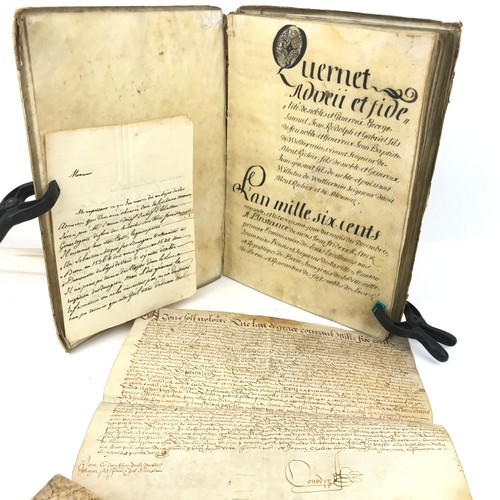
… Autograph letter signed “Galileo Galilei, to Mademoiselle de Gournay”, woman of letters and friend of Montaigne. 2 pp. on 1 leaf, 15 x 20 cm. A letter with a falsely learned air, in which Galileo praises the merits of an Italian translator: “Mademoiselle, en réponse à ma lettre du 3 juillet dernier, que je vous adressay en vous envoyant un exemplaire du grand livre de l’Enéide de Virgile, traduit en latin par Jean André dell Anguillara, et par laquelle je vous disois que la langue italienne devoit beaucoup de ses beautés à ce traducteur, qui avoit en mesme temps traduit les Métamorphoses d’Ovide en stance de 8 vers, le mesme qu’il la fait pour le premier livre de l’Enéide /…/.?Le traducteur dites-vous a employé une stance de huit vers pour rendre ce seul vers d’Ovide dans la description du chaos quaque fuit tellus illic et pontus aër. Et vous ajoustez que Du Bartas dans sa Semaine n’en a employé que quatre /…/.?J’admets Mademoiselle votre observation /…/.?Je suis Mademoiselle votre très humble, très dévoué et très affectionné Galileo Galilei” [In substance: Galileo answers her letter of 3 July, to which he had attached a copy of the Aeneid translated by Jean André dell Anguillara, whose eight-line stanza she finds too generous next to the four lines Du Bartas needs in his Semaine; he grants her observation and signs himself her very humble, devoted and affectionate servant.] In yellowish ink, on laid paper artificially aged, 2 old fold marks, 2 wormholes, a small loss in the margin and a large foxing stain at the centre. Later tear over 10 cm, without loss, partly restored.
The signature Galileo Galilei is identical to that of the 4 letters of the Fonds deposited by the Public Prosecutor’s office at the BnF, two of them addressed to Mlle de Gournay, one of which speaks of Petrarch and of Dante’s Mystic Rose, the other of Guido Cavalcanti and Shakespeare.
Vrain-Lucas autographs in private collections are very rare. Indeed, part of the “Chasles collection” was deposited by the Ministry of Justice at the Bibliothèque nationale. The others were in principle destroyed.
It was estimated at 1,500–2,000 euros. I regret that I do not have the hammer price.
H
Sources:
http://gallica.bnf.fr/ark:/12148/btv1b525049362
Wikipedia
Si cette chronique vous a plu : recevez trois nouvelles par semaine — livres rares, reliures, enchères, et les Dossiers IGLI. 18 ans d'archives, quelques milliers de lecteurs.
Pas de pub, pas de revente de données. Désabonnement en un clic.
When They Guillotined the Booksellers: Paris, Spring 1794



Leave a Reply