When They Guillotined the Booksellers: Paris, Spring 1794

Dear bibliophiles, good day.

By Barthélémy d’Arcole, Inspector of Bibliophilic Aesthetics and Modern Heresies to the Guild of Bibliopolicés.

There is, in the history of French bookselling, a spring that nobody celebrates. It is the spring of Year II of the Revolutionary calendar. Between January and May 1794, in the weeks leading up to the fall of Robespierre, five Parisian book dealers went to the scaffold for doing what their trade had taught them to do: print, sell, ship, display in the shop window. None of them had taken up arms. None had conspired. All kept shop at the Palais-Royal, on the quai des Grands-Augustins, or in the Saint-Honoré quarter. The offence held against them was not plotting but having let printed sheets circulate. The indictment was not about their deeds but about their catalogues. They were condemned as booksellers.

The names are little known, and even well-informed bibliophiles meet them only in a footnote in Mellot, or in the work of Annie Duprat, on which I draw here. They are: Jacques-François Froullé, printer-bookseller on the quai des Grands-Augustins; Thomas Levigneur, his occasional partner, who set up shop within the very galleries of the Convention; François-Charles Gattey, bookseller at 14 Palais-Royal; Michel Wébert, bookseller and dealer in caricatures, also at the Palais-Royal; and finally a woman of whom the archives have kept only the name of a widow, la veuve Lesclapart, bookseller in Paris. Five people, five fates, one era and, give or take a few weeks, the same end.

Three of these five booksellers fell for the same book. It is a pamphlet that every eighteenth-century enthusiast should know, if not as a bibliographical object then at least as a historical document: the Liste comparative des cinq appels nominaux faits dans les séances des 15, 16, 17, 18 et 19 janvier 1793 sur le procès de Louis XVI [Comparative list of the five roll-call votes taken in the sessions of 15–19 January 1793 on the trial of Louis XVI]. The title looks dry. The contents are less so. It is a compilation of the votes of the deputies of the Convention on the death of the king, accompanied by a Relation des vingt-quatre heures d’angoisses qui ont précédé la mort de Louis XVI [Account of the twenty-four hours of anguish that preceded the death of Louis XVI] and by a footnote, modest in appearance, that would feed a French legend for two centuries: that of the “majority of a single vote”.

That footnote, more than anything, is what condemns. Royalists found in it the proof that the king had been murdered by a procedural stroke and not by the will of the people. The revolutionary authorities saw in it a manoeuvre, and the most dangerous of all, since it struck at the very legitimacy of the regicide. The pamphlet was printed by Froullé and Levigneur as early as April 1793. It spread. It travelled. Levigneur admitted having sold it openly at the door of the Convention, under the eyes of the people’s representatives, adding that after a few reproaches he had withdrawn it. Froullé, more deeply involved, confessed to having disposed of two thousand copies. Asked why he had not read the Relation des vingt-quatre heures before inserting it, he answered simply that he had not thought it dangerous, “by virtue of the freedom of the press”.

The argument carried little weight. The law of 29 March 1793, whose reach Froullé had perhaps not measured, imposed the death penalty on the authors and distributors of writings tending to restore the monarchy. Both booksellers were arrested on 8 Ventôse, Year II. Fifteen copies of the Liste were found at Froullé’s, along with twenty-seven suspect pamphlets and, a detail that did not help, a packet of cartridges. They were guillotined on 13 Ventôse, Year II (3 March 1794).

François-Charles Gattey did not fall for the Liste. He fell for the Actes des Apôtres, the great royalist journal launched in 1789 by Peltier, Suleau and their friends, of which he was the appointed publisher. Gattey was no latecomer to trouble with the Revolution. He had been at odds with the book-trade authorities since before 1789, and had even known Charenton for breaking the rules of the trade, which made him, in the profession, one of those disreputable booksellers whom the whole Palais-Royal knew. In May 1790 the commissioner Toublanc seized six packets of the Actes des Apôtres in his shop. An anonymous pamphlet appeared shortly afterwards under the eloquent title L’aristocratie du libraire Gattey punie par le peuple ou supplice des Actes des Apôtres [The aristocracy of the bookseller Gattey punished by the people, or the torment of the Acts of the Apostles].

Gattey carried on. He published, he sold, he distributed. The Revolution hardened around him and he changed nothing in his trade. Arrested in Year II and tried for active royalist propaganda and for supposed links with the counter-revolutionary networks of the colonies (he had correspondents in Saint-Domingue and in the Île-de-France), he went to the scaffold on 25 Germinal, Year II (14 April 1794). His case illustrates a second category of hunted bookseller: no longer the distributor of one particular text, but the merchant identified with an entire catalogue.

That leaves the last two. Michel Wébert, bookseller at the Palais-Royal, a native of Saverne, sold royalist caricatures, some of them engraved in such a way that weeping willows and funerary urns encoded tributes to the beheaded king. The veuve Lesclapart, of whom almost nothing is known, kept a shop in Paris. Both were guillotined on the same day, 20 May 1794. The charge against Lesclapart is laconic: having sold the Liste comparative. Having sold. Not printed. Not distributed through a network. Sold, as a bookseller sells whatever is on the shelves of her shop.

For the bibliophile, the name Lesclapart is not neutral. Under the Ancien Régime, Pierre-Antoine Lesclapart had been “marchand relieur-papetier-colleur et en meubles privilégié suivant la Cour” [merchant binder, stationer, paper-hanger and furnisher with a privilege to follow the Court]. At his death, around 1781, the privilege passed to Honoré-François Jollivet. Now this same Jollivet wrote to the Convention twelve years later, offering to strip the gold of the royal arms from the volumes of the Bibliothèque nationale at the rate of two sols a volume. Whether or not the widow Lesclapart guillotined in 1794 was the direct widow of the former binder to the Court (the Paris archives, largely destroyed in 1871, do not allow a formal answer, and the hypothesis would need checking in the central records of the notaries), the name alone is enough to draw, across the revolutionary decade, a strange symmetry. On one side of the privilege, a man prospers by offering to undo the bindings he was commissioned to serve. On the other side of the same name, a woman dies for having sold, as she had always done, what her shop sold. The coincidence of names here looks like a judgment.

It remains to understand why these five booksellers, and not the many others whose shops were searched between January and May 1794, went to the guillotine. The booksellers Garnéry and Desenne, suspected of the same complacencies, were released shortly after Thermidor. The distinction lies not in the gravity of the trade but in the moment of the arrest. Froullé, Levigneur, Gattey, Wébert and Lesclapart fell within the narrow window between the law of 29 March 1793, which made royalist propaganda a capital offence, and the fall of Robespierre on 9 Thermidor. A few weeks more, and they would have come through as Desenne and Garnéry did. A few weeks less, and the law would not yet have been passed.

The lesson, for the bibliophile, is archival rather than political. Books outlive their sellers. The Liste comparative can still be found today at the Bibliothèque nationale de France (shelfmark Lb41 354) and turns up regularly at public sales, with no catalogue mentioning that it cost five heads to those who circulated it. The copies of the Actes des Apôtres still met with in the trade rarely bear any trace of their executed publisher. For Wébert and Lesclapart it is worse: their stock was dispersed without any bibliographical note preserving their names beyond a mention in Mellot. The book survives. The bookseller passes.

Five guillotined in four months, for a few printed items. It is little, set against the 17,000 victims of the Great Terror. It is a great deal, set against a trade whose Parisian shops numbered a few dozen among practising printers, and a few hundred at most among all the merchant booksellers. And it is enough to be remembered, in a milieu that by tradition prefers its glorious binders to its martyred booksellers.

Principal sources: Annie Duprat, “Un réseau de libraires royalistes à Paris sous la Terreur”, Annales historiques de la Révolution française, no. 321, 2000, pp. 3-26. Jean-Dominique Mellot and Élisabeth Quéval, Répertoire d’imprimeurs-libraires XVIᵉ-XVIIIᵉ siècle, Paris, BnF, 1997. Archives nationales, W 332 (Froullé/Levigneur file) and W 345 (Gattey file).

GUILDE · BdA/MARTYRS-LIBRAIRES

La lettre du bibliophile

Si cette chronique vous a plu : recevez trois nouvelles par semaine — livres rares, reliures, enchères, et les Dossiers IGLI. 18 ans d'archives, quelques milliers de lecteurs.

Pas de pub, pas de revente de données. Désabonnement en un clic.

À lire ensuite

Portrait of a Binder: Charles Meunier (1866-1948) and His “Binding a Day”
Portrait de relieur: Charles Meunier (1866 – 1948), « une reliure par jour »

Dear bibliophiles, good day.

By Barthélémy d’Arcole,
Inspector of bibliophilic aesthetics and modern heresies to the Guild of Bibliopolices.

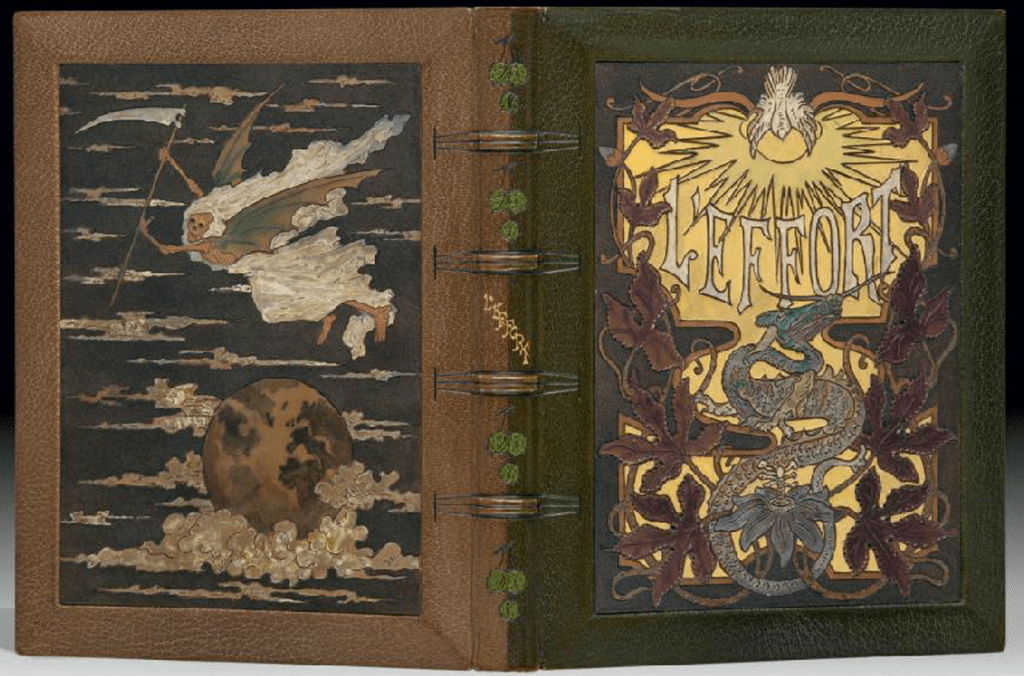
To place Charles Meunier (1866-1948), and to understand the singular position he holds in French binding, one must first accept an idea that the “good taste” of his time condemned: that a design can be conceived quickly, can aim at novelty, and can still claim the rank of a work of art. Apprenticed to Bénard at the age of eleven, Meunier worked until the 1920s, and he still leaves an impression today through the boldness of his work. There, already, is the signature of a temperament: not a conservator of fine craftsmanship, but a man in a hurry to impose a manner.

After that apprenticeship with Bénard, where he stayed until he was sixteen, he became a journeyman with Domont, then with Maillard, and finally with Marius Michel, whom he left at twenty to set up on his own. Everything about him, one senses, had to go fast, very fast. Established, yet still in his twenties, he naturally struggled to stand apart from the style of his last employer, Henri Marius Michel, who then ruled over Parisian creation: ornamental flora, plant motifs, incised leather. But the man, as we shall see, was boiling with ideas and meant to impose a style of his own. He soon became one of the standard-bearers of the emblematic binding (reliure emblématique), alongside Pétrus Ruban, and threw himself headlong into numerous experiments, some of them hazardous, because, as Devauchelle stresses, his rapid apprenticeship left him no “time to perfect himself or to acquire all the mastery of which he was capable.” Here, from the outset, is the tension of an entire body of work: the fever of the creator set against the patience the trade demands.

Never mind the reservation: Charles Meunier teemed with ideas, and as Devauchelle again reports, he kept saying, “I haven’t the time for that, for I mean to produce, if I so please, one design a day.” The line could have been mere bravado; it was a programme. His output was indeed colossal: in 1897 Beraldi already put it at five or six hundred pieces. He also published, over twelve years, seven albums of one hundred plates each reproducing his best work (1893-1905); the albums were printed in one hundred copies and put on the market. That a craftsman should think to archive and circulate his own output says enough: he saw himself as a practitioner and, beyond that, as a school unto himself.

Charles Meunier was a great binder, and he also had a head for business. A colossal output, albums put on sale: he moved from 3 rue de la Bienfaisance to 75 boulevard Malesherbes (an address occupied, as this was written, by the engraver Benneton), where he had a magnificent shop that would house his publishing house and his review L’Œuvre et l’image. One recognizes a trait I have already described elsewhere in Octave Uzanne: that of the bibliophile who refuses to separate the object of commerce from the object of worship, and makes the shop a manifesto. Nobody should be surprised, then, that where many binders of the day sought recognition at the world’s fairs, Charles Meunier refused to compete at the one of 1900: partly because he did not think he could win the grand prize, but also, he added, for a reason worth a whole treatise on offended aesthetics: “Why would you have me pay 750 francs per square meter to show my bindings in display cases lost in the middle of the paperbound-books section, killed by that icy setting of white and black that drives the visitor away! The day there are 400,000 people at the Exposition, you find two of them in front of the bindings… and those two are binders!” There is, in this calculated disdain, more than a sulk: an art’s refusal to let itself be relegated, the conviction that binding has no need to beg for its place in a setting that “kills” it.

While continuing to practice and create, he explored other directions: he went further than Lortic by publishing his own books, whose deluxe copies he clothed in his characteristic designs. The first volume published and bound in this way was Les Fleurs du Mal, illustrated by Carlos Schwabe in 1900. Rather in the manner of Octave Uzanne, he founded in November 1900, with Léon Berubé, L’Œuvre et l’image, a monthly review of contemporary art and the illustrated book, which ran until September 1902; in 1904 it became the quarterly Les Arts bibliographiques, devoted to contemporary literature, technique and the arts of the book, and it stopped in December 1907. It carried articles on binding, of course, but also on engraving, on papermaking, and bibliographical news, all lavishly illustrated. He even pushed the logic as far as holding a public sale of part of his library: fifty volumes… bound by his own hand, on 21 November 1908.

He was a jack-of-all-trades, as we see, and he had firm opinions. Annoyed by the theses Beraldi developed in La Reliure du XIXᵉ siècle, he published in reply Les Réflexions d’un praticien en marge de « La Reliure du XIXᵉ siècle » de M. Henri Beraldi. As in Beraldi’s work, it runs to four volumes, a symmetry that in itself sounds like a challenge. According to Devauchelle, Meunier there “dissects the bibliophile’s work, picks out every error, page by page, and takes a malicious pleasure in inflating the most insignificant ones in order to discredit the author, who had the finesse to feign indifference.” In another work, Paroles d’un praticien pour l’art et la technique du relieur-doreur, he attacks the methods of the Estienne school in Paris. The man takes sides, as we see; and he gave lectures to defend his ideas, at the Grolier Club in New York in 1906, but also in Paris and Amiens. Then he retired in 1920, after organizing a second sale that was a kind of liquidation of all his activities: he put up for sale his binding workshop, taken over by Conil and Septier, who came from Marius Michel’s, and all his books, even those still in progress, stripped of their paper wrappers, sewn, or ready for gilding. He died in November 1948.

Let us now judge on the evidence, as befits the Inspection. Charles Meunier was an exceptionally gifted binder: his bindings resemble no others, and few French binders can be said to be the same, certainly not Capé or Trautz, for all their immense talent. His bindings can be identified at first glance, as can his collaboration with Carlos Schwabe, which also left a definitive mark on the history of Les Fleurs du Mal. It was the Geneva bibliophile Frédéric who introduced them, and their collaboration lasted a dozen years. Charles Meunier had already bound editions of Les Fleurs du Mal, but with his own edition he naturally surpassed himself: its execution took nearly four years. Bibliophiles will also note the extraordinary and unique set of the Œuvres complètes of Victor Hugo (Paris, J. Lemmonyer, G. Richard et Cie, Émile Testard, 1885-1895), in forty-five quarto volumes bound by Charles Meunier in claret morocco, with ninety incised and tinted leather panels in all set into the covers, where one can read two portraits of Victor Hugo and several emblematic characters of his work, down to those pearly reflections of which Meunier had the secret. This is the kind of undertaking before which praise bows: not a binding but a cathedral of leather.

For the Guild’s expert, this series moreover poses a textbook case. Charles Meunier bound three copies of this edition, three of the fifty copies on Japan paper, but he signed only number 3, which is also the only one on which he took care to sign and date each piece of leather. Number 1, belonging to the Lyon booksellers Bernoux, Cumin and Masson, was shown at the 1900 Exposition Universelle and sold for 100,000 gold francs. Number 2 was in the library of the Lille bibliophile Hector Franchomme. As for number 3, it went through the fire of the auction room on 7 April 2011 at Aguttes in Lyon: estimated at €35,000 / €50,000, it was knocked down at €163,485. Emboldened by that success, it reappeared at Artcurial in Paris on 14 June 2017, this time as lot 38 and under a far more ambitious estimate of €180,000 / €200,000… where it went unsold, for want of a bidder. Fashions have their whims, and auctions their sulks: the same object, hammered down without difficulty at a reasonable price, is shunned as soon as it is given airs. The cathedral of leather has returned to the shadows. But a copy signed and dated by Meunier’s own hand, of such an edition, has never had to fear oblivion; it merely waits, like all great things, for the patience to return.

Meunier was, at bottom, neither a devotee of the past nor a gratuitous iconoclast. By wanting a design a day, by publishing his own books, by founding his reviews, by feuding with Beraldi and the Estienne school, he made speed a doctrine and daring a method. Where others sought mastery in slowness and recognition in official display cases, he preferred risk, controlled quantity, and a signature recognizable among all others. That is why, a century later, his bindings are recognized at a glance where so many irreproachable works blur together. The Inspection takes note: well-conducted heresies always end up entering the canon.

Sources: Devauchelle, Fléty, Wikipedia; Henri Béraldi, La Reliure du XIXᵉ siècle (Paris); by Charles Meunier himself, Les Réflexions d’un praticien… and Paroles d’un praticien pour l’art et la technique du relieur-doreur; and, for the auctions, the Aguttes catalog entry (7 April 2011) and the Artcurial entry (Paris, 14 June 2017, lot 38, unsold).

Be the first to comment

Leave a Reply

Your email address will not be published.