Dear bibliophiles, good day.
By Alcide Raturon, perpetually provisional secretary of the Guild, in charge of awkward comparisons, defensive enthusiasms and the statistics one consults with a frown.
An old library, looked at from the side of its materials, is a herd. Goats, calves, sheep, sows, and a few more singular boarders of whom I shall speak at the end of this column, because the worst guest is always kept for dessert.
Let us first set out the hierarchy as three centuries of catalogues have fixed it and as prices still recite it.
At the summit, morocco: the goat, whose proud grain and deep dye have made it the garment of great occasions. Its rating is the only one that runs away with itself. With text and condition equal, a copy easily doubles or triples its price in passing from sheepskin to morocco, and catalogues pronounce the word with a relish they show nowhere else.
Then comes calf, the honest man of the shelf, which was in the classical age what the grey suit is to shareholders’ meetings: the uniform of respectability.
Then sheepskin (basane), the sheep, eternal third, whose very name serves as a reservation in a description. “Modest binding,” one says, and the sheep has carried for three centuries the modesty that was sewn onto it.
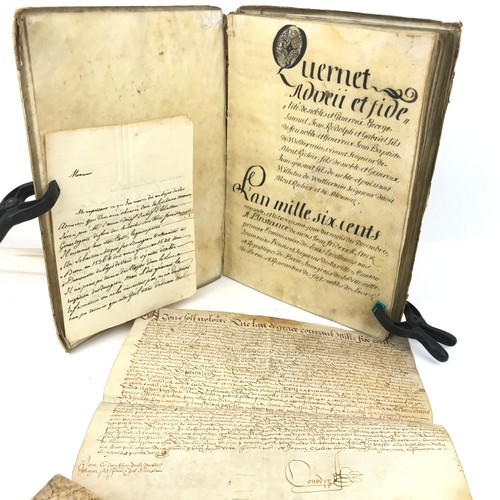
Lower still, pigskin, relegated to Germanic curiosities, and vellum, those whitish, cockled bindings that the French amateur regards while wondering what they are for.
The French reference is less peremptory, and it must be given its due.
Christian Galantaris, in his Manuel de bibliophilie, ranks copies in eight degrees:
At the first, the modern binding with short margins, on browned or foxed paper.
At the second, the modern binding with medium margins.
At the third, the old sheepskin binding, smooth spine or raised bands, undecorated or discreetly ornamented.
At the fourth, the old binding of ivory vellum, limp or with rigid boards.
At the fifth, old calf: brown, marbled, tree-calf, blond.
At the sixth, old morocco, Jansenist or with three gilt fillets.
At the seventh, morocco with dentelle borders, with coats of arms, with a super ex-libris.
At the eighth, the mosaic binding.
Let us hold on to the fourth degree: in Christian Galantaris, vellum comes ahead of sheepskin… and I believe we all agree with the master. The sow, for her part, appears nowhere in the scale, which is a politer way of showing her the door. Wrongly.
Here now is the second ranking, the one nobody displays, which orders the same skins by their sole capacity to last. First: pigskin. Second: vellum. Third: morocco. Fourth: calf. Last, and by a long way: sheepskin.
The two lists read almost backwards from one another.
Under the microscope, sheep is the worst-built of binding skins. Its grain layer alone takes up more than half the thickness, the glands that riddled it vanished in tanning and left a sponge, and the lower layer, loose and hollow, holds together only by fibres that the wool prevented from interlacing.
From this architecture follows the fault that every bookseller describes ten times a week without knowing he is describing anatomy: sheepskin “skins itself” (s’épiderme): its surface peels off in plaques from what lies beneath. Add the aggravation, which is a scandal of the late nineteenth century: leathers tanned with mimosa, whose condensed tannins fix the sulphuric acid of urban air and digest themselves by hydrolysis. This is red rot (la maladie rouge), which has reduced whole shelves of bindings to powder. Leather was industrialised at the very moment when it was being asked to last.
The sow is the exact opposite, and nobody takes account of it. A thick, hard skin with a triangular grain, it is frequently prepared not by tanning but by alum tawing, and tawed skins count among the most stable ever produced. The German pigskin bindings over wooden boards, those made between the middle of the sixteenth century and the middle of the seventeenth, stand today upright, flat and legible, their blind stamping still sharp, while the sheepskin of their Parisian great-great-grandcousins crumbles to dust.
And here is why the sow stays in last place: she is too stiff and too pale to be gilt. She refuses gold.
Vellum is the second defendant in this mock trial. An untanned skin, it is structurally out of reach of red rot: one cannot hydrolyse a tanning that never took place. Resistant to wear, it keeps the shape it was given in drying, and it supplied the most brutal proof of its worth where nobody expected it: in the Florence flood, the limp vellum bindings took the disaster without passing it on to the text block they enclosed. They rotted in the act of protecting.
Its fault is real and unique: vellum drinks the moisture of the air and cockles, which has the unpardonable drawback of being visible from afar. As for its price, it says nothing of its quality and everything of its past. Limp vellum was often, after the invention of printing, the binding of waiting and economy, the one a book was given before a proper binder took it in hand.
Morocco, king of skins, is dear because the goat came from far away, from the Levant and then from Barbary, whence the name. It happens that it is also excellent (close fibre, resistant grain, steady colour, centuries on the clock), but the market had not foreseen this and learned it after the fact. For pigskin and vellum, it never learned it.
I come to the guest at dessert, whom I ask to be forgiven for serving with tongs. There exist, at the extreme margins of this market in skins, bindings that owe nothing to the herd: the so-called anthropodermic bindings, in human skin. Whatever the amateurs of shivers may hope, the affair is less gothic and more bourgeois than one dreams. The vogue was above all medical and fin-de-siècle, practitioners having a treatise bound in the skin of departed subjects, out of a positivism that took itself for homage. For a long time these objects circulated at the price of curiosities, half whispered and half displayed, their rarity silencing the rest.
Then the laboratory came along, and I enter two sets of facts in the file, for they tell everything about our age and a little about the one before.
The first is statistical, hence to my taste: of the thirty-one copies reputed human that the American census programme submitted to spectrometry, eighteen were and thirteen were not. Calf, sheep, goat and pig, in short the complete farm, which leaves one pensive about three generations of experts who recognised human skin by eye and by touch.
The second is moral: the institutions that held authentic ones have begun to withdraw them from consultation, and one of the largest American university libraries has had removed the binding of a work on the destiny of the soul, in which a French physician had, in the last century, covered his copy with the skin of a woman patient who died in a hospital, and whom nobody had thought to consult.
Prices pass, herds remain, and the best ranked are not always those that stay standing. Nevertheless, one must take care not to “rank” too much, and many a pretty gilt vellum has in my eyes more qualities than shiny moroccos.
Editor’s note. The eight-degree scale is that of Christian Galantaris, Manuel de bibliophilie. The ranking by sturdiness is not our own invention: the report of the Society of Arts on binding leather, of which Leather for Libraries (1905) is the public version, gives it in so many words and puts pigskin first (“the strongest leather made is pigskin”), the goat coming only third. The structural fragility of sheep (spongy grain layer, loose dermis, tendency to peel) and the stability of alum-tawed skins are documented in the conservation literature, and French restorers describe it in the same terms: sheep leathers “have a lamellar structure and tend to flake off” (« ont une structure lamellaire, ont tendance à se desquamer »). Red rot strikes by preference the nineteenth-century leathers tanned with condensed tannins.
The limp vellum bindings of the Biblioteca Nazionale in Florence suffered the damage of the 1966 flood without passing it on to the text blocks.
Anthropodermic bindings really did exist, chiefly in nineteenth-century medical circles. The Anthropodermic Book Project submitted 31 of the roughly 50 copies reputed to be such to peptide mass fingerprinting (PMF): 18 were authenticated as human, 13 as animal skin.
In March 2024 Harvard had removed the binding of Des destinées de l’âme by Arsène Houssaye (1879), covered by Dr Ludovic Bouland in the skin of a woman who died in hospital, taken without consent.
GUILDE · AR/TROUPEAU
Document classified: restricted circulation.
Si cette chronique vous a plu : recevez trois nouvelles par semaine — livres rares, reliures, enchères, et les Dossiers IGLI. 18 ans d'archives, quelques milliers de lecteurs.
Pas de pub, pas de revente de données. Désabonnement en un clic.
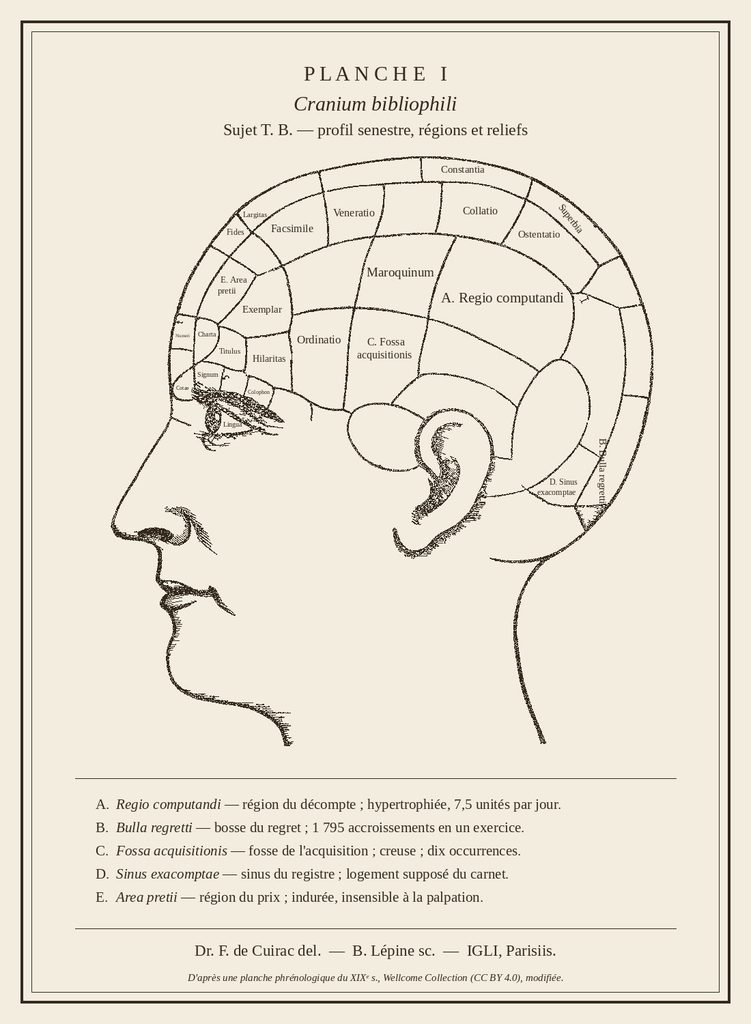
IGLI Clinical Files: Thierry B., the Man Who Counted the Books He Did Not Buy


Leave a Reply