By Hugues Ouvrard, custodian of the Guild’s chronicles, receiver of correspondence and answerable for everything published under names other than his own, and for nothing said in it.
Never having been co-opted, he appointed himself to this post; nobody objected.
There are purchases one prepares, watches, notes in a notebook (or a digital alert) while waiting for the occasion. And there are those that fall on you while you are talking about something else.
I had a lunch appointment with Nicolas M., a bookseller in the sixth arrondissement of Paris. We were in his shop, seated, talking about everything and nothing before going out — those pre-lunch conversations that always run twenty minutes longer than planned. He faced me. Behind him, in the bookcase, at shoulder height, stood a board of black morocco, set face-on, framed by gilt fillets, and in the centre two letters: O. H.
I stopped listening.
Ouvrard Hugues, yes well, everybody knows by now. In that order, the order of the civil register, of ledgers and roll calls. Two gilt letters on a black board, thirty centimetres from Nicolas’s back, as he went on talking to me without suspecting that the conversation was over. 😊
I asked him to turn round. I asked him whether it was deliberate. Had I not known Nicolas, I would have had my doubts, but with him, no “Malaise”… There is no chance, only appointments, and in my mind I had already acquired the book before knowing what it contained. I bought it before going out to lunch. It helps the digestion.
The book? Don Quichotte en images (Don Quixote in pictures), by Edmond Morin, published in Paris by Arnauld de Vresse, 55 rue de Rivoli. Convenient, for a great text. It is an oblong album, all plates, in which the knight receives and hands out blows of the cudgel with a generosity that never flags — the caption of one of them announces bluntly that the hero and his squire are beaten by Yanguesan muleteers, and the image keeps the promise.
Morin is an illustrator one meets everywhere in the nineteenth century and about whom little is said: L’Illustration, Le Monde illustré, children’s albums, Norman beach scenes. His Don Quixote is all movement, drawn broadly, without Doré’s monumental seriousness. It is an album for laughing, not a monument.
The copy was bound later: black morocco slipcase, black chemise, gilt fillets in a frame, a dos long spine fully decorated, a red morocco title label, inside dentelle. The publisher’s illustrated cover, green, has been kept — which, for this kind of cheap publication meant to be destroyed by children, is the real luxury of the copy. And on the board, these two initials, gilt-tooled with a small iron, in a sober typeface.
Someone paid to have a picture album dressed like a serious book, then had his name put on it. It is exactly the kind of gesture I understand. I paid for the same thing.
Out of laziness and lack of humility, I posted the book in the Facebook group “Le coin du bibliophile”, asking whether anyone had an idea of the owner. The answer was immediate and, let us say, not entirely scientific.
Matthieu opened the ball seriously: Octave Homberg? Octave Hamelin? Then Philippe, an administrator of the group, wrote “Ouvrard Hugues…..” followed by an emoji crying with laughter, and six people approved, which shows I am very badly surrounded.
Then, bibliophiles being facetious (there is an idea for an article, by the way: “why are serious bibliophiles deadly boring?”), various opinions were expressed.
Benoît proposed Octave Huzanne, which would make the copy a major piece for the history of nineteenth-century bibliophily. Jonathan suggested Orsène Houssaye. Arnaud regretted that it was not a book about wigs, which would have let us read the monogram as On Hair. I proposed Ouictor Hugo…
Since then I have carried on alone, without an audience, which is the first symptom.
There is Oustave Haubert, whose Hadame Ovary went before the criminal court and never quite recovered. Onoré de Halzac, dead of too much coffee and too little sleep, who would have had the album bound before paying for it. Omile Hola, author of J’Haccuse, who would at least have checked the collation. Oscar Hilde, who had only his genius to declare at customs and a black morocco binding to have put on it. And the likeliest of all, Odmond Horin, the illustrator himself, who would have bought his own album to check that it had been properly printed.
There remains Oiguel de Hervantès, who would have bought back his own book to see what had been made of it, and would not have been pleased.
One can play at this a long time. It is even the main use of two nameless letters: they belong to nobody, so they belong to everybody.
Once the laughing is done, there remains Octave Homberg.
The name is the only one on the list that stands up: a real collector, a man whose sales mattered, and initials that match. But matching is not proving. A gilt monogram in the centre of a board, without bookplate, without sale mark, without stamp, without manuscript note, without a catalogue in which to find a description of the binding, proves strictly nothing. There have been thousands of O. H.’s, and most never had anything bound but their missal.
I have, for the moment, no trace that would allow me to attribute this copy to anyone. If someone recognises the binder’s hand, or remembers seeing this album pass through a sale, that information interests me far more than my own jokes.
I did not buy it for Morin, whom I like without seeking him out. I did not buy it for Cervantes, of whom I already have a few copies that ask nothing of anyone. I bought it because an unknown person, more than a century ago, had two letters that speak to me put on a black board.
It is a ridiculous reason. It is also, if we are honest, one of the only reasons for which people actually buy old books: coincidence, encounter, the absurd and tenacious feeling that the object was waiting for you. We dress it up afterwards with considerations of rarity, condition, provenance. But at the moment the hand reaches out, there is only that.
The true owner of these initials remains unknown. Until he is found, the copy is at my house, and the letters are in the right order.
We did end up going to lunch. I paid for the book before the meal, which is as good a way as any of ordering one’s priorities.
Thanks to Nicolas M., who did not know he was keeping my name behind his back.
GUILDE · HO/O.H.
Reference assigned by the custodian, who did not resist. Document classified: restricted circulation.
La lettre du bibliophile
Si cette chronique vous a plu : recevez trois nouvelles par semaine — livres rares, reliures, enchères, et les Dossiers IGLI. 18 ans d'archives, quelques milliers de lecteurs.
Pas de pub, pas de revente de données. Désabonnement en un clic.
By Barthélémy d’Arcole, Inspector of Bibliophilic Aesthetics and Modern Heresies to the Guild of Bibliopolicés.
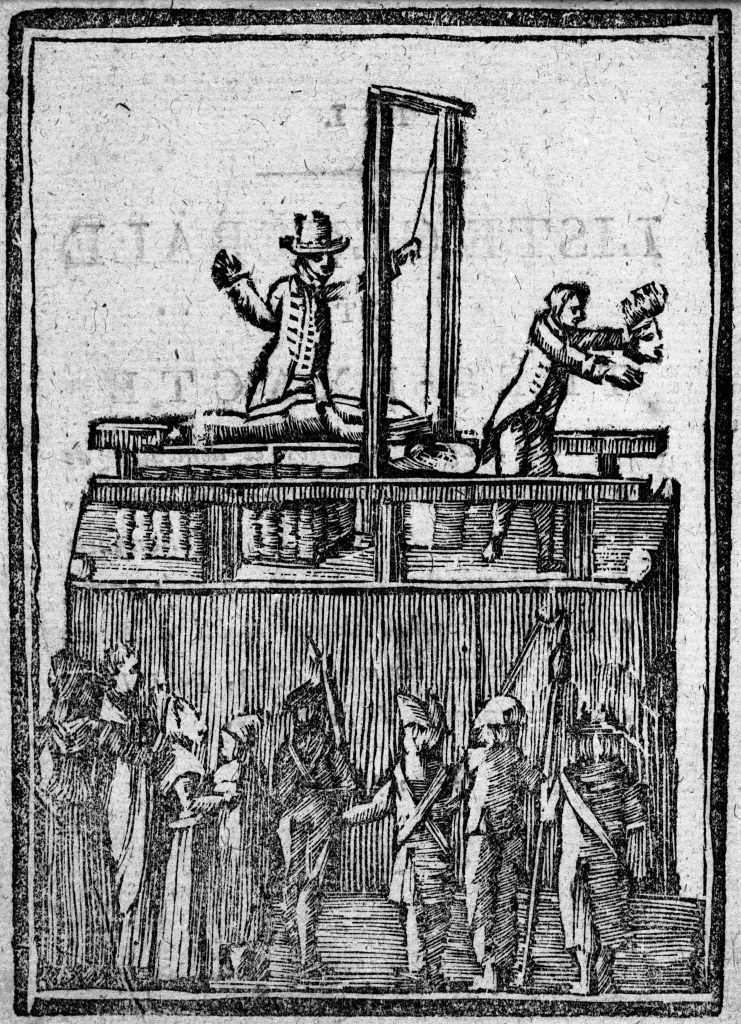
There is, in the history of French bookselling, a spring that nobody celebrates. It is the spring of Year II of the Revolutionary calendar. Between January and May 1794, in the weeks leading up to the fall of Robespierre, five Parisian book dealers went to the scaffold for doing what their trade had taught them to do: print, sell, ship, display in the shop window. None of them had taken up arms. None had conspired. All kept shop at the Palais-Royal, on the quai des Grands-Augustins, or in the Saint-Honoré quarter. The offence held against them was not plotting but having let printed sheets circulate. The indictment was not about their deeds but about their catalogues. They were condemned as booksellers.
The names are little known, and even well-informed bibliophiles meet them only in a footnote in Mellot, or in the work of Annie Duprat, on which I draw here. They are: Jacques-François Froullé, printer-bookseller on the quai des Grands-Augustins; Thomas Levigneur, his occasional partner, who set up shop within the very galleries of the Convention; François-Charles Gattey, bookseller at 14 Palais-Royal; Michel Wébert, bookseller and dealer in caricatures, also at the Palais-Royal; and finally a woman of whom the archives have kept only the name of a widow, la veuve Lesclapart, bookseller in Paris. Five people, five fates, one era and, give or take a few weeks, the same end.
Three of these five booksellers fell for the same book. It is a pamphlet that every eighteenth-century enthusiast should know, if not as a bibliographical object then at least as a historical document: the Liste comparative des cinq appels nominaux faits dans les séances des 15, 16, 17, 18 et 19 janvier 1793 sur le procès de Louis XVI [Comparative list of the five roll-call votes taken in the sessions of 15–19 January 1793 on the trial of Louis XVI]. The title looks dry. The contents are less so. It is a compilation of the votes of the deputies of the Convention on the death of the king, accompanied by a Relation des vingt-quatre heures d’angoisses qui ont précédé la mort de Louis XVI [Account of the twenty-four hours of anguish that preceded the death of Louis XVI] and by a footnote, modest in appearance, that would feed a French legend for two centuries: that of the “majority of a single vote”.
That footnote, more than anything, is what condemns. Royalists found in it the proof that the king had been murdered by a procedural stroke and not by the will of the people. The revolutionary authorities saw in it a manoeuvre, and the most dangerous of all, since it struck at the very legitimacy of the regicide. The pamphlet was printed by Froullé and Levigneur as early as April 1793. It spread. It travelled. Levigneur admitted having sold it openly at the door of the Convention, under the eyes of the people’s representatives, adding that after a few reproaches he had withdrawn it. Froullé, more deeply involved, confessed to having disposed of two thousand copies. Asked why he had not read the Relation des vingt-quatre heures before inserting it, he answered simply that he had not thought it dangerous, “by virtue of the freedom of the press”.
The argument carried little weight. The law of 29 March 1793, whose reach Froullé had perhaps not measured, imposed the death penalty on the authors and distributors of writings tending to restore the monarchy. Both booksellers were arrested on 8 Ventôse, Year II. Fifteen copies of the Liste were found at Froullé’s, along with twenty-seven suspect pamphlets and, a detail that did not help, a packet of cartridges. They were guillotined on 13 Ventôse, Year II (3 March 1794).
François-Charles Gattey did not fall for the Liste. He fell for the Actes des Apôtres, the great royalist journal launched in 1789 by Peltier, Suleau and their friends, of which he was the appointed publisher. Gattey was no latecomer to trouble with the Revolution. He had been at odds with the book-trade authorities since before 1789, and had even known Charenton for breaking the rules of the trade, which made him, in the profession, one of those disreputable booksellers whom the whole Palais-Royal knew. In May 1790 the commissioner Toublanc seized six packets of the Actes des Apôtres in his shop. An anonymous pamphlet appeared shortly afterwards under the eloquent title L’aristocratie du libraire Gattey punie par le peuple ou supplice des Actes des Apôtres [The aristocracy of the bookseller Gattey punished by the people, or the torment of the Acts of the Apostles].
Gattey carried on. He published, he sold, he distributed. The Revolution hardened around him and he changed nothing in his trade. Arrested in Year II and tried for active royalist propaganda and for supposed links with the counter-revolutionary networks of the colonies (he had correspondents in Saint-Domingue and in the Île-de-France), he went to the scaffold on 25 Germinal, Year II (14 April 1794). His case illustrates a second category of hunted bookseller: no longer the distributor of one particular text, but the merchant identified with an entire catalogue.
That leaves the last two. Michel Wébert, bookseller at the Palais-Royal, a native of Saverne, sold royalist caricatures, some of them engraved in such a way that weeping willows and funerary urns encoded tributes to the beheaded king. The veuve Lesclapart, of whom almost nothing is known, kept a shop in Paris. Both were guillotined on the same day, 20 May 1794. The charge against Lesclapart is laconic: having sold the Liste comparative. Having sold. Not printed. Not distributed through a network. Sold, as a bookseller sells whatever is on the shelves of her shop.
For the bibliophile, the name Lesclapart is not neutral. Under the Ancien Régime, Pierre-Antoine Lesclapart had been “marchand relieur-papetier-colleur et en meubles privilégié suivant la Cour” [merchant binder, stationer, paper-hanger and furnisher with a privilege to follow the Court]. At his death, around 1781, the privilege passed to Honoré-François Jollivet. Now this same Jollivet wrote to the Convention twelve years later, offering to strip the gold of the royal arms from the volumes of the Bibliothèque nationale at the rate of two sols a volume. Whether or not the widow Lesclapart guillotined in 1794 was the direct widow of the former binder to the Court (the Paris archives, largely destroyed in 1871, do not allow a formal answer, and the hypothesis would need checking in the central records of the notaries), the name alone is enough to draw, across the revolutionary decade, a strange symmetry. On one side of the privilege, a man prospers by offering to undo the bindings he was commissioned to serve. On the other side of the same name, a woman dies for having sold, as she had always done, what her shop sold. The coincidence of names here looks like a judgment.
It remains to understand why these five booksellers, and not the many others whose shops were searched between January and May 1794, went to the guillotine. The booksellers Garnéry and Desenne, suspected of the same complacencies, were released shortly after Thermidor. The distinction lies not in the gravity of the trade but in the moment of the arrest. Froullé, Levigneur, Gattey, Wébert and Lesclapart fell within the narrow window between the law of 29 March 1793, which made royalist propaganda a capital offence, and the fall of Robespierre on 9 Thermidor. A few weeks more, and they would have come through as Desenne and Garnéry did. A few weeks less, and the law would not yet have been passed.
The lesson, for the bibliophile, is archival rather than political. Books outlive their sellers. The Liste comparative can still be found today at the Bibliothèque nationale de France (shelfmark Lb41 354) and turns up regularly at public sales, with no catalogue mentioning that it cost five heads to those who circulated it. The copies of the Actes des Apôtres still met with in the trade rarely bear any trace of their executed publisher. For Wébert and Lesclapart it is worse: their stock was dispersed without any bibliographical note preserving their names beyond a mention in Mellot. The book survives. The bookseller passes.
Five guillotined in four months, for a few printed items. It is little, set against the 17,000 victims of the Great Terror. It is a great deal, set against a trade whose Parisian shops numbered a few dozen among practising printers, and a few hundred at most among all the merchant booksellers. And it is enough to be remembered, in a milieu that by tradition prefers its glorious binders to its martyred booksellers.
Principal sources: Annie Duprat, “Un réseau de libraires royalistes à Paris sous la Terreur”, Annales historiques de la Révolution française, no. 321, 2000, pp. 3-26. Jean-Dominique Mellot and Élisabeth Quéval, Répertoire d’imprimeurs-libraires XVIᵉ-XVIIIᵉ siècle, Paris, BnF, 1997. Archives nationales, W 332 (Froullé/Levigneur file) and W 345 (Gattey file).
Nous utilisons des cookies pour mesurer l'audience du site et améliorer votre expérience de lecture. En continuant à naviguer, vous acceptez ces cookies. Vous pouvez à tout moment ajuster vos préférences.
ID used to identify users for 24 hours after last activity
24 hours
_gat
Used to monitor number of Google Analytics server requests when using Google Tag Manager
1 minute
_gac_
Contains information related to marketing campaigns of the user. These are shared with Google AdWords / Google Ads when the Google Ads and Google Analytics accounts are linked together.
90 days
__utma
ID used to identify users and sessions
2 years after last activity
__utmt
Used to monitor number of Google Analytics server requests
10 minutes
__utmb
Used to distinguish new sessions and visits. This cookie is set when the GA.js javascript library is loaded and there is no existing __utmb cookie. The cookie is updated every time data is sent to the Google Analytics server.
30 minutes after last activity
__utmc
Used only with old Urchin versions of Google Analytics and not with GA.js. Was used to distinguish between new sessions and visits at the end of a session.
End of session (browser)
__utmz
Contains information about the traffic source or campaign that directed user to the website. The cookie is set when the GA.js javascript is loaded and updated when data is sent to the Google Anaytics server
6 months after last activity
__utmv
Contains custom information set by the web developer via the _setCustomVar method in Google Analytics. This cookie is updated every time new data is sent to the Google Analytics server.
2 years after last activity
__utmx
Used to determine whether a user is included in an A / B or Multivariate test.
18 months
_ga
ID used to identify users
2 years
_gali
Used by Google Analytics to determine which links on a page are being clicked


Leave a Reply