By Olympe Marcelet, inspector of platforms, emphatic keywords and the priced miracles of the digital bibliophilic market.
I came across it 3 times in under a year on the Alde website (Alde is a Paris auction house specialising in books), always under the same title. The Description des festes données par la ville de Paris, issued for the marriage of Louise-Élisabeth of France to the Infante Philip, is a large folio printed by Le Mercier in 1740, with the 2 views of the fireworks fired over the Seine and of the illuminations of the Hôtel de Ville.
The copy is a presentation copy, bound in red morocco for the city itself. I opened the 3 catalogue entries side by side: same joints, split and restored, same consolidated tear at leaf A1. The book has not moved from one sale to the next. Its estimate has. It lost 1,000 euros at each passage, and on 4 June 2025 it went for 2,000 euros hammer price, 2,500 fees included. The page for lot 86 is still online on Alde’s website.
Alde, sale of 4 June 2025, lot 86. DESCRIPTION DES FESTES données par la ville de Paris, à l’occasion du mariage de Madame Louise-Elisabeth de France et de Dom Philippe, Infant et Grand Amiral d’Espagne. “Paris, P.-G. Le Mercier, 1740. Large folio, red morocco, gilt fleur-de-lis roll, fleurs-de-lis at the corners, gilt arms at the centre, spine decorated with fleurs-de-lis, decorated board edges, gilt inner roll, gilt edges (contemporary binding). […] Presentation copy luxuriously bound in red morocco with the arms of the city of Paris. Joints partly split and restored, headcaps and corners worn; some stains, foxing and slight dampstaining of no consequence; repair at the foot of a plate, consolidated tear at leaf A1.” Estimate: 2,000 – 3,000 €. Sold: 2,000 €. See the lot page on Alde’s website
The entry gives the estimate, the hammer price, the condition of the joints. It does not give the figure that weighed on everything else, the reserve, which the room never hears.
The French Commercial Code provides for it in article L. 321-11: “the minimum price agreed with the seller below which the property cannot be sold.” If the property has been estimated, this price cannot exceed the lowest estimate announced to the public. The text obliges no one to publish the amount, nor even to set one: the reserve is agreed between seller and auction operator, lot by lot, and it may sit right at the low estimate or not exist at all. That of the festival book is impossible to know, as is whether there was one. I know only that it could not exceed the low estimate, and that this ceiling went down from 4,000 to 3,000 and then to 2,000 euros in 3 passages.
I wanted to know whether this festival book was alone on that slope. In the same sales, Frederik Ruysch was following it down. His Thesaurus anatomicus, printed at Amsterdam from 1701 to 1716, 10 parts in one quarto volume bound in vellum, was estimated at 5,000 to 6,000 euros on 30 January 2024 and found no buyer.
It came back on 20 June at 3,000 – 4,000 euros, under the same entry down to the pale dampstain on pages 55 to 58 of the ninth part, and it went for 4,250 euros, fees included.
Barbey d’Aurevilly fell more steeply. The first edition of Une vieille maîtresse (Cadot, 1851, 3 volumes bound in 2, half green calf, in a slipcase), estimated at 5,000 to 6,000 euros on 26 March 2024, was not sold. Back on 17 December at 2,000 – 3,000 euros, it went for 2,500 euros, fees included. The low estimate had been divided by 2.5, and the ceiling of the reserve with it.
These 3 books do not make a market. Alde publishes its results lot by lot (and my thanks to them for that), with the estimates, and the entry does not change when the book comes back: all it took was to count. I went through all its sales from January 2024 to September 2026 and looked for books estimated at 1,000 euros or more, left without a buyer, then put back on sale under the same entry. There are 96. The evening went on it.
For 89 of them, the low estimate fell on their return, for 6 it did not move, for one alone it rose (“if it goes, it goes”). In median value, the low estimate of the second passage is worth two thirds of the first. Of these 96 books, 59 sold the second time, 56 of them with the reduced estimate, and 37 went unsold once more. Of the 7 books that came back at the same price or higher, only 3 found a buyer. Whoever keeps an eye on an unsold book will therefore, most often, get it cheaper on its return. A risk worth taking?
One of these 96 made me look up. The 1942 Voyage au bout de la nuit illustrated by Gen Paul, in wrappers and unopened, was estimated at 4,000 to 5,000 euros on 26 March and was not sold. On 17 December, estimated at 3,000 to 4,000 euros, it went for 5,000 euros fees included, or 4,000 euros hammer price once the 25% fees that Alde’s prices let one read are taken off. The hammer fell on the low estimate of March.
Alde gives me only columns of figures. Bibliophilie.com, for its part, has kept the trace of an older unsold lot. On 7 December 2004, at Pierre Bergé & associés, Fables choisies by La Fontaine in 6 volumes of morocco bearing arms, estimated at 7,500 euros, were declared unsold. The lot was recorded on this site in April 2013, along with 2 copies without arms sold for 6,000 euros at Piasa in 2005 and 3,600 euros at Robert-Baille in 2011.
The expert for the 2004 sale was Dominique Courvoisier.
Put yourself in the room in 2004. You have only the catalogue figure. You raise your hand, the bidding climbs, then stops without the auctioneer bringing down the hammer. It is harsh. At Drouot, the main Paris auction house, they say the lot is ravalé (bought in); the record of the sale, drawn up at the latest one clear day afterwards under article L. 321-9, declares it unsold. You made your offer in public, before the whole room, and you leave empty-handed without knowing by how much you missed your book.
The same article L. 321-9 then allows the operator, at the owner’s request, to sell by private treaty a property declared unsold, at a price that may not fall below the last bid made, unless an amendment to the mandate is signed after the sale. The last bidder must be “informed beforehand if known.” If you left your name, you will be called. If you stayed at the back of the room, with neither name nor number, no one is obliged to.
The seller, for his part, is protected. On 28 February 2017, the Paris regional court (tribunal de grande instance) condemned a sales operator who had knocked down a property below the reserve price agreed with his client. Paying the seller the difference was not necessarily enough to discharge his liability, according to the judgment. The sale was not annulled for all that, since the reserve did not appear in the catalogue and the buyer could not know it.
One does not, then, sell one’s book below one’s figure, and an operator who does so answers for it before the court.
For 2018, the Conseil des maisons de vente (the French auction regulator) recorded 35.9% of lots unsold across 670 sales by 12 operators, against 33% in 2017. It puts the blame on reserves: kept secret, they may discourage buyers; and since the buyer counts the auction fees in what he is willing to pay, he stops earlier, so that a lot with a high reserve stays unsold.
The owner who puts a book up for sale “to see” asks for a reserve right at the low estimate and takes the book back if the room does not climb high enough. Economists have followed paintings that stayed below their reserve. Sold later, they fetch less than those that were not offered in the meantime, and among the possible explanations the authors cite a reserve that the seller ended by lowering… but it is also true that a book exhibited and not sold at a sale leaves a trace, and loses value almost automatically in the age of the internet and its flawless memory.
The reserve… Wanting to sell without really wanting to?
Editors’ note. Survey of Alde’s results from 1 January 2024 to 16 September 2026; a book is counted as put back on sale when its entry is identical from one sale to the next, so the count is a minimum. Prices fees included, except the hammer price of the festival book; the hammer price of the Céline is deduced from a fee rate of 25%. Lots of 2004, 2005 and 2011: article on this site of 6 April 2013. Judgment of 2017: Conseil des maisons de vente. Unsold lots: Conseil des maisons de vente, 1 March 2019, and Marie Potard, Le Journal des Arts, 10 April 2022. Paintings that stayed below their reserve: Alan Beggs and Kathryn Graddy, CEPR working paper no. 5811.
GUILDE · OM/RESERVE
Reserve price for the present document: not disclosed. Document classified: restricted circulation.
La lettre du bibliophile
Si cette chronique vous a plu : recevez trois nouvelles par semaine — livres rares, reliures, enchères, et les Dossiers IGLI. 18 ans d'archives, quelques milliers de lecteurs.
Pas de pub, pas de revente de données. Désabonnement en un clic.
By Barthélémy d’Arcole, Inspector of bibliophilic aesthetics and modern heresies to the Guild of Bibliopolices.
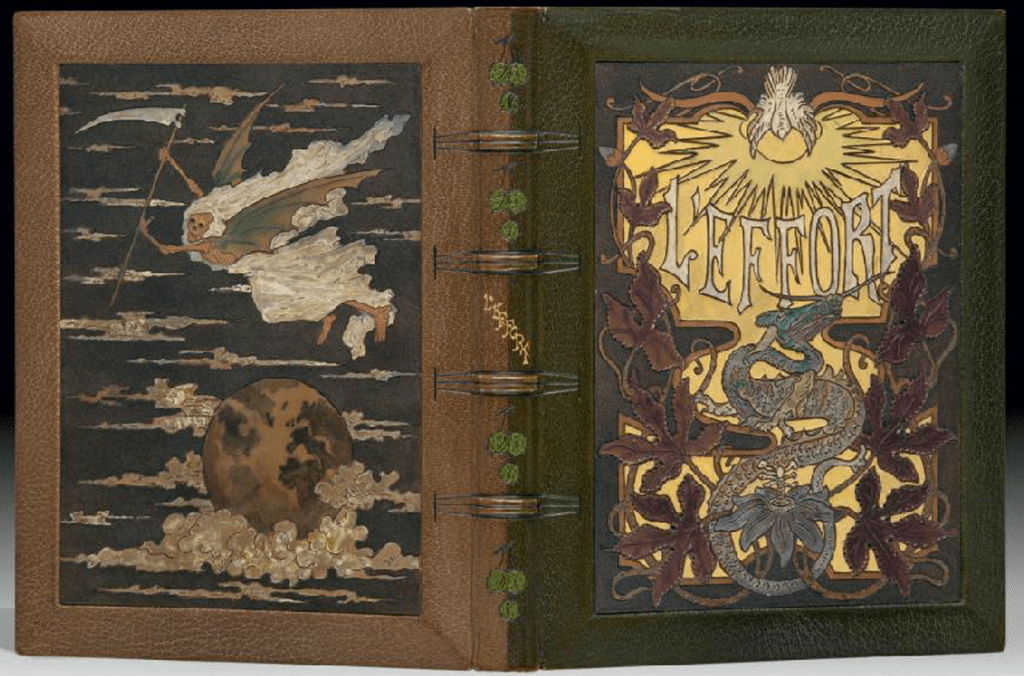
To place Charles Meunier (1866-1948), and to understand the singular position he holds in French binding, one must first accept an idea that the “good taste” of his time condemned: that a design can be conceived quickly, can aim at novelty, and can still claim the rank of a work of art. Apprenticed to Bénard at the age of eleven, Meunier worked until the 1920s, and he still leaves an impression today through the boldness of his work. There, already, is the signature of a temperament: not a conservator of fine craftsmanship, but a man in a hurry to impose a manner.
After that apprenticeship with Bénard, where he stayed until he was sixteen, he became a journeyman with Domont, then with Maillard, and finally with Marius Michel, whom he left at twenty to set up on his own. Everything about him, one senses, had to go fast, very fast. Established, yet still in his twenties, he naturally struggled to stand apart from the style of his last employer, Henri Marius Michel, who then ruled over Parisian creation: ornamental flora, plant motifs, incised leather. But the man, as we shall see, was boiling with ideas and meant to impose a style of his own. He soon became one of the standard-bearers of the emblematic binding (reliure emblématique), alongside Pétrus Ruban, and threw himself headlong into numerous experiments, some of them hazardous, because, as Devauchelle stresses, his rapid apprenticeship left him no “time to perfect himself or to acquire all the mastery of which he was capable.” Here, from the outset, is the tension of an entire body of work: the fever of the creator set against the patience the trade demands.
Never mind the reservation: Charles Meunier teemed with ideas, and as Devauchelle again reports, he kept saying, “I haven’t the time for that, for I mean to produce, if I so please, one design a day.” The line could have been mere bravado; it was a programme. His output was indeed colossal: in 1897 Beraldi already put it at five or six hundred pieces. He also published, over twelve years, seven albums of one hundred plates each reproducing his best work (1893-1905); the albums were printed in one hundred copies and put on the market. That a craftsman should think to archive and circulate his own output says enough: he saw himself as a practitioner and, beyond that, as a school unto himself.
Charles Meunier was a great binder, and he also had a head for business. A colossal output, albums put on sale: he moved from 3 rue de la Bienfaisance to 75 boulevard Malesherbes (an address occupied, as this was written, by the engraver Benneton), where he had a magnificent shop that would house his publishing house and his review L’Œuvre et l’image. One recognizes a trait I have already described elsewhere in Octave Uzanne: that of the bibliophile who refuses to separate the object of commerce from the object of worship, and makes the shop a manifesto. Nobody should be surprised, then, that where many binders of the day sought recognition at the world’s fairs, Charles Meunier refused to compete at the one of 1900: partly because he did not think he could win the grand prize, but also, he added, for a reason worth a whole treatise on offended aesthetics: “Why would you have me pay 750 francs per square meter to show my bindings in display cases lost in the middle of the paperbound-books section, killed by that icy setting of white and black that drives the visitor away! The day there are 400,000 people at the Exposition, you find two of them in front of the bindings… and those two are binders!” There is, in this calculated disdain, more than a sulk: an art’s refusal to let itself be relegated, the conviction that binding has no need to beg for its place in a setting that “kills” it.
While continuing to practice and create, he explored other directions: he went further than Lortic by publishing his own books, whose deluxe copies he clothed in his characteristic designs. The first volume published and bound in this way was Les Fleurs du Mal, illustrated by Carlos Schwabe in 1900. Rather in the manner of Octave Uzanne, he founded in November 1900, with Léon Berubé, L’Œuvre et l’image, a monthly review of contemporary art and the illustrated book, which ran until September 1902; in 1904 it became the quarterly Les Arts bibliographiques, devoted to contemporary literature, technique and the arts of the book, and it stopped in December 1907. It carried articles on binding, of course, but also on engraving, on papermaking, and bibliographical news, all lavishly illustrated. He even pushed the logic as far as holding a public sale of part of his library: fifty volumes… bound by his own hand, on 21 November 1908.
He was a jack-of-all-trades, as we see, and he had firm opinions. Annoyed by the theses Beraldi developed in La Reliure du XIXᵉ siècle, he published in reply Les Réflexions d’un praticien en marge de « La Reliure du XIXᵉ siècle » de M. Henri Beraldi. As in Beraldi’s work, it runs to four volumes, a symmetry that in itself sounds like a challenge. According to Devauchelle, Meunier there “dissects the bibliophile’s work, picks out every error, page by page, and takes a malicious pleasure in inflating the most insignificant ones in order to discredit the author, who had the finesse to feign indifference.” In another work, Paroles d’un praticien pour l’art et la technique du relieur-doreur, he attacks the methods of the Estienne school in Paris. The man takes sides, as we see; and he gave lectures to defend his ideas, at the Grolier Club in New York in 1906, but also in Paris and Amiens. Then he retired in 1920, after organizing a second sale that was a kind of liquidation of all his activities: he put up for sale his binding workshop, taken over by Conil and Septier, who came from Marius Michel’s, and all his books, even those still in progress, stripped of their paper wrappers, sewn, or ready for gilding. He died in November 1948.
Let us now judge on the evidence, as befits the Inspection. Charles Meunier was an exceptionally gifted binder: his bindings resemble no others, and few French binders can be said to be the same, certainly not Capé or Trautz, for all their immense talent. His bindings can be identified at first glance, as can his collaboration with Carlos Schwabe, which also left a definitive mark on the history of Les Fleurs du Mal. It was the Geneva bibliophile Frédéric who introduced them, and their collaboration lasted a dozen years. Charles Meunier had already bound editions of Les Fleurs du Mal, but with his own edition he naturally surpassed himself: its execution took nearly four years. Bibliophiles will also note the extraordinary and unique set of the Œuvres complètes of Victor Hugo (Paris, J. Lemmonyer, G. Richard et Cie, Émile Testard, 1885-1895), in forty-five quarto volumes bound by Charles Meunier in claret morocco, with ninety incised and tinted leather panels in all set into the covers, where one can read two portraits of Victor Hugo and several emblematic characters of his work, down to those pearly reflections of which Meunier had the secret. This is the kind of undertaking before which praise bows: not a binding but a cathedral of leather.
For the Guild’s expert, this series moreover poses a textbook case. Charles Meunier bound three copies of this edition, three of the fifty copies on Japan paper, but he signed only number 3, which is also the only one on which he took care to sign and date each piece of leather. Number 1, belonging to the Lyon booksellers Bernoux, Cumin and Masson, was shown at the 1900 Exposition Universelle and sold for 100,000 gold francs. Number 2 was in the library of the Lille bibliophile Hector Franchomme. As for number 3, it went through the fire of the auction room on 7 April 2011 at Aguttes in Lyon: estimated at €35,000 / €50,000, it was knocked down at €163,485. Emboldened by that success, it reappeared at Artcurial in Paris on 14 June 2017, this time as lot 38 and under a far more ambitious estimate of €180,000 / €200,000… where it went unsold, for want of a bidder. Fashions have their whims, and auctions their sulks: the same object, hammered down without difficulty at a reasonable price, is shunned as soon as it is given airs. The cathedral of leather has returned to the shadows. But a copy signed and dated by Meunier’s own hand, of such an edition, has never had to fear oblivion; it merely waits, like all great things, for the patience to return.
Meunier was, at bottom, neither a devotee of the past nor a gratuitous iconoclast. By wanting a design a day, by publishing his own books, by founding his reviews, by feuding with Beraldi and the Estienne school, he made speed a doctrine and daring a method. Where others sought mastery in slowness and recognition in official display cases, he preferred risk, controlled quantity, and a signature recognizable among all others. That is why, a century later, his bindings are recognized at a glance where so many irreproachable works blur together. The Inspection takes note: well-conducted heresies always end up entering the canon.
Sources: Devauchelle, Fléty, Wikipedia; Henri Béraldi, La Reliure du XIXᵉ siècle (Paris); by Charles Meunier himself, Les Réflexions d’un praticien… and Paroles d’un praticien pour l’art et la technique du relieur-doreur; and, for the auctions, the Aguttes catalog entry (7 April 2011) and the Artcurial entry (Paris, 14 June 2017, lot 38, unsold).
Nous utilisons des cookies pour mesurer l'audience du site et améliorer votre expérience de lecture. En continuant à naviguer, vous acceptez ces cookies. Vous pouvez à tout moment ajuster vos préférences.
ID used to identify users for 24 hours after last activity
24 hours
_gat
Used to monitor number of Google Analytics server requests when using Google Tag Manager
1 minute
_gac_
Contains information related to marketing campaigns of the user. These are shared with Google AdWords / Google Ads when the Google Ads and Google Analytics accounts are linked together.
90 days
__utma
ID used to identify users and sessions
2 years after last activity
__utmt
Used to monitor number of Google Analytics server requests
10 minutes
__utmb
Used to distinguish new sessions and visits. This cookie is set when the GA.js javascript library is loaded and there is no existing __utmb cookie. The cookie is updated every time data is sent to the Google Analytics server.
30 minutes after last activity
__utmc
Used only with old Urchin versions of Google Analytics and not with GA.js. Was used to distinguish between new sessions and visits at the end of a session.
End of session (browser)
__utmz
Contains information about the traffic source or campaign that directed user to the website. The cookie is set when the GA.js javascript is loaded and updated when data is sent to the Google Anaytics server
6 months after last activity
__utmv
Contains custom information set by the web developer via the _setCustomVar method in Google Analytics. This cookie is updated every time new data is sent to the Google Analytics server.
2 years after last activity
__utmx
Used to determine whether a user is included in an A / B or Multivariate test.
18 months
_ga
ID used to identify users
2 years
_gali
Used by Google Analytics to determine which links on a page are being clicked



Leave a Reply