Dear bibliophiles, good day.
By Dr. Achille Dandillot, physician-inspector in the clinical section of the IGLI, holder of a chair he created himself and that nobody thought of disputing. File no. 2, reference IGLI-DC-2/207.
The patient’s sister telephoned at ten past seven, and she spoke low. Her brother had gone onto the classifieds site the evening before just to look, and since then, nothing more. He had not dined, he had not slept. He could be heard, from time to time, repeating prices with no sentences around them: ninety euros, a thousand euros, fourteen euros eighty. Around five in the morning he had said aloud, to himself, “this one might be the one.” His sister waited two hours before calling, out of consideration for him.
I record the symptom under the name of price palilalia. The patient no longer repeats words, he repeats prices, and the price is the only element that survives from a listing stripped of its description. We had not yet met this stage in so practiced a subject.
Mr. R. is fifty-two and owns 2,000 volumes, a good part of them in period bindings. He has frequented public sales for twenty years, he reads printers’ Latin, he knows how to collate. Our services already knew him: file IGLI-DC-1/193, gallicanosis in a benign form, resolved without treatment. I add, because the diagnosis depends on it entirely, that he has never in his life bought a Jean de Bonnot.
The place where we found him has no name in our nomenclature. A plain. Or a dump; the word comes to me and I keep it.
Under the two words livre ancien (“old book”), the site’s Books section declares 545,417 listings. The same two words, entered in Antiques, give 2,859, and the first on the list is a marble clock with its urns, €130.
The vocabulary of the site comes down to four adjectives that trade places without anyone losing by it: “old” (ancien), “old” (vieux), “rare,” “collectible.” One therefore finds, on the first screen of every query and without having had to look for them, a Larousse encyclopedia set sold as old books for €10, a lot of rare old books advertised with “over 100 years old” in parentheses for €15, a rare old book of 1862 at €1,000 whose title and author are both withheld, an old book at €8 about which nothing whatever is given, and a rare old book entitled L’Éléphant rose at €14.80. Another listing offers old Victor Hugo books, sold on account of a death, without saying whose, and a pair of Art Deco bookends appears in the same category, where, admittedly, it holds something up. The patient was looking for a book printed before 1700.
The prices have no scale. A Bible in Latin, a Vulgate printed at Lyon in 1732, €90. Three lines higher, a sentimental novel of 1920, €89. Under the word incunable (“incunabulum”), 154 listings mix Gutenberg facsimiles at €100 with a Bartholomaeus Anglicus of 1525 at €2,200; university essays on incunabula appear there too, at €15, with nothing to distinguish them from the objects. Under the word bibliophilie, the very first listing, shown at €8,000, is not a sale: a bookseller is buying there, and he filled in the box because it was compulsory.
The photographs remain. Always the same one: the closed volume, laid on a flowered duvet, shot from three-quarters. Never the title page. Never the spine. The description comes down to two words, “see photos,” and there is nothing to see in the photos. I add, to no purpose, that it is often the same flowers, big pink peonies on a cream ground, and that I ended up wondering which home-linen manufacturer has equipped a whole generation of sellers.
The history had been left open. The patient first searched for an Elzevier and obtained eleven results, four of them for a twentieth-century Dutch scientific publishing house and one for a cat to give away. He then refined, reliure plein veau XVIIe (“17th-century full calf binding”), and received the pair of bookends and an arithmetic textbook of 1883. Precision degrades the result: the engine seems not to know what full calf is, and to retain the listings that share the most letters with the query. He finally typed incunable, the highest word in the vocabulary, and received a Gutenberg facsimile and an essay on woodcut engraving.
He then gave up all querying, typed livre ancien, and stopped reading. I propose to call this state scrolling acedia. Slack jaw, high breathing, thumb descending at regular intervals, loss of the sense of time, critical intelligence intact: questioned the next day, Mr. R. knew perfectly well that the last three hundred listings were worth nothing. We found him at page forty-one, between a lot of Bibliothèque verte (a children’s series) and the arithmetic textbook of 1883, returned there by a path I cannot explain.
We did not speak to the patient and we refrained from telling him he was wasting his time, since he knows it and it is the only thing he still knows. My assistant read aloud, slowly, the complete entry for one book. A real one. Full title, place, printer, date, format, collation, pagination, condition of the binding, nature of the endpapers, accidents, provenances with the names of their bearers. After two minutes, Mr. R. looked up.
The protocol stops there. The cure by catalogue entry, a heavy variant of the gentle bibliographic electrotherapy administered in the previous file, takes three minutes of exact description and requires no apparatus. One does not get a bibliophile off the site by showing him the door; one gets him off by making him hear a described book. The patient asked the time, took a long while to admit that a whole day was missing, and said he had found nothing.
Neither greed nor laziness holds a man that deep in the listings. Hope holds him. Among 545,417 badly named and undescribed listings, there is the 17th-century full calf sold for forty euros by someone who does not know what he holds; I had one in my hands a long time ago, picked up off a sidewalk by a colleague who knew nothing about it and who showed it to me that same evening, delighted. The patient is therefore right, and a man who is right does not get treated. We have no long-term treatment to offer.
The bookseller’s catalogue entry serves first to make it possible to say no. Its collation and its list of defects make the day finishable, and a catalogue makes a passion habitable. The site never delivers its verdict. A man who never obtains a verdict stops only from exhaustion, and exhaustion came, in Mr. R., at the twenty-fourth hour.
Prognosis guarded. The patient slept eleven hours and resumed his work. For practiced subjects, I recommend that a third party call the subject by name, aloud, in the room, after forty minutes of presence on the site, and by the surname, not the first name, the first name waking no one. The other measures I had planned to propose do not stand up against hope, and I withdraw them.
It remains to be seen whether the site has anything to do with it. The Institute draws up no indictment and I impute no intention to a company I do not know, but I note the state of the boxes. A seller must choose a category, state a price and post a photograph.
He may leave the description empty, and many do. No field demands a printing date, a format, a binding condition, whereas the patient never bought anything else than that. The same category takes in a marble clock, a pair of bookends, a lot of Bibliothèque verte and a Bartholomaeus Anglicus of 1525.
The engine appears to rank by shared letters, and the company appears to sell visibility options that can carry listings that say nothing to the head of the list. The price box cannot be left empty.
I looked at the site for twenty minutes on my way home, for the needs of the file. I bought nothing. His sister writes that he no longer wants to hear anything about anything.
He went back Thursday. So did I.
GUILDE · AD/BONCOIN
Si cette chronique vous a plu : recevez trois nouvelles par semaine — livres rares, reliures, enchères, et les Dossiers IGLI. 18 ans d'archives, quelques milliers de lecteurs.
Pas de pub, pas de revente de données. Désabonnement en un clic.
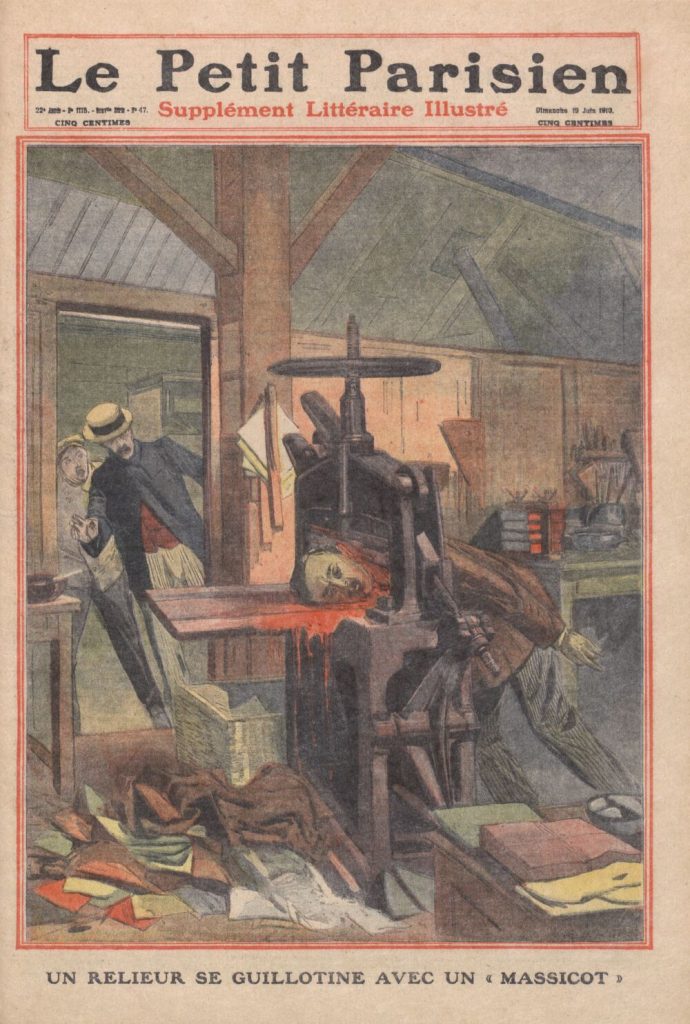
The Murder of the Parisian Binder, an Investigation by Hélène Vasseur.


Leave a Reply