The Murder of the Parisian Binder, an Investigation by Hélène Vasseur.

Dear bibliophiles, good day.

By Alcide Raturon, perpetually provisional secretary of the Guild, in charge of awkward comparisons, defensive enthusiasms and statistics consulted with a frown.

Hélène Vasseur is a forensic physician (and a police commissioner). She files her cases with the Guild on a regular basis, which gives our two services a family likeness that neither she nor I asked for.

And she took a day off without telling her institute what for: she accepted my invitation with the air of someone accepting a drink so as not to argue. She does not believe in time travel; she believes even less in desk hypotheses, which she calls desk hypotheses.

I needed her for that double incredulity. When you have frequented binders’ workshops as long as I have, you see moroccos, raised bands, finishing tools, and you no longer see the room. I needed someone whose trade is to walk into a room where a man has died and to understand, before anything else, what happened in it.

The cover of the Petit Parisien had been lying on my desk for weeks. A workshop under a timber roof, scraps of leather and paper scattered over the floor, a machine with a flywheel, and across the machine a man in a brown jacket, his head resting on the bed of the cutter, the blood running in orange-red sheets over the wood; at the door, a gentleman in a boater holds out an arm and restrains a young man by the shoulder.

Beneath it, in capitals: UN RELIEUR SE GUILLOTINE AVEC UN « MASSICOT » [A BINDER GUILLOTINES HIMSELF WITH A “MASSICOT”, the guillotine paper cutter]. Inside the issue, the news item gives the names. The proprietor, M. Stanislas Ruffin, a bachelor, was found by his two workmen, Philippe Cordebaigt and Antoine Lassouche, at 37 rue de l’Amiral-Roussin; the paper says he was frantic over the poor state of his affairs, and the police commissioner of the Necker district, M. Cœuille, carried out the customary findings.

The dailies of Saturday 4 June, which the Guild keeps in a bundle, already disagreed among themselves: Le Journal reported a proprietor of 53 panicked by his affairs, Le Matin and Le Figaro a workman of 52 suffering from neurasthenia, who worked there “as a rule” among “the other workmen”. Two deaths to choose from in the same workshop. I followed Le Journal, because the Supplément followed it. We were five months after the January flood, which had put so many cellars under water and swollen so many stocks of paper and leather; the hypothesis of a craftsman strangled by a payment deadline stood up. I have no figures on the ruined binders of 1910 and do not claim to have any: my hypothesis was worth what the hypotheses of a statistician without statistics are worth.

We arrived on Friday 3 June 1910 at 7:05, by the usual route, which the Guild’s rules forbid me to describe and which I would be hard put to explain.

The Supplément did not give the day, it said “a few days ago”; the dailies of Saturday the 4th said “yesterday morning”. So Friday it is, a day like any other for dying. Hélène looked at her watch, then at the street, then at the horses, and said “right” in the tone she uses when she is told of a body. She opened a black-covered notebook that she did not put down all morning, and wrote the time. We were received in the courtyard as, on such a day, two well-dressed people are received: as relatives or as creditors, and we were both, depending on who was asking.

The rue de l’Amiral-Roussin smelled of coal and flour paste. The workshop occupied the back of a courtyard, and the body had not been moved. I shall not describe it, the cover shows it well enough, with a care that the draughtsman, who was not there, owes to a reporter’s account.

The two workmen stood near the door, hats in hand, repeating one after the other the same sentence about how they had stepped back. A third man stood with them, very upright, a boater on his head: M. Anatole Pradel, bookseller of the quai Voltaire, who had come at opening time to collect a volume entrusted to M. Ruffin for binding.

Commissaire Cœuille arrived shortly afterwards with an inspector and a notebook of his own. He looked like a man who had been promised a short case. He listened to M. Pradel, he listened to the workmen, he read the paper found on the workbench, three lines in ink, “Je n’en peux plus. Pardonnez-moi. S. Ruffin” [I can’t go on. Forgive me. S. Ruffin], and he pronounced the word the press was going to take up. Suicide. I nodded. Statisticians without statistics nod when what they hear confirms what they read the day before. I hold nothing against the commissaire: he had before his eyes a proprietor in difficulty, a farewell note and a machine, and he did what one does in front of that.

Hélène, for her part, had gone round the room without touching anything, hands in her pockets, which is the first gesture of her trade and the last of the binders’. She introduced herself to the commissaire as a doctor of medicine. He took this for a family eccentricity, and let her approach the body because the district doctor had not yet arrived and the commissaire was hungry. She laid the back of her hand on the jaw, lifted an arm, put it down, looked at the other. She wrote a line. “Dead since last night,” she told me in a low voice, “between seven and ten. Not this morning.” I pointed out that the workmen had found him this morning. “They found him this morning,” she answered. “But he died last night.”

She raised her eyes to the ceiling. A transmission ran under the roof timbers, a long iron shaft, and from this shaft a belt came down to the cutter, which the newspaper says is driven by motive power. Hélène asked me where the belt was. I looked: it had been moved onto the loose pulley, the one that turns idle and leaves the machine at rest. “He kills himself,” said Hélène, “the blade falls, and afterwards he disengages.” I defended my hypothesis for ten minutes: he had disengaged beforehand. “Disengaged beforehand, the blade would not fall. Disengaged afterwards, he was no longer there to do it.” She closed her notebook on that sentence.

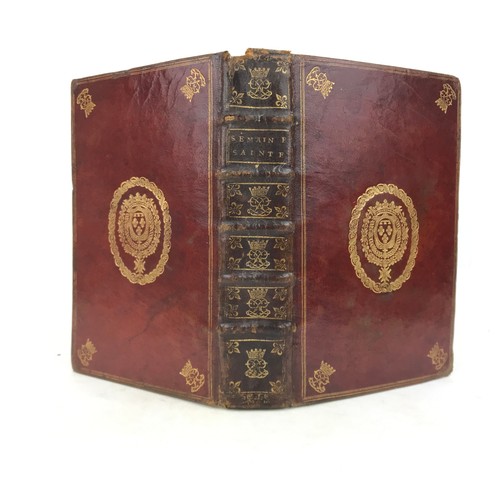
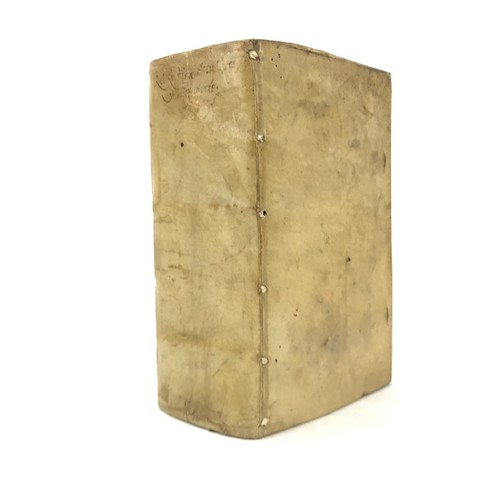
The commissaire handed me the paper as one hands a receipt to a man who looks as if he knows about such things, which is the only advantage of my face. I saw in it what he had no reason to see. The paper was no ordinary sheet. It was a flyleaf, laid paper, yellowed, with the tip of a watermark at the edge, torn out of a book. The book was on the workbench: a small duodecimo in its vellum wrapper, from which the first blank leaf was missing. Le Pastissier françois, Amsterdam, Elzevier, 1655; a cookery book, and one of the Elzevirs that collectors have always chased. The sale records have made it one of the dearest of them all: a copy found for 6 sous by Fontaine de Resbecq in 1856, another knocked down at 2,910 francs in the Potier sale of 1870, a third pushed to 3,255 francs at the Benzon sale in 1875; Willems counted only about thirty. In 1910 a fine copy came to something like two years of Cordebaigt’s pay. It was M. Pradel who had brought it in for binding.

I felt offended before I felt enlightened. A binder who wants to die has every reason in the world; he also has, on his shelves, reams of ordinary paper, and he does not tear the blank leaf out of an Elzevir that a client has entrusted to him. The very idea is foreign to his trade, which consists in not doing that. Hélène, to whom I showed the tear, put it otherwise: “Whoever wrote that is not from the trade.”

She took Philippe Cordebaigt aside, on the threshold, and I let her, because a workman does not have the same things to say before his commissaire as to someone who listens while taking notes. She put her questions in the order of the morning, minute by minute, the way one unwinds a thread. The workmen had the key to the back door; they had arrived a little before seven, at the same time as M. Pradel, who was waiting in the courtyard; M. Pradel had taken hold of the handle before them, said “Don’t come in, gentlemen,” and held them back with his arm, as in the drawing. “Did he say that before or after he had seen?” Hélène asked. Cordebaigt thought for a long time, with the conscientiousness of people who are asked for an exact order of events. “Before,” he said. “The door wasn’t open an inch.”

The order book was under the elbow of the machine. Nobody had opened it: commissaires read farewell letters, and it is binders who read order books. Hélène opened it with a handkerchief, at the last written page. The last line, in the proprietor’s hand, the same as that of his labels, as Cordebaigt, who read it every day, confirmed before I did, said: “Pastissier de M. P. Un exemplaire fait de deux : cahiers du milieu d’un autre, marges refaites à la pâte sur dix feuillets. Refusé de signer la reliure. Écrire à l’acheteur.” [Pastissier for M. P. A copy made from two: middle gatherings from another, margins remade in pulp on ten leaves. Refused to sign the binding. Write to the buyer.]

For those who do not frequent Elzevirs: the book is judged by the height of its leaves, and margins remade in pulp make it taller without the eye suspecting. A gilt signature at the foot of the spine vouches for the rest (or not, it is true, but we are in mourning, so let us be nice to the binders).

Between the copy made from two and the copy tall in the margins and signed, the gap was counted in years of wages; between the signed copy and the letter Ruffin meant to write to the buyer lay, for a bookseller of the quai Voltaire, the criminal court. M. Pradel needed Ruffin’s name as one needs a character witness, and he had brought to a man whose name carried weight two books to make one. The man had refused, which was the only thing M. Pradel had not foreseen, and had announced that he would write to the buyer, which put him, at the hour that Hélène’s notebook gave for his death, under a blade that awaited only a click and a witness who disengages the belt.

“It is a murder,” said Hélène. She said it in the courtyard, without raising her voice, her back to the workshop, as she no doubt tells her interns that the coffee is cold. I had been wrong. I told her so; she replied that she had heard worse from people who were right.

“One rarely kills for a book,” she added. “One kills for money. And when there is a book, the money is never far.”

I then invoked the Guild’s rules, which are clear: the time traveler observes, does not interpose himself, and does not explain to the police of 1910 that they are mistaken. She looked at me the way she would look at a void. “Then you will report,” she said. That is what I am doing. She wrote, for her part, a ten-line report that no one will read and that she refused to show me, which I understand.

M. Pradel, on the threshold, was adjusting his boater. Commissaire Cœuille carried out the customary findings, as the newspaper says, and the Petit Parisien printed the article on the Sunday, for five centimes. As for the Pastissier françois, it left the workshop bound by a successor, with Ruffin’s name gilt at the foot of the spine. A catalogue of 1924 gives it as tall in the margins and signed. It is signed: Ruffin had refused to do it.

GUILDE · AR/MASSICOT

La lettre du bibliophile

Si cette chronique vous a plu : recevez trois nouvelles par semaine — livres rares, reliures, enchères, et les Dossiers IGLI. 18 ans d'archives, quelques milliers de lecteurs.

Pas de pub, pas de revente de données. Désabonnement en un clic.

À lire ensuite

Hitler’s Library at the Berghof, Seized by the 2nd Armored Division (May 1945)

Dear bibliophiles, good day.

By Silas Deckard, Inspector of the Department of Altered Manuscripts (IGLI), division T – Temporality, temporal chronicler of the Guild of the Bibliopolicés.

Temporal Chronicle — infiltration report, operation Crayon Gris (“Gray Pencil”). Obersalzberg, 4–5 May 1945

I did not read what I report here in the archives. I saw it. We were set down high in the mountains, agent Raturon and I, on the morning of 4 May 1945, in the uniform of the Régiment de marche du Tchad, a unit of the French 2nd Armored Division. Serial numbers, kit and accents borrowed for the occasion. Two more men in the detachment climbing toward the nest of the man.

The mission carried a code name. The sealed order of service ran to four lines:

Infiltrate the 2nd Armored Division in its assault on the Obersalzberg. Locate and record the real state of the private library of subject A.H. No removals. No intervention. Visual record mandatory. Withdraw before 6 May.

I had accepted without argument; that is the rule. When the Guild sends an Inspector of the Temporality division, it is not to debate. One looks, one dates, one closes again.

The Guild had assigned Raturon to me — traveller of libraries, perpetually provisional secretary, entrusted for the occasion with the count.

The detachment has been climbing toward Berchtesgaden since dawn. The half-tracks stall on the hairpin bends, the engines overheat, and nobody talks about books. They talk about Munich fallen the day before, the Danube crossed, the files of prisoners in grey greatcoats coming down while we go up. Snow still clings to the slopes. One word passes from man to man, the only one that makes them lift their heads: Berghof. The subject’s house. The nest.

“The nest,” Raturon whispers beside me without taking his eyes off the ridge, “is a disappointment unaware of itself.” He already knew. On 25 April the Royal Air Force had gutted the Obersalzberg under a carpet of bombs. Then, as the Allies approached, the SS had burned what remained. We were climbing toward a carcass.

And we were not alone. Below, from the evening before, the American 7th Infantry Regiment had been the first to enter Berchtesgaden. The 2nd Armored Division pushes in the same day. The paratroopers of the 101st will arrive only the next day. Three units for one setting: the race for prestige has already begun, and History will take decades to untangle who was really first. I already know it will never quite settle the matter.

We reach the top in the fading light of 4 May. The Berghof is nothing but a smoking shell: roof stove in, blind windows, beams still warm under the ash. Men enter through the breaches, weapon in hand, out of reflex, though there is no one left to fight, only a draught and the smell of burnt wood. The tricolour soon snaps above the ruin. Two days later the American staff will firmly ask the 2nd Armored Division to come back down. Berchtesgaden will be in the American zone.

“The whole war is there,” notes Raturon, who was already filing his moral away as one classifies a statistic. “Some take the setting, others the loot. And History, out of laziness, remembers the setting.” The loot, precisely, took two forms that evening. The first flowed.

For before the books, there is wine. It is always so in war. The pantries of the Berghof, half spared, are still overflowing with spirits, cheeses, tinned food: the Americans of the 3rd Division help themselves with full haversacks before heading back down. But the real liquid treasure is higher, at the Eagle’s Nest, and it is our own men who find it: a cellar of half a million bottles. The greatest growths of France, from champagne to cognac, and whole rows of Château Lafite Rothschild — brought back from who knows what pillaging, and which French soldiers recover this evening as one recovers stolen property.

The lift at the Kehlstein has been sabotaged by the fleeing Germans. No matter: stretcher-bearers are sent up, and their stretchers — designed for bodies — come back down loaded with crates. Men pour the water out of their canteens to fill them with burgundy, throw equipment out of the tanks to fit in a few more cartons. A whole division drunk on victory and great wines.

One imagines a library as a wall of bindings, an orderly sanctuary. Think again, and let the accountant give you the figures; he was only waiting for it. “A few hundred volumes at the Berghof,” recites Raturon, stepping over the rubble of the second-floor study, now a blackened floor strewn with debris. “A crumb. Count instead the thousands of Munich, the ten thousand of Berlin. In all, nearly sixteen thousand books spread across his residences. The ground under your feet is not a library: it is an auxiliary storeroom, and it has burned.”

The real store is not here. It sleeps a few kilometres away, in a salt mine: three thousand volumes put out of the way of the bombing, which the Americans of the 21st Counter Intelligence Corps will soon carry off. “Twelve hundred will end up in Washington,” adds Raturon, who describes the future in the present tense as our condition allows. “Rare books room of the Library of Congress. And it is there, not here, that the pieces that speak are sleeping.” He lists them as a bookseller recites a catalogue: “A Schertel — Magic: History, Theory, Practice — a treatise on occultism inscribed by the author, in whose margins the subject left sixty-six strokes. A guide to Berlin by Max Osborn, dated 1909, his oldest surviving book, bought in 1915 a stone’s throw from the trenches. That is what will survive. Not the ruin: the strokes.”

Two ways of treating this loot clash before my eyes. The first is wild: a GI who has come back down to poke about pockets three volumes without even opening them. War souvenir. “Multiply by a thousand,” murmurs Raturon. “At this minute, all over Germany, hundreds of the subject’s books are slipping into haversacks. Ohio, Nebraska. Mantelpiece trinkets. Provenance lost for ever.”

The second is French, and methodical. The division’s G.5 section — civil affairs, the people who register property in occupied territory — has begun its work. Under the authority of Lieutenant-Colonel Rouvillois, every piece taken from the subject’s collections receives an ink stamp on the flyleaf: “Cette pièce provient des collections personnelles d’Adolf Hitler. Berghof. Berchtesgaden, 4 mai 1945” [This piece comes from the personal collections of Adolf Hitler. Berghof. Berchtesgaden, 4 May 1945], beneath the round seal struck with the Cross of Lorraine. More than six hundred documents will be recorded in this way; in September the division will hand over a part of them to twenty-one municipalities and to the Bibliothèque nationale, the French national library.

“Now that is serious,” approves Raturon. “In its administrative way the G.5 does what the Guild does in its own: it treats the book as an exhibit in evidence. And it is right. For these volumes are worth nothing by their text. They will be worth something through the stamp, and through what a hand did on them.” A hand, precisely. I was coming to that.

A sergeant has picked up an almost intact volume, blown under a beam, its light leather binding astonishingly spared. He hands it to me laughing — here, intellectual, you read German, don’t you — because I had been clumsy enough to decipher a sign earlier. I open it. Raturon leans over my shoulder, and I feel him freeze.

It is Fichte. The complete works of the nationalist philosopher, first edition, newly bound in white vellum. “I know this copy,” says Raturon, very low. “A gift from the filmmaker Leni Riefenstahl. The dedication reads: To my beloved Führer, with deep respect. The only real philosopher in the whole collection, in the finest binding in the whole collection — and it is a courtesan’s present to a tyrant. The centrepiece owes him nothing: it owes everything to flattery.”

I turn the pages. And I find it: a pencil underlining. A grey line, straight, drawn under a passage on the unity of the German people. Nothing else. No comment, no gloss. Just that stroke. This is what the Guild wanted me to record, I believe. Not the ruin — the ruin is spectacular, hence misleading. The stroke is tiny, and it says everything.

“Do the sum with me,” says Raturon, and it was his trade. “Out of these thousands of volumes, barely a few dozen carry an annotation in his hand. And these annotations, almost always, are not thoughts: they are underlinings. Vertical strokes. Exclamation marks. The man did not converse with his books. He sought ammunition in them. He underlined what comforted him, never what contradicted him. A reader who reads only to hear himself confirmed — the worst species, and the most widespread.”

I close the Fichte. The sergeant takes it back from me, shrugs, stuffs it in his bag. One more volume bound for nowhere.

The traveller’s thankless privilege: I know what follows. This G.5 stamp that I watch drying on the flyleaves — Berghof, 4 May 1945 — will one day become a market’s Grail. People will no longer scramble for the text, which can be found in every library in Europe; they will scramble for the stamp. Provenance as relic. A bibliophilia of horror: one does not collect the word, one collects the crime of having owned, and underlined, that word. One of the men climbing this evening — a certain Paul Gerbi, among the first to arrive up there on 4 May — will keep four albums given to the man in the 1930s, two bound in red leather, with dedications and photographs of the Führer. Decades later, a man of ninety-two, he will put them up for auction in the Vendée, in western France: knocked down for ten thousand one hundred euros. Elsewhere an entire sale will be announced under the title “Prises de guerre de la 2e DB du général Leclerc au Berghof” [War booty of General Leclerc’s 2nd Armored Division at the Berghof] — and will be withdrawn amid protests, war booty having become, with time, something that troubles.

On the morning of the 5th, as we are already being pressed to pack up, I cross an American major in the courtyard of the Platterhof. He has just arrived with the paratroopers of the 101st; behind him his men head for Göring’s cellar and its ten thousand bottles. He is in no hurry. Clean features, exact calm, the eye of a man who counts his losses rather than his loot. His name is Winters.

— You came up for the cellar, too? he asks me in approximate French, pointing at the crates being evacuated.

— For the books, I say. What is left of them.

He looks for a moment at the blackened shell of the Berghof, then barely shrugs.

— My men have earned the right to drink. Me, I only wanted to see the place. (A pause.) It is smaller than one thinks.

— Everything is, major. Especially great men seen up close.

He sketched what, in so sober a man, had to pass for a smile, and he went into the ruin without taking anything. I noted the date: his paratroopers will long tell that they were the first — they were not — and yet will sign the most famous images of the whole affair, those hilarious GIs emptying Göring’s growths at the Eagle’s Nest. That is what History will retain of the summit: not a pencil under a sentence, but happy soldiers raising bottles. And History, here again, will not be wrong. It will only have chosen the loot that can be drunk.

As for the cold record, it is another American officer who draws it up, that night, in an outbuilding of the Platterhof: a classified report on the collection. I read its heading over his shoulder. A document that historians will unearth much later, as an appendix to a book that no one here can have read, and which will be called Hitler’s Private Library.

We are recalled before the 2nd Armored Division comes back down toward the American zone. We leave behind a mountain that will change flags, a cellar being evacuated on stretchers, and thousands of books dispersing — into haversacks, under the stamp of the French, or at the bottom of a salt mine.

Beware, bibliophile friends, of the idea that great readers are great souls. I held the proof to the contrary in my hands, in a ruined house, on 4 May 1945. The binding was superb. The stroke beneath was that of a mediocre man.

We returned to our century on the morning of the 6th. The Fichte, for its part, is still running around somewhere, under a Cross of Lorraine stamp, from discreet sale to showcase of horror.

By Silas Deckard, traveller from the year 2125, temporal chronicler of the Guild of the Bibliopolicés, and Alcide Raturon, traveller of libraries — infiltrated in the uniform of the Régiment de marche du Tchad, 2nd Armored Division, Obersalzberg, May 1945.

IGLI-MS.T/1945-OBS-CG/04 Operation “Crayon Gris”. Visual record, Berghof. Source piece: Fichte, complete works, first edition, white vellum, one pencil underlining. Stamp 2e DB / G.5, Cross of Lorraine. Restricted access — Guild circulation.

P.S. — The bibliophilic elements of this report (the ~16,000 volumes spread across the residences, the 3,000 of the salt-mine depot, the ~1,200 kept at the Library of Congress, the Fichte given by Leni Riefenstahl, the 66 annotations in the Schertel, the Berlin guide by Max Osborn, the manner of underlining in pencil) come from: Timothy W. Ryback, Hitler’s Private Library: The Books That Shaped His Life, Alfred A. Knopf, New York, 2008 (French translation by Gilles Maurice-Dumoulin: Dans la bibliothèque privée d’Hitler. Les livres qui ont modelé sa vie, Le Cherche midi, 2009; reissued Le Livre de Poche, 2010). The stamp “collections personnelles d’Adolf Hitler / Berghof” of the G.5 section of the 2nd Armored Division, the Paul Gerbi sale (Vendée) and the Eagle’s Nest cellar come, for their part, from press and division archive sources.

Be the first to comment

Leave a Reply

Your email address will not be published.