De auctionibus: a Little Handbook for the Well-Advised Auctioneer

By Barthélémy d’Arcole, Inspector of Bibliophilic Aesthetics and Modern Heresies to the Guilde des Bibliopolicés.

Dear bibliophiles, good day.

In March 1981, in a library in Milan, an Italian semiologist gave a lecture to librarians in which he set out, in perfect seriousness, the rules for making a library thoroughly hostile to its readers. There was a good deal of laughter; nothing changed; the text has become a classic. I borrow his method here and turn it on another edifice, one the Guild frequents more often.

For there is an abundant literature on how to sell. There is none on how to sell well to few people, which is nonetheless the art most practised in the profession and the only one in which our age has made measurable progress… or even on how not to sell, and that generally conceals darker designs.

Below will be found the eight precepts that govern this art. I did not invent them: I noted them down, then put them in the imperative, which is the only operation a semiologist is permitted to perform on a custom.

1. Arrange the catalogue in an order no one can guess.

Neither alphabetical, nor chronological, nor thematic: the order in which the boxes arrived. An incunable between a solfège method and a lot of postcards, then forty numbers of twentieth-century literature, then, without warning, three manuscripts.

Thus the amateur will be able to look up nothing: he will have to read everything. Whoever has read your four hundred and twelve lots will have paid his entrance fee in time, the one currency you do not invoice and yet levy on each of them. It will be objected that alphabetical order has solved this problem since Callimachus, around 250 BC. The answer is that it solves the wrong problem.

2. Make up your lots of one desirable item and six that are not.

“Lot of fourteen miscellaneous volumes, including an Elzevir.” The amateur who wants the Elzevir will carry off the other thirteen, which he does not want, which he cannot throw away — one does not throw away a book, it is the last taboo of a civilisation that has not many left — and which he will therefore end by reselling.

You will not have sold him a book: you will have handed him a problem. And since this problem can only be solved in a saleroom, your buyer of today is your seller of tomorrow. The composite lot is not a defect of classification, it is a reproductive organ: it manufactures stock, transport and commission out of nothing, indefinitely, like those machines that eighteenth-century mechanicians dreamed of, which were to run without being fed.

3. Let the bidding advance by a rule you will never state.

Fifty, eighty, ninety-six, one hundred, one hundred and twenty, one hundred and fifty, one hundred and eighty, two hundred, two hundred and twenty, five hundred and twelve. The sequence is neither arithmetic nor geometric; it is written down nowhere; it is perfectly known to all who count.

Whoever announces ninety will have singled himself out to the whole room with the efficiency of a foreign accent. Do not correct him — one never corrects. Go up to one hundred with perfect courtesy, which is the finished form of exclusion.

4. Put into every description a term whose definition helps in no way.

“Light dampstain in the margin,” “a few scattered spots of foxing,” “copy a little short in the margins,” “binding slightly later.” These expressions all have a precise, attested meaning, which can be looked up in any handbook — and knowing them tells you nothing about the condition of the object, since everything rests on light, a few, a little and slightly, four adverbs for which no bibliographer has ever fixed the scale.

Your language therefore does not serve to describe. It serves to signal that a language is being spoken. Linguists call this the phatic function: the message carries no information, it checks that the channel exists and that your interlocutor exists.

5. Publish your results exclusive of fees.

It is the French custom, and it must be kept: a lot knocked down at one thousand euros cost the winner twelve hundred and fifty or thirteen hundred, but it is one thousand that will enter the databases, one thousand that the experts will cite, one thousand that will serve as an estimate in ten years, one thousand that will be compared with a London result calculated by another convention.

You will thus write the history of rare-book prices in a currency nobody has ever paid. This is not falsification: it is a convention, and conventions presuppose an informed reader. It happens only that the informed reader is here precisely the one for whom the information was no longer of any use.

6. Make the room inhospitable.

Folding chairs, excessive heating, no cloakroom, no surface on which to set down a catalogue. This will be put down to negligence; it is a sorting. The curious leave, the professional stays, for he has been before and will come again. An establishment that discourages passers-by is not badly kept: it is kept for something else.

7. Multiply the channels until no one knows any longer where the sale is.

In the room, by telephone, on three platforms, with different fees for each and deadlines that do not match. Whoever nonetheless manages to establish where he is bidding, at what total price and under what right of withdrawal will have passed your real entrance examination.

8. Never answer a precise question.

To “is leaf 137 present?”, answer that the lot may be viewed at the exhibition. This is not a refusal, it is a displacement: the question concerned the object, the answer concerns the procedure, and since the procedure is irreproachable, the question ceases to exist.

It remains to say what one manufactures by applying these eight precepts, and one would be wrong to answer: deception. No profession is capable of coordinating itself for three centuries in lying; it manages very well in ritual.

Together, these rules produce a community.

A device that methodically discourages the newcomer does not lose clients at random: it retains those who agree to learn a code. To know that after one hundred and twenty comes one hundred and fifty; to know that a few spots of foxing means “go and look”; to know that a result is understood exclusive of fees and must be marked up in one’s head; to know that one never buys the Elzevir alone, and to plan in advance what one will do with the other thirteen; to know that the precise question is not put by telephone but at the exhibition, in a low voice, to the right person. This body of knowledge is learned nowhere, written nowhere, and constitutes exactly what medievalists call an initiation.

The auction house is therefore not a deficient market. It is a restricted-entry market that has kept the forms of the open market. It resembles a public place as the Latin Mass resembled a speech: everyone could attend, a minority knew what was said there, and this asymmetry was not a defect of the rite — it was its function.

Hence the very particular irritation aroused by online platforms. They are reproached for their approximate descriptions and their superlatives. Their scandal lies elsewhere: they have put the code in writing. They sort the catalogue by ascending price, display the total, fees included, before the bid, sell item by item, answer by message, and the reply stays written. They have desacralised, and we know what one gains by desacralising: a wider public and a dissolved community.

The title of this manual must therefore be corrected. These eight precepts do not serve to discourage the buyer: they serve to distinguish the one who is discouraged from the one who is adopted.

And if you have read this far nodding at each article, it is because you are not an auctioneer, because you have long been on the right side of the sorting, and because you no longer have any reason to complain of it.

References. Umberto Eco, De Bibliotheca, trans. Eliane Deschamps-Pria, Paris, L’Échoppe, 1986 (lecture delivered in Milan on 10 March 1981). Roman Jakobson, “Linguistique et poétique,” in Essais de linguistique générale, vol. I, Paris, Éditions de Minuit, 1963, for the phatic function. Luciano Canfora, La Véritable Histoire de la bibliothèque d’Alexandrie, Paris, Desjonquères, 1988, on Callimachus’s classifications. Book of Judges, XII, 5-6, for the password and the use made of it.

GBA/DE-AUCTIONIBUS

Document classified: restricted circulation – given the number of active bibliophiles and auctioneers….

La lettre du bibliophile

Si cette chronique vous a plu : recevez trois nouvelles par semaine — livres rares, reliures, enchères, et les Dossiers IGLI. 18 ans d'archives, quelques milliers de lecteurs.

Pas de pub, pas de revente de données. Désabonnement en un clic.

À lire ensuite

Hitler’s Library at the Berghof, Seized by the 2nd Armored Division (May 1945)
Dear bibliophiles, good day.

By Silas Deckard, Inspector of the Department of Altered Manuscripts (IGLI), division T – Temporality, temporal chronicler of the Guild of the Bibliopolicés.

Temporal Chronicle — infiltration report, operation Crayon Gris (“Gray Pencil”). Obersalzberg, 4–5 May 1945

I did not read what I report here in the archives. I saw it. We were set down high in the mountains, agent Raturon and I, on the morning of 4 May 1945, in the uniform of the Régiment de marche du Tchad, a unit of the French 2nd Armored Division. Serial numbers, kit and accents borrowed for the occasion. Two more men in the detachment climbing toward the nest of the man.

The mission carried a code name. The sealed order of service ran to four lines:

Infiltrate the 2nd Armored Division in its assault on the Obersalzberg. Locate and record the real state of the private library of subject A.H. No removals. No intervention. Visual record mandatory. Withdraw before 6 May.

I had accepted without argument; that is the rule. When the Guild sends an Inspector of the Temporality division, it is not to debate. One looks, one dates, one closes again.

The Guild had assigned Raturon to me — traveller of libraries, perpetually provisional secretary, entrusted for the occasion with the count.

The detachment has been climbing toward Berchtesgaden since dawn. The half-tracks stall on the hairpin bends, the engines overheat, and nobody talks about books. They talk about Munich fallen the day before, the Danube crossed, the files of prisoners in grey greatcoats coming down while we go up. Snow still clings to the slopes. One word passes from man to man, the only one that makes them lift their heads: Berghof. The subject’s house. The nest.

“The nest,” Raturon whispers beside me without taking his eyes off the ridge, “is a disappointment unaware of itself.” He already knew. On 25 April the Royal Air Force had gutted the Obersalzberg under a carpet of bombs. Then, as the Allies approached, the SS had burned what remained. We were climbing toward a carcass.

And we were not alone. Below, from the evening before, the American 7th Infantry Regiment had been the first to enter Berchtesgaden. The 2nd Armored Division pushes in the same day. The paratroopers of the 101st will arrive only the next day. Three units for one setting: the race for prestige has already begun, and History will take decades to untangle who was really first. I already know it will never quite settle the matter.

We reach the top in the fading light of 4 May. The Berghof is nothing but a smoking shell: roof stove in, blind windows, beams still warm under the ash. Men enter through the breaches, weapon in hand, out of reflex, though there is no one left to fight, only a draught and the smell of burnt wood. The tricolour soon snaps above the ruin. Two days later the American staff will firmly ask the 2nd Armored Division to come back down. Berchtesgaden will be in the American zone.

“The whole war is there,” notes Raturon, who was already filing his moral away as one classifies a statistic. “Some take the setting, others the loot. And History, out of laziness, remembers the setting.” The loot, precisely, took two forms that evening. The first flowed.

For before the books, there is wine. It is always so in war. The pantries of the Berghof, half spared, are still overflowing with spirits, cheeses, tinned food: the Americans of the 3rd Division help themselves with full haversacks before heading back down. But the real liquid treasure is higher, at the Eagle’s Nest, and it is our own men who find it: a cellar of half a million bottles. The greatest growths of France, from champagne to cognac, and whole rows of Château Lafite Rothschild — brought back from who knows what pillaging, and which French soldiers recover this evening as one recovers stolen property.

The lift at the Kehlstein has been sabotaged by the fleeing Germans. No matter: stretcher-bearers are sent up, and their stretchers — designed for bodies — come back down loaded with crates. Men pour the water out of their canteens to fill them with burgundy, throw equipment out of the tanks to fit in a few more cartons. A whole division drunk on victory and great wines.

One imagines a library as a wall of bindings, an orderly sanctuary. Think again, and let the accountant give you the figures; he was only waiting for it. “A few hundred volumes at the Berghof,” recites Raturon, stepping over the rubble of the second-floor study, now a blackened floor strewn with debris. “A crumb. Count instead the thousands of Munich, the ten thousand of Berlin. In all, nearly sixteen thousand books spread across his residences. The ground under your feet is not a library: it is an auxiliary storeroom, and it has burned.”

The real store is not here. It sleeps a few kilometres away, in a salt mine: three thousand volumes put out of the way of the bombing, which the Americans of the 21st Counter Intelligence Corps will soon carry off. “Twelve hundred will end up in Washington,” adds Raturon, who describes the future in the present tense as our condition allows. “Rare books room of the Library of Congress. And it is there, not here, that the pieces that speak are sleeping.” He lists them as a bookseller recites a catalogue: “A Schertel — Magic: History, Theory, Practice — a treatise on occultism inscribed by the author, in whose margins the subject left sixty-six strokes. A guide to Berlin by Max Osborn, dated 1909, his oldest surviving book, bought in 1915 a stone’s throw from the trenches. That is what will survive. Not the ruin: the strokes.”

Two ways of treating this loot clash before my eyes. The first is wild: a GI who has come back down to poke about pockets three volumes without even opening them. War souvenir. “Multiply by a thousand,” murmurs Raturon. “At this minute, all over Germany, hundreds of the subject’s books are slipping into haversacks. Ohio, Nebraska. Mantelpiece trinkets. Provenance lost for ever.”

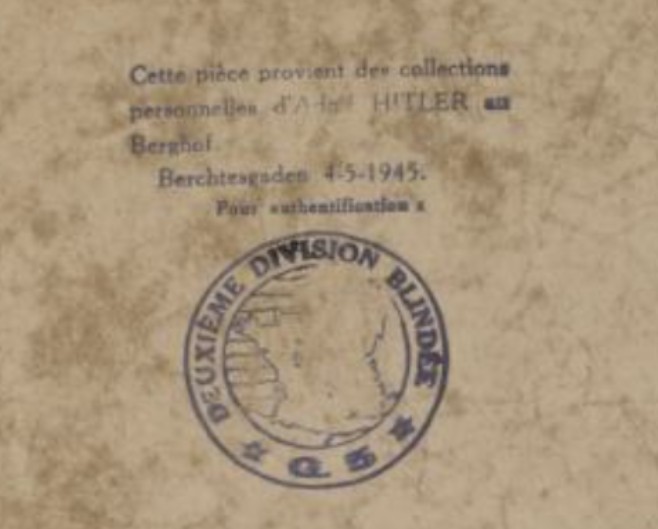
The second is French, and methodical. The division’s G.5 section — civil affairs, the people who register property in occupied territory — has begun its work. Under the authority of Lieutenant-Colonel Rouvillois, every piece taken from the subject’s collections receives an ink stamp on the flyleaf: “Cette pièce provient des collections personnelles d’Adolf Hitler. Berghof. Berchtesgaden, 4 mai 1945” [This piece comes from the personal collections of Adolf Hitler. Berghof. Berchtesgaden, 4 May 1945], beneath the round seal struck with the Cross of Lorraine. More than six hundred documents will be recorded in this way; in September the division will hand over a part of them to twenty-one municipalities and to the Bibliothèque nationale, the French national library.

“Now that is serious,” approves Raturon. “In its administrative way the G.5 does what the Guild does in its own: it treats the book as an exhibit in evidence. And it is right. For these volumes are worth nothing by their text. They will be worth something through the stamp, and through what a hand did on them.” A hand, precisely. I was coming to that.

A sergeant has picked up an almost intact volume, blown under a beam, its light leather binding astonishingly spared. He hands it to me laughing — here, intellectual, you read German, don’t you — because I had been clumsy enough to decipher a sign earlier. I open it. Raturon leans over my shoulder, and I feel him freeze.

It is Fichte. The complete works of the nationalist philosopher, first edition, newly bound in white vellum. “I know this copy,” says Raturon, very low. “A gift from the filmmaker Leni Riefenstahl. The dedication reads: To my beloved Führer, with deep respect. The only real philosopher in the whole collection, in the finest binding in the whole collection — and it is a courtesan’s present to a tyrant. The centrepiece owes him nothing: it owes everything to flattery.”

I turn the pages. And I find it: a pencil underlining. A grey line, straight, drawn under a passage on the unity of the German people. Nothing else. No comment, no gloss. Just that stroke. This is what the Guild wanted me to record, I believe. Not the ruin — the ruin is spectacular, hence misleading. The stroke is tiny, and it says everything.

“Do the sum with me,” says Raturon, and it was his trade. “Out of these thousands of volumes, barely a few dozen carry an annotation in his hand. And these annotations, almost always, are not thoughts: they are underlinings. Vertical strokes. Exclamation marks. The man did not converse with his books. He sought ammunition in them. He underlined what comforted him, never what contradicted him. A reader who reads only to hear himself confirmed — the worst species, and the most widespread.”

I close the Fichte. The sergeant takes it back from me, shrugs, stuffs it in his bag. One more volume bound for nowhere.

The traveller’s thankless privilege: I know what follows. This G.5 stamp that I watch drying on the flyleaves — Berghof, 4 May 1945 — will one day become a market’s Grail. People will no longer scramble for the text, which can be found in every library in Europe; they will scramble for the stamp. Provenance as relic. A bibliophilia of horror: one does not collect the word, one collects the crime of having owned, and underlined, that word. One of the men climbing this evening — a certain Paul Gerbi, among the first to arrive up there on 4 May — will keep four albums given to the man in the 1930s, two bound in red leather, with dedications and photographs of the Führer. Decades later, a man of ninety-two, he will put them up for auction in the Vendée, in western France: knocked down for ten thousand one hundred euros. Elsewhere an entire sale will be announced under the title “Prises de guerre de la 2e DB du général Leclerc au Berghof” [War booty of General Leclerc’s 2nd Armored Division at the Berghof] — and will be withdrawn amid protests, war booty having become, with time, something that troubles.

On the morning of the 5th, as we are already being pressed to pack up, I cross an American major in the courtyard of the Platterhof. He has just arrived with the paratroopers of the 101st; behind him his men head for Göring’s cellar and its ten thousand bottles. He is in no hurry. Clean features, exact calm, the eye of a man who counts his losses rather than his loot. His name is Winters.

— You came up for the cellar, too? he asks me in approximate French, pointing at the crates being evacuated.

— For the books, I say. What is left of them.

He looks for a moment at the blackened shell of the Berghof, then barely shrugs.

— My men have earned the right to drink. Me, I only wanted to see the place. (A pause.) It is smaller than one thinks.

— Everything is, major. Especially great men seen up close.

He sketched what, in so sober a man, had to pass for a smile, and he went into the ruin without taking anything. I noted the date: his paratroopers will long tell that they were the first — they were not — and yet will sign the most famous images of the whole affair, those hilarious GIs emptying Göring’s growths at the Eagle’s Nest. That is what History will retain of the summit: not a pencil under a sentence, but happy soldiers raising bottles. And History, here again, will not be wrong. It will only have chosen the loot that can be drunk.

As for the cold record, it is another American officer who draws it up, that night, in an outbuilding of the Platterhof: a classified report on the collection. I read its heading over his shoulder. A document that historians will unearth much later, as an appendix to a book that no one here can have read, and which will be called Hitler’s Private Library.

We are recalled before the 2nd Armored Division comes back down toward the American zone. We leave behind a mountain that will change flags, a cellar being evacuated on stretchers, and thousands of books dispersing — into haversacks, under the stamp of the French, or at the bottom of a salt mine.

Beware, bibliophile friends, of the idea that great readers are great souls. I held the proof to the contrary in my hands, in a ruined house, on 4 May 1945. The binding was superb. The stroke beneath was that of a mediocre man.

We returned to our century on the morning of the 6th. The Fichte, for its part, is still running around somewhere, under a Cross of Lorraine stamp, from discreet sale to showcase of horror.

By Silas Deckard, traveller from the year 2125, temporal chronicler of the Guild of the Bibliopolicés, and Alcide Raturon, traveller of libraries — infiltrated in the uniform of the Régiment de marche du Tchad, 2nd Armored Division, Obersalzberg, May 1945.

IGLI-MS.T/1945-OBS-CG/04 Operation “Crayon Gris”. Visual record, Berghof. Source piece: Fichte, complete works, first edition, white vellum, one pencil underlining. Stamp 2e DB / G.5, Cross of Lorraine. Restricted access — Guild circulation.

P.S. — The bibliophilic elements of this report (the ~16,000 volumes spread across the residences, the 3,000 of the salt-mine depot, the ~1,200 kept at the Library of Congress, the Fichte given by Leni Riefenstahl, the 66 annotations in the Schertel, the Berlin guide by Max Osborn, the manner of underlining in pencil) come from: Timothy W. Ryback, Hitler’s Private Library: The Books That Shaped His Life, Alfred A. Knopf, New York, 2008 (French translation by Gilles Maurice-Dumoulin: Dans la bibliothèque privée d’Hitler. Les livres qui ont modelé sa vie, Le Cherche midi, 2009; reissued Le Livre de Poche, 2010). The stamp “collections personnelles d’Adolf Hitler / Berghof” of the G.5 section of the 2nd Armored Division, the Paul Gerbi sale (Vendée) and the Eagle’s Nest cellar come, for their part, from press and division archive sources.

Be the first to comment

Leave a Reply

Your email address will not be published.