Dear bibliophiles, good day.
By Mathieu Lenoir, slayer of received ideas, reader of present-day usages and appointed contradictor of bibliophilic confusions for the Guild of Bibliopolices.
I have in my cellar volume 43 of the Kehl edition of Voltaire’s works. Tree calf, smooth spine, green title label. I paid 5 € for it in a job-lot box at Drouot, the main Paris auction house, on a Thursday of ordinary sales, along with 11 other volumes of the same edition. The Kehl edition runs to 70 octavo volumes, published from 1784 to 1789. I once had as many as 12.
5 €. I did the sum that same evening. Everyone does. The proof?
I have no Encyclopédie and am not looking for one, but its figures are public. Lot 26 at Collin du Bocage, sold in 2018, puts the volume of the Encyclopédie at about 110 €. The original edition has 35 folio volumes: 17 of text, 11 of plates, 4 of supplement, 1 of supplement plates, 2 of index. 35 volumes at 110 € make 3,850 €. On 17 January 2018, in room 7 at Drouot, the 34-volume copy presented by Thierry de Maigret, estimated at 6,000 to 10,000 €, ended at 19,714 €. The gap is 15,000 € and some. A patient amateur, who spends his Saturdays at the secondhand book market of the Parc Georges-Brassens in Paris and his evenings on auction sites, tells himself that in 10 years he will have gathered the 35 and saved 15,000 €.
But no, actually, no.
The notebook exists, I kept one. 3 columns in pencil, the volume, the date of purchase, the price, and a 4th for the height in centimeters, added in the 2nd year when I understood why the volumes would not line up. One page for my Voltaire, and even so 9 purchases in 3 years, which took me to 21 volumes out of 70. I stopped the madness there. 20 went to a secondhand bookseller on the rue de Seine, who gave me 40 € for them, and I kept the 43rd, to remember the lesson well. The other 20 may be in your home.
The Encyclopédie was sold in sheets. Subscribers received the volumes as deliveries came and had them bound by their own binder, at their own expense. The survey published on this very site in 2013 counts 4,225 copies for the Paris edition.
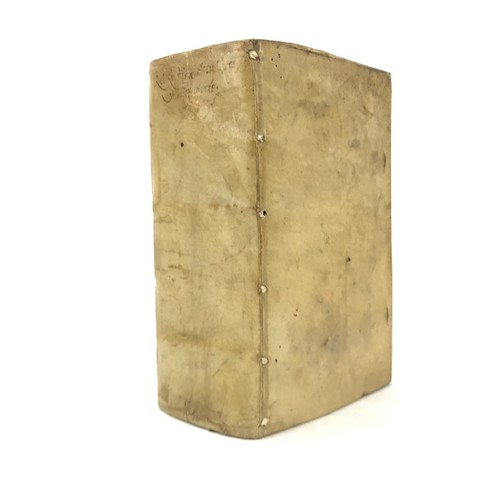
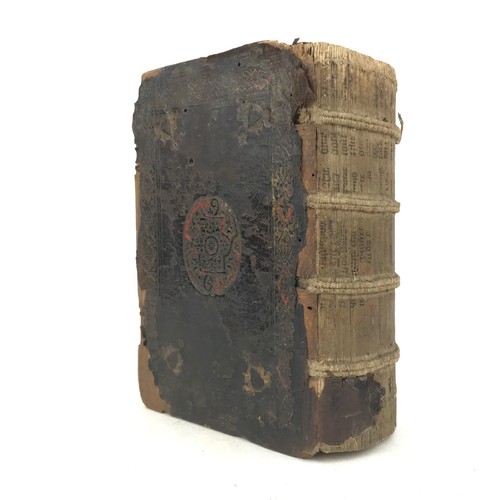
So there were, roughly, 4,225 different bindings, in 4,225 leathers that resemble one another only from afar, with volume labels in 4,225 colors or nearly, edges red or left bare, and marbled endpapers that never come out of the same vat, and above all different lives. The volume XI you will find was never bound by the man who bound your volume X. It is 0.5 cm taller or shorter, because each binder trims in his own way, and 0.5 cm is visible at 3 meters on a shelf.
Buffon poses the same problem over 40 years. The Histoire naturelle of the Imprimerie royale (the Royal Press) runs to 36 quarto volumes, from 1749 to 1789. The first buyer of 1749, who was 30, was 70 at the last delivery, if he saw it, and Buffon himself died in 1788 before his last volume.
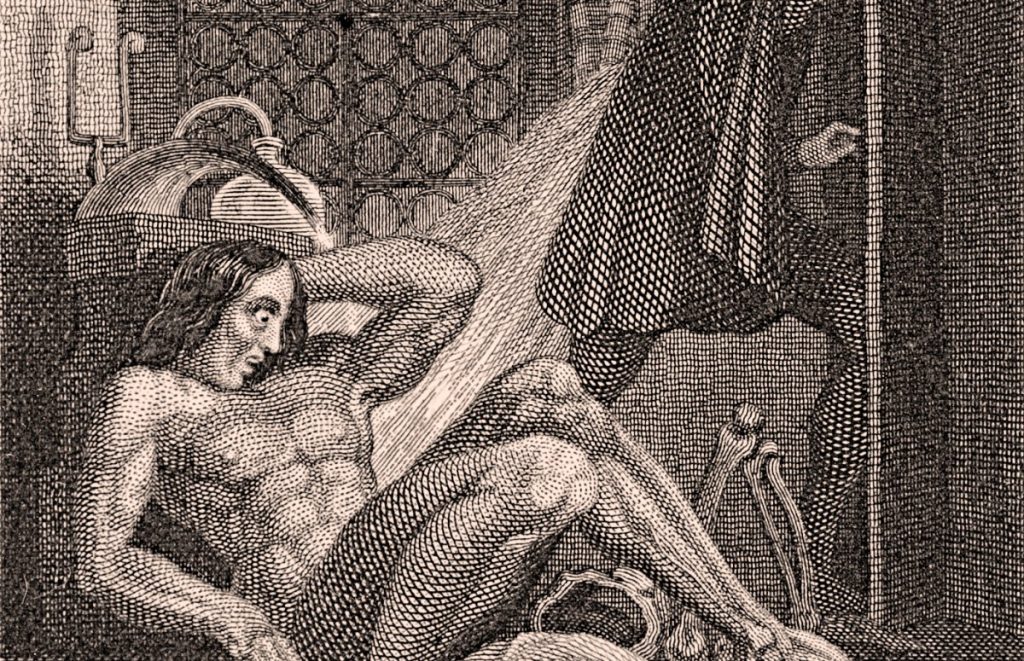
The copies of Buffon that come up for sale almost all have 2 or 3 bindings (or else they were bound afterwards), because nobody keeps the same binder for 40 years, and booksellers have a word for this in their descriptions: composite copy. Composite, in a description, designates bindings of 2 periods on a copy that stayed with the same subscriber (and not just that, we agree, it is equally apt for the Frankenstein enthusiasts)…
Recomposed designates volumes from several copies brought together after the fact by a bookseller or an amateur. Descriptions use the first without embarrassment; the second I have only ever read next to a low price. Cringe, as young bibliophiles say (yes, they exist, I met one in 1979).
A volume does not vanish at random. On 18 October 2022, the Paris auction house Tajan presented in room 11 a complete copy of the first edition, estimated at 12,000 to 15,000 €, whose first 7 volumes were in a different binding from the following 28. It found no buyer. The first 7 volumes are those of 1751 to 1757. The privilege was revoked in 1759, and the 10 following volumes of text were delivered all at once in 1765 under a false Neuchâtel address. 8 years separate the 7th delivery from the 8th. I suppose the subscriber died between the two, or the heir found the first binder too expensive. The copy was already not uniform in 1765. One can imagine anything, but in the end it is reality that wins out. The whole thing is botched.
And the plates?
They go missing more often than the text. The first edition has several thousand plates, and a plate of the Gobelins or the forge has been sold on its own, framed, for 2 centuries. On eBay, a German seller is offering, at the time of writing, 44 tapestry plates cut out of a volume. The volume you are missing may be the one that was dismembered. The volumes that circulate alone are the text volumes, XI and XIII, that nobody cuts up because there is nothing to frame. We shall come back to this: worse than the amateurs who dream of reuniting odd volumes, a fantasy as vain as it is laudable, there are those who want to gather loose leaves… I swear, I know one, we will talk about him in a few days!
I am not saying the market forgives nothing. Thierry de Maigret’s copy had a mismatched binding for volume III of the plates and for the 4 supplement volumes, it lacked 1 supplement volume out of 5, and it made 2 times its high estimate. 29 uniform volumes out of 34 get through. I have never seen a recomposed copy with 35 volumes in 10 bindings clear 10,000 €. Well, true, I did not look much. Can’t be bothered, as young bibliophiles say. If they exist, I met one in…
Well, let us say you manage it.
Say 12 years, 35 volumes, 35 sellers. Look at the shelf.
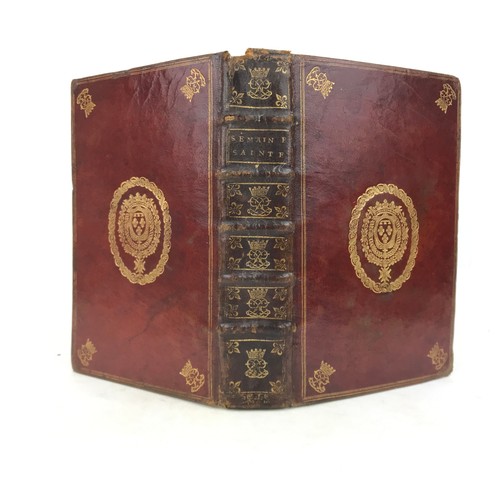
Volume I is in fawn calf with raised bands, with a bird fleuron in the compartments; volume II in marbled calf, browner, raised bands too, but the tools are pomegranates; volume III was redone in the 19th century in half green sheepskin with a flat spine, and it is 1 cm shorter, nausea; volumes IV and V come from the same copy and keep each other company; VI carries a black volume label when all the others have red or lemon yellow; the plates are in 4 bindings, one of them in municipal-library half cloth with a shelfmark in white ink on the spine. The gilding is not by the same hand nor of the same gold. The edges go from red to yellow to blue to nothing.
Mary Shelley published her monster in 1818, sewn from pieces taken from several bodies. Yours has 35 seams and it cost 3,850 €.
I know what comes next, because I saw it at a Guild colleague’s: the amateur who has gathered his 35 odd volumes cannot bear the shelf, and has the lot bound anew, in uniform red half shagreen, by a neighborhood binder who charges 150 € a volume. 5,250 € more. I saw it, in Lyon, at a binder’s! With my own eyes!
In passing, 35 eighteenth-century bindings, at least 20 of which had nothing wrong with them, went into the binder’s wastebin, and the copy now has 35 volumes trimmed a second time, in margins that a bookseller will describe as short. The result is uniform. I would not give 5,000 € for it, and I do not believe a bookseller would give more.
The description, for its part, does not forgive. A recomposed copy carries forever the words that describe it: bindings not uniform, volume VI from another edition. The words are not erased at the next sale, the next catalogue copies them. You will have bought 35 odd volumes and you will own 35 odd volumes standing side by side, or 35 volumes re-covered in new leather whose catalogue will say where they come from. The Thierry de Maigret catalogue wrote “légèrement dépareillée” [slightly mismatched] for 5 volumes out of 34, and the word followed the copy all the way to the results page. It makes me retch.
Not to mention that volume I of the Encyclopédie carries, folded in, the Système figuré des connoissances humaines, a table on a sheet larger than the volume. It tears at the fold, or ends up framed, and descriptions mention it when it is there because it is often missing. I have never seen this sheet come up for sale alone, and you will have your 35 volumes before you have it. Thierry de Maigret’s copy had it, it is true.
Adam Pilinski, a Pole settled in Paris, made in the 1870s and 1880s facsimiles of leaves of incunabula and sixteenth-century books, with pen and lithographic stone, so exact that booksellers used them to complete defective copies. Catalogues still carry today the mention “feuillet en fac-similé Pilinski” [leaf in Pilinski facsimile]. It lowers the price. It does not bring it down to zero, because Pilinski has himself become a collecting name, and a leaf by his hand is recognized under the loupe by the grain of the stone.
On the pastedown of my volume 43 of Kehl, a label of a Lyon bookseller, rue Mercière, and a price in pencil: 3 francs. Someone, in Lyon, bought a single volume long ago and kept it.
I sometimes go down to the cellar to look at it. I do not know what it contains. I have never opened it past the title page, and I have never looked for the 44th. Banished.
I know, I exaggerate, it is my signature.
GUILDE · ML/TOMAISON
The Guild has checked under the wardrobe; volume XII is not there. Document classified: restricted circulation.




Leave a Reply